Saturday, March 24, 2012

A Little Tiger in the Chinese Night...

A Little Tiger in the Chinese Night: An Autobiography in Art

Last week, we finished reading this awesome living book by Song Nan Zhang.  It's an autobiography in art. The story tells of Song Nan's life growing up in Shanghai after WW II.  There were many ups and downs during this time period in China from the Great Leap Forward to the Cultural Revolution, then relaxing policies after Chairman Mao's death to the riot at Tienanmen Square.  "His story provides rare insight into the hopes and disappointments, dreams and nightmares, that almost every Chinese has experienced in our time and gives a human dimension to a people numbering more than one billion."  Song Nan tells the story in narrative form with beautiful paintings.

Though I found the book at the library in the juvenile section and it has only 48 pages, it's not your usual picture book.  Ruben was disappointed early on because the tiger turned out to be a part of the symbolism and not the focus of the story.  If you're going to read it to younger children, I would break it up into parts rather than a one time read.  The Farmer, Jennifer, Angel, and I really enjoyed the story.  Maybe because we had prior knowledge of the plight of the people in China during that time period.  I would definitely recommend this book as part of your China study for ages 10 and up.

Enjoy!

Wednesday, March 21, 2012

First Day of Spring 2012

It feels like summer here in the Midwest rather than mid March.  We've had 10+ days of record high temperatures this month.  My perennials are growing, the grass is greening and the birds are returning.  Yesterday, the first official day of spring, we saw a male bluebird.  Today, we saw a male and female!!  The robins have been back for a week or so.  I also saw a killdeer fly over head and a pair of whooping cranes out in the field.  The frogs and crickets are croaking and the turkeys are gobbling.  It's such a delight!


Budding trees

and babbling brooks.

Doing math with the door open


outside reading books.  
 
Green grass

 and a boy hanging from tree.
A bleeding heart growing

and mud up to your knees.
Ahhhhh.....spring!!!  

Monday, March 19, 2012

Tie Pillows

RileyAnn loves projects and making things.  A very kind homeschool mom recently gave us some pillow forms, so Riley set to work.  After choosing her fabric, I helped with the cutting, and Riley tied away...


Make it your goal to live a quiet life, minding your own business and working with your hands, just as we instructed you before.  1 Thessalonians 4:11

Saturday, March 17, 2012

Charlotte Mason Education - Part 4

I recently spoke to a group of homeschooling mom's regarding the Charlotte Mason method of education.  In this, the final post of the Charlotte Mason series, (part 1, part 2, part 3) I would like to address some of the questions that came from that group.


1. I'm worried about spending all my time planning a CM education and that I will miss out on other precious moments with my kids.  How do you find balance?

I am a planner/organizer type of person and thrive on researching books and resources.  So much so, that I've made planning our children's education a hobby.  One of my favorite planning tools that I recently purchased from Simply Charlotte Mason is Planning Your Charlotte Mason Education.  (Feel free to click on the link and download the free sample.)  This great resource helps you plan your Charlotte Mason education in 5 easy steps.  Sonya Shafer does a wonderful job of walking you through the Big Picture, Your Year, Your Term, Your Week, and Your Day.  The book is full of examples and there are appendixes with printable timetables, schedules, and charts.  SCM also offers an online CM Organizer, where you can schedule resources and create lesson plans.  I have not used the online resource because I'm more of pencil/paper planner, but I've read wonderful reviews about it.

In addition, there are online sites, where homeschool mom's have planned a complete CM education for you. You can just download and go.  I mentioned some in my last post, but will reference a few here as well....

Simply Charlotte Mason Curriculum Guide (grades 1-12) - http://simplycharlottemason.com/planning/scmguide/

Ambleside Online Curriculum (grades 1-12) - http://www.amblesideonline.org/curriculum.shtml

Charlotte Mason Help: Free Curriculum (kindergarten - 12th grade) - http://www.charlottemasonhelp.com/p/free-curriculum.html

Old Fashioned Education Christian Homeschool Education (kindergarten -  12th grade) - http://oldfashionededucation.com/fullcurriculum.htm

Also, in the last post I mentioned various companies who sell Charlotte Mason resources/curriculum.  They include, but are not limited to:

Simply Charlotte Mason
Heart of Dakota
TruthQuest
Nothing New Press - Christine Miller (All Through the Ages)
Living Books Curriculum
Lifetime Books & Gifts
Queen Homeschool
Sonlight - use book lists
Bethlehem Books
Five in a Row
WinterPromise
Yesterday's Classics
Beautiful Feet
Greenleaf Press

There is no need to spend countless hours planning.  There are a wealth of resources available to assist you.

2. Formal Charlotte Mason education started at age 6. Are there resources or things I can do with my pre-school/kindergarten age child?

Ambleside Online offers a Year 0 book list for children prior to age 6 - http://www.amblesideonline.org/00.shtml

Simply Charlotte Mason offers an Early Years Guide for children age 3-5 - http://simplycharlottemason.com/planning/eyguide/

In those early years, the most important things you can do with your child are habit training, play outside, read aloud, and read scripture.  There will be plenty of time for formal education in your child's future.

3. How do you keep track of grades and transcripts for high school when using the Charlotte Mason method?

While using the Charlotte Mason method for high school, we keep track of hours and books read.  Angel has a notebook where she logs various events and hours under tabs for Jobs & Volunteer Work; Clubs & Organizations; Camps, Civic Events & Conferences; Travel & Field Trips; Sports, Competitions, & Contests; Plays, Radio, TV, & Movies; and Books, Magazines, & Newspapers.  This idea was based on a resource by Alison McKee titled From Homeschool to College & Work: Turning Your Homeschooled Experiences Into College and Job Portfolio.  Another great resource for tracking homeschool high school is Senior High: A Home Designed Form+U+La by Barbara Shelton.

I do use some packaged curriculum for high school with a CM flair including My Father's World, Beautiful Feet, TruthQuest, Notgrass Exploring...series, Apologia, and Math-U-See.  Many of these provide grading guidelines and rubrics.  In addition, when your student is reading Living Books and narrating or having meaningful discussion with you, more than likely they get it and there's no need for pages of comprehension questions and tests.

Keep in mind, Charlotte Mason is a method of educating.  It's really not about specific books or curriculum.  I believe it's more about incorporating Charlotte's ideas into whatever subjects you're teaching.  You would log and track progress as with any other method.

Again, there is a wealth of information online regarding using CM through high school.  Here are a few sites:

Ambleside Online: High School - http://www.amblesideonline.org/HighSchool.shtml

Hepburn Family Homepages provides a great overview of Ambleside Online High School with sample transcripts - http://homepages.rootsweb.ancestry.com/~cheps/highschool.html

Simply Charlotte Mason provides a forum with various tags including High School - http://simplycharlottemason.com/scmforum/tags/high-school

Barb at Handbook of Nature Study has posted various articles on using the Charlotte Mason method of nature study for high school
http://handbookofnaturestudy.blogspot.com/2012/03/nature-study-3-steps-to-better.html
http://handbookofnaturestudy.blogspot.com/2009/08/nature-study-as-part-of-high-school.html
http://handbookofnaturestudy.blogspot.com/2011/08/door-to-fuller-lifenature-study-for.html
http://handbookofnaturestudy.blogspot.com/2009/10/keeping-things-fresh-with-electives.html

Barb also blogs at Harmony Art Mom Here's a few more blog posts on CM High School
http://harmonyartmom.blogspot.com/2009/05/charlotte-mason-high-school-or-not.html
http://harmonyartmom.blogspot.com/2012/03/homeschooling-for-life-and-not.html
http://harmonyartmom.blogspot.com/2012/02/how-do-you-organize-your-homeschool.html
http://harmonyartmom.blogspot.com/2009/08/keeping-things-real-in-our-homeschool.html

Charlotte Mason High School Study Guide - http://homepage.bushnell.net/~peanuts/CMhighschool.html

4. What are some of your favorite Charlotte Mason books/curriculum? 

Updated February 2015

I hesitate to recommend particular books because each individual homeschooling family should use what works for them and that's not always going to be the same.  The Charlotte Mason method is certainly not an end all be all method.  Feel free to pick and choose, alter, and use what works best for your family.

Here are some of our top picks so far:

Bible
The Child's Story Bible by Catherine Vos - I've used this with our younger kids for the past two years in early elementary. We read the Old Testament along side our Ancient History Study for Creation, Mesopotamia, Egypt, and Greece.  We used the New Testament along side our Ancient History Study of Rome.  I also have my kids narrate from this Bible.

History
We've used a variety of things including Beautiful Feet, TruthQuest, SCM History Modules, H.A. Guerber The Story of .....series, Mystery of History, and many living books.  We are an avid read aloud family.  I intertwine much of our home education around the subject of history, including Bible and language arts. 

Geography
Galloping the Globe has provided us with great living books and ideas to make geography come alive.  We also do map work and cook recipes from other countries. Here's a more recent post listing our geography resources.

Math
Math-U-See has been working for us worked for us in the past.  It provides manipulatives and supports Charlotte's idea of teaching kids why they are performing certain math functions, not just how. I've also used RightStart, Singapore and Practical Arithmetics.  One thing I've learned regarding math is, it's not so much the curriculum, as how you teach/implement it. 

Science
We use Apologia and Master Books at the high school level and a variety of things at the elementary level including Outdoor Secrets, Thornton Burgess books, and Among the Farmyard People Lesson Plans.  Our kids love nature study and spend time outside nearly every day.  RileyAnn is the most consistent in keeping a nature journal.  I would recommend getting each child a spiral bound sketchbook rather than a lined paper notebook.  Here's a couple of links regarding this...
http://handbookofnaturestudy.blogspot.com/2008/05/nature-journal-or-nature-notebook.html
http://handbookofnaturestudy.blogspot.com/2011/04/outdoor-hour-challenge-blog-carnival.html


Riley's also done several animal drawings though our Galloping the Globe study.  In addition, The Story Book of Science is a wonderful living book for elementary science. 

Poetry
We've enjoyed poems from Favorite Poems Old and New and A Child's Garden of Verses.  I just simply read misc. poems aloud several days a week.  Occasionally, we discuss them, but usually we just savor the language. Once the children are old enough to study on their own, I really love the Poetry for Young People series.  I assign RileyAnn one book/poet, per twelve week term. 

Copywork
My kids do use copywork for handwriting.  One of our favorites has been Pictures in Cursive from Queen Homeschool.  They also provide a variety of other copywork books including manuscript handwriting, as well as copywork for boys and girls.

Spelling & Dictation
We like All About Spelling.  You can find out more about this program by clicking the link on the right side bar.  AAS is based on the Orton-Gillingham method of teaching.  It's scripted, open and go, which I really like.  Yet, you can choose how much or how little you want to teach per lesson.  This allows you to go at each child's pace and can be adjusted to fit well with Charlotte's method of short lessons.   AAS also provides dictation exercises.  We did take a sabbatical from AAS to try Logic of English.  However, it was not a good fit for us.  I do not start formal spelling until at least 2nd grade, when the child has some reading lessons fully under their belt.  In addition, I have used dictation passages from Spelling Wisdom and Sonlight Language Arts. 

Language and Grammar
The girls LOVE Language Lessons by Queen Homeschool.  After a couple of years, the girls tired of these books.  Particularly at the younger level.  Each book is much the same.  Around 4th/5th grade we've used Easy Grammar and Michael Clay Thompson for formal grammar.  At the high school level, I used My Father's World, Lightning Lit & Comp, Commas Are Our Friends, and Beautiful Feet history guides.  I typically tie language arts and history together at the upper levels.

This is certainly not an all inclusive list but it may give you some ideas to spring from.  Feel free to comment or ask further questions pertaining to the Charlotte Mason method.

To me, the bottom line is the motto from Charlotte herself saying, "Education is an atmosphere, a discipline, a life."   By using Charlotte Mason's methods, I hope to nurture a love of learning so our children will be life long learners.  

Friday, March 16, 2012

Charlotte Mason Education - Part 3

So why did I choose the Charlotte Mason method/approach for teaching our children?

Simply to create a love of learning. I started homeschooling five years ago with textbooks. After a period of time, I felt like I was recreating school at home. As I began networking with other homeschooling moms, I learned there was a whole other world of methods out there.

I then began to study the Classical Education Method, which still intrigues me. However, when our younger kids were old enough to school, it seemed so unnatural to have them memorizing dates and times. They got so much out of me reading aloud. Ruben's vocabulary grew to great proportions. Riley's love for nature became very apparent. Angel much preferred reading literature and historic works rather than her textbook. We started having family conversations about various people and historic events. As I continued researching, I found the Charlotte Mason method, it really seemed like an answer to prayer.

I'm enamored with the idea of living books, short lessons, reading history about people's lives rather than memorizing dates and events, copywork, nature study, reading scripture daily and incorporating it into our history, poetry, and picture study. I have seen these methods of teaching work in our family. It was that natural fit that I'd been hoping for. I wouldn't claim to be a Charlotte Mason purist, but we do incorporate many of her methods in our day to day education and we're loving it!


Charlotte Mason Style Websites & Free Curricula

Here are some online links for further information regarding Charlotte Mason education. They are in no particular order...


Ambleside Online   http://www.amblesideonline.org/index.shtml  - here you will find a free k-12 Charlotte Mason curriculum including book lists and weekly lesson plans. Just click on "Ambleside Online Curriculum" and choose the year/age/grade you'd like.

An Old Fashioned Education  http://oldfashionededucation.com/index.html  - here is another free Charlotte Mason curriculum. Just click on "Full Curriculum" in the upper left and then choose what year you'd like.

Higher Up and Further In  http://higherupandfurtherin.blogspot.com/2006/01/our-curriculum.html  - Lindafay has created a Charlotte Mason friendly free curriculum that's based on Ambleside, but incorporates more Bible into the curriculum. Her curriculum is K-6th, then switches over to House of Education, which is the Ambleside model for upper grades.  http://www.charlottemasonhelp.com/  is an updated version of the website.

Simply Charlotte Mason  http://simplycharlottemason.com/  - I love this site and have gleaned many things from it. In the blue box on the left you will see the "Free Curriculum Guide". Once you click this you can see how they've laid out their Charlotte Mason curriculum for 1-12th grade. If you click on each individual subject, you can see the resources they recommend. In addition, in the blue box in the left, you will see a "CM Organizer/Book Finder", here you will find "living book" lists. One last thing on this site is also in the blue box on the left, you will see "Discussion Forum". If you click on this, it will take you to the forum. I check this regularly. You do not need to be a member to read this forum. In the middle, you'll find the latest discussions. On the lower left, you'll see popular tags. If you click on Kindergarten, you'll see former posts on this topic from the past 2 years. Oh yeah, and there is a SCM Blog in that blue box at the beginning. You'll find great articles there regarding homeschooling, Charlotte Mason, and habit training. Again....I love this site!

Queen Homeschool Supply  http://www.queenhomeschool.com/bookpage/bookframe.html  - this is Charlotte Mason curriculum designed by a homeschool mom (as most of the above are).


The Baldwin Project   http://www.mainlesson.com/  - free online books

Project Gutenberg  http://www.gutenberg.org/ - over 38,000 free online books


http://www.livingbookscurriculum.com/  Living Books Curriculum
http://www.pennygardner.com Great resource for Bible lesson plans, handwriting instruction, math, etc.  
http://materamabilis.org/ma/ Catholic Charlotte Mason site
http://www.tanglewoodeducation.com/ Charlotte Mason mixed with Classical Education
http://www.heritage-history.com/www/heritage.php  Heritage History - excellent living books in chronological order
http://harmonyartmom.blogspot.com/ - Homeschoool Art & Music Plans
http://handbookofnaturestudy.blogspot.com/  - Nature Study for Homeschoolers


What is twaddle?

There are a wealth of online free resources for educating using the Charlotte Mason method. As mentioned in a former post I believe you could educate at no cost with a Bible and library care. However, for those who aren't as confident or need a guide to follow, here are some Charlotte Mason types of curriculum....

Simply Charlotte Mason
Sonlight Book Lists
Heart of Dakota
Living Books Curriculum
Lifetime Books & Gifts
Ambleside Online
House of Education
Queen Homeschool
Lamplighter Publishing
Nothing New Press
All Through the Ages by Christine Miller
Bethlehem Books
Five in a Row
WinterPromise
TruthQuest
Yesterday’s Classics
Higher Up and Further In
Beautiful Feet
Mott Media – Ruth Beechick books & website
Greenleaf Press
Math-U-See
RightStart Math


Hopefully, this series gives you a good place to start. If you are truly interested in the Charlotte Mason method, I would highly recommend reading her original writings It's a 6 volume set available in hard copy or online. I confess I have not read them all, but I aspire to :)


See also Part 1, Part 2, and Part 4 of this series. 

Thursday, March 15, 2012

Charlotte Mason Education - Part 2

What are the basic methods of a Charlotte Mason education?


As mentioned in a the former post, Charlotte believed in spreading a feast before the children and allowing them to take what they were ready for.  Her method incorporates all core subjects including history, geography, Bible, math, science, foreign language, writing, spelling, grammar, art, music & hymn study, literature, poetry, and handicrafts.  She used the best books, the best music, and the best art possible.  Charlotte's methods throughout the subjects included:

1. Short Lessons - beginning around age 6 for approx. 15-20 minutes, increasing around age 10 to 20-30 minutes, and continuing around age 14 to 30-45 minutes

2. Emphasis on Good Habits - develop the habit of attention by doing things only one time; develop the habit of best effort by encouraging quality not quantity 

3. Varying the Order of Subjects - lessons should range in a large variety of subjects altering between concentrated intense subjects and less intense subjects including those that allow for physical movement; using different parts of the brain allows for better attention span

4. Living Books - books usually written by one person who is passionate about a subject;  they make the subject come alive by pulling you in and involving your emotions; avoid dry, factual textbooks, written by various authors with snippets on various topics

5. Narration - start by reading a short passage from a living book, ask the child to retell (either orally or in writing) what they just saw, heard, or felt about what was read; this method requires a higher thinking level vs. fill in the blank "comprehension" type questions; start oral narration around age 6 (not before); move to written narration around age 10; Don't interrupt a narration, narration puts emphasis on what the child knows, not on what they might have missed; when the child can rename or recite it, they observably know it;  It's not necessary to narrate every book read.  

6. Copywork - used to teach and give practice in handwriting skills; rather than write a full page of the letter "a", a full page of the letter "b", a full page of the letter "c", Charlotte Mason chose poems, scripture, inspirational quotations, and great passages from living books for the child to carefully copy; emphasize quality not quantity, the goal is legible handwriting.  Charlotte Mason continued copywork through 9th grade.

7. Nature Study - Charlotte believed children, as well as adults, should spend time out of doors regularly, regardless of weather, studying God's creation by walking in fields, meadows, woodlands, and along streams; children should be encouraged to look carefully at their natural surroundings, then enter their observations in a notebook/journal; these entries can include sketches, descriptions, watercolor paintings, weather observations, thoughts, feelings, poems, etc.; upon return, use field guides to follow up and help identify child's findings; The nature journal is the child's possession and should not be corrected.


You can read more about these methods as well as detailed descriptions of each subject at:


After daily lesson are complete, the child is given free time to pursue other interests and hobbies.  With the Charlotte Mason method, there is no need to buy curriculum, but a Bible and library card are important.  The Charlotte Mason method can be used solely or along side other educational methods.  It's often paired with unit studies and classical education.

Charlotte's methods are gentle and simple, yet work remarkably well.  She believed that the development of good character and good habits was essential.  As parents model great traits and capitalize on teachable moments, the child will develop completely.  This method supports each child's learning style and abilities.   

Continue with Part 3 and Part 4 of this series. 

Wednesday, March 14, 2012

Charlotte Mason Education - Part 1

   
Who was Charlotte Mason?


Charlotte Mason was a British educator who lived at the turn of century from 1842-1923. She lived in the era of: Beatrix Potter, Winston Churchill, Helen Keller, and Charles Darwin. Charlotte was orphaned at the age of 16, after which she enrolled in the Home and Colonial Society for the training of teachers. After earning her teaching certificate, she taught school for more than 10 years in Worthing, England.


During this time, she began to develop her vision of a “liberal education for all”. English children in the 1800’s were educated according to their social class. The poor were taught a trade. The fine arts and literature were reserved for the wealthy. Charlotte’s idea of “liberal” was a generous and broad curriculum or all children, regardless of social class.


Charlotte was convinced that parents would be greatly helped if they understood some basic principles about raising children. She was invited to lecture. Parents came and immediately liked her ideas so much that they wanted her to train their governesses. Eventually, schools were formed devoted to her principles; teachers were trained in her methods and then went into employment in the English public school system.


Though her methods were widely used both in Britain and U.S., the Christian principles on which they were founded were left behind. By the mid 20th century, public education had become increasingly secular and her methods were overlooked in favor of more “progressive” forms.


In 1984, Susan Schaeffer Macaulay wrote a book titled For the Children’s Sake, introducing readers to Charlotte’s ideas on educating the whole child – body, soul, and spirit – as well as her ideas on character development. At that time the homeschooling movement was gaining momentum and Charlotte's ideas were welcomed. Many people found the methods refreshing compared to changes happening in public education.


Since that time, appreciation for Charlotte Mason’s work has rapidly increased in the U.S. Many parents homeschool their children using her methods. Charlotte Mason’s method is centered on the idea that education is three-pronged: “Education is an Atmosphere, a Discipline, a Life”.


By “Atmosphere,” Charlotte meant the surroundings in which the child grows up. A child absorbs a lot from his home environment. This is referred to as the relative or relational prong. Charlotte believed in respecting children as persons, in giving them all a broad education by using a generous curriculum. She believed you shouldn’t talk down to children. She said children are naturally curious and if you spread a feast before them, they will take what they’re ready for. She sought to nurture a love for learning, not just present a body of information.


By “Discipline,” Charlotte meant the discipline of good habits — and specifically habits of character. Cultivating good habits in your child’s life make up another third of his education. This is the objective or physiological prong. Laying Down the Rails , a Habits Handbook by SCM, is an excellent resource for learning more about habit training.


The other third of education, “Life,” applies to academics. Charlotte believed that we should give children living thoughts and ideas, not just dry facts. This was the subjective or spiritual prong. All of her methods for teaching the various school subjects are built around this concept. For example, Charlotte’s students used "living books" rather than dry textbooks. Living books are usually written in story form by one author who has a passion for the subject. A living book makes the subject “come alive.” Charlotte taught spelling by using passages from great books that communicate great ideas rather than just a list of words. She encouraged spending time outdoors, interacting with God’s creation firsthand and learning the living ways of nature. This is where the idea of “nature study” comes from.


Students in Charlotte Mason schools wore a brooch with the motto “I am, I can, I ought, I will”.


I am – a unique person, created in the image of God

I can – do it. I believe in myself in a balanced, realistic way. "I can all things through Christ because he gives me strength."

I ought – duty, responsibility; unfortunately, we currently live in a society of I want. Many people believe anything goes. But in reality, it shouldn’t be about what I want or what you want. It’s about a sense of what is right. It’s about responsibility and I ought to do what is right.

I will – the student must; If we’ve clarified what is right, we realize we are able to chose. I will do it even though it’s hard, I don’t feel like it, everyone else isn’t doing it, etc.


Online Resources:


http://www.amblesideonline.org/WhatIsCM.shtml

http://simplycharlottemason.com/basics/started/whowascm/

http://www.charlottemasoneducation.com/

Charlotte Mason Resource Books


Original Homeschooling Series by Charlotte Mason - 6 Volume Set

Charlotte Mason Companion by Karen Andreola

Pocketful of Pinecones: Nature Study with the Gentle Art of Learning by Karen Andreola

A Charlotte Mason Education by Catherine Levison

More Charlotte Mason Education by Catherine Levison

For the Children’s Sake by Susan Schaeffer Macaulay

When Children Love to Learn by Elaine Cooper

Educating the Whole Hearted Child by Clay & Sally Clarkson

The Read-Aloud Handbook by Jim Trelease

Honey for a Child’s Heart by Gladys Hunt

The Three R’s by Ruth Beechick

You Can Teach Your Child Successfully by Ruth Beechick

Easy Homeschooling Techniques by Lorraine Curry

The Handbook of Nature Study by Anna Botsford Comstock

Charlotte Mason Study Guide by Penny Gardner


Continue with Part 2, Part 3, and Part 4 of this series.

Monday, March 12, 2012

Making Maple Syrup

My father and grandfather made maple syrup when I was a kid.  I have very fond memories of chugging through knee deep mud or snow collecting the sap.  Then cooking it down in the big pan in the woods over an open fire. If we were lucky, we could roast hot dogs and marshmallows while waiting for the sweet brown liquid to finish.

Since then, Grandpa's farm was sold, along with all the tapping equipment and memories.  He and my mom passed away and my dad moved to a different property.

Now, after years of hearing stories and reading books, our kids wanted to try making syrup.  The Farmer was game, so here's our story...

Preparation - building the fire pit, drilling holes, pounding in taps, and hanging buckets....


The sap starts running and eventually fills the pails....


Gather the sap and dump it into the pan.  Gather wood and start the fire to cook...


It takes 40 gallons of sap to make 1 gallon of syrup.  Unfortunately, it started to rain before the sap was cooked down.  So the Farmer brought the unfinished sap to the house to finish on the stove.  We had 3 large kettles to finish.  It took all night and day.


We use a special thermometer to test when the syrup is ready.


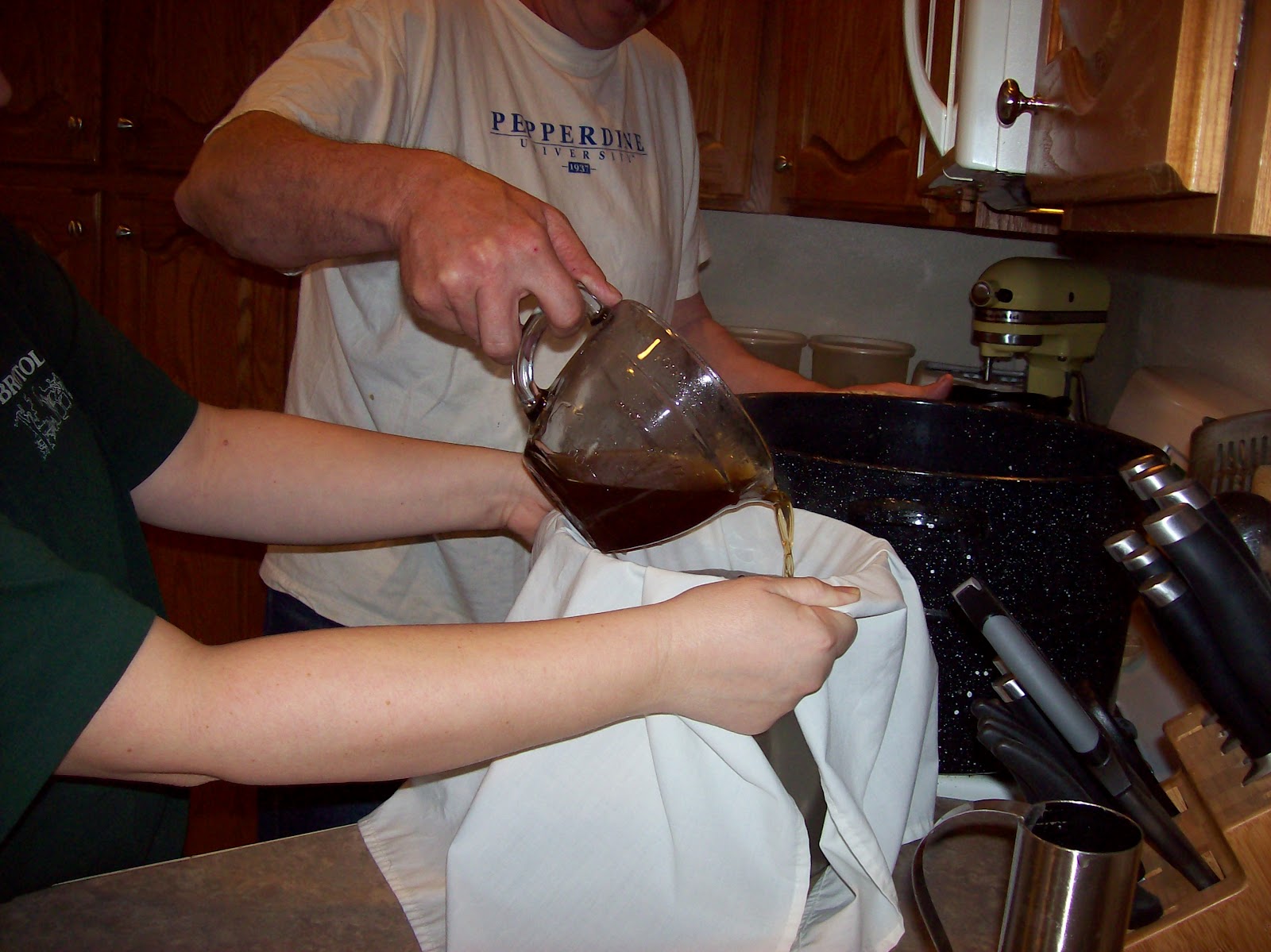
When it's ready, you must strain the syrup to clean debris and sediment. 


Once it's strained, we bottle it in quart jars and warm in the oven on a low heat to seal.  


We enjoyed some for supper on our french toast....YUMMY! There's nothing like fresh maple syrup :)

Friday, March 9, 2012

My Father's World Combined with Beautiful Feet High School

I mentioned in a former post that I added literature from Beautiful Feet to our My Father's World World History study for 10th grade.  Here is the plan I created.  It will not make as much sense without the MFW and BF Instructor Guides.  I do not recommend using this plan exclusively.  The Beautiful Feet supplements are in red.  I supplemented from the BF Ancient History and BF Medieval guides.  Let me know what you think or if you have questions.  

Monday
Tuesday
Wednesday
Thursday
Friday
Augustus Caesar’s World  BF 1
ACW BF 2
ACW BF 3
ACW BF 4
ACW BF 5
ACW BF 6
ACW BF 7
ACW BF 8
ACW BF 9
ACW BF 10
Usborne Pompeii/Early Rome
ACW BF 11/12 Julius Caesar
Usborne Roman Republic
Julius Caesar
Usborne Everyday Life
Julius Caesar
Usborne Everyday Life
Julius Caesar
Service Project
 Usborne Everyday Life
Julius Caesar
Usborne Everyday Life
Julius Caesar
Usborne Everyday Life
Julius Caesar
Usborne Everyday Life
Caesar’s Gallic Wars BF 13
Service Project
CGW BF 14
Notgrass 46 Rise & Fall of Rome  CGW BF 15
Notgrass 47 Augustus Caesar
CGW BF 16
Notgrass 48 Roman Law
ITW pg 13 CGW BF 17
Notgrass 49 Everyday Life Rome CGW BF 18
Service Project
CGW BF 19
Notgrass 50 The Kingdom of God CGW BF 20
Notgrass 51 Intro to Gospel of Luke CGW BF 21
Notgrass 52 The Revolution of Jesus CGW BF 22
Notgrass 53 Unlikely Heroes
CGW BF 23
Service Project
The Bronze Bow BF 25
Notgrass 54 Spiritual Topics in Luke  TBB BF 26
Notgrass 55 Jerusalem
TBB BF 27
Notgrass 56 Church Begins
TBB BF 28
Notgrass 57 Conversion of Cornelius TBB BF 29
Service Project
TBB BF 30
Notgrass 45 God’s Wisdom vs. Man’s TBB BF 31
Notgrass 58 Paul
TBB BF 32
Notgrass 59 Daily Life in the 1st Century TBB BF 33
Notgrass 60 How to Study New Test. Letter City BF 34
Service Project
City BF 34
Usborne Quo Vadis? BF 35
Usborne QV BF 36
Usborne QV BF 37
Usborne QV BF 38
Service Project
QV BF 39
Usborne
QV BF 40
Notgrass 61 Decline of Rome
QV BF 41
Notgrass 62 Changing Face of Church ITW pg 26-27; 28
QV BF 42
Notgrass 63 Develop.  in Church Practice ITW pg 29
QV BF 43
Service Project
QV BF 44
Notgrass 64 Constantine
ITW pg 30-31; 32 QV BF 45
Notgrass 65 What Happened to Church? ITW pg 33 QV BF 46
Notgrass 66 Factors in the Middle Ages – DK ITW pg 34 QV BF 47
Notgrass pg 207 text box about Bede – DK ITW pg 36-39
QV BF 48
Service Project
QV BF 49
Notgrass 67 Rise of Islam - DK ITW pg 35 QV BF 50
Write letter to share God’s truth – DK QV BF 51/BF Test
Notgrass 68 Alfred the Great - DK ITW pg 41
Notgrass 69 Everyday Life among the Vikings – DK
Service Project
Story of Liberty BF 1
Notgrass 70 Evangelism
ITW pg 40  Beowulf
The Magna Charta BF 2
Notgrass 71 A Changing World – DK ITW pg 44-49 Beowulf
The Magna Charta BF 2
Notgrass 72 Everyday Life in Middle Ages – DK ITW pg 42-43
Beowulf The Magna Charta BF 2
DK  Castle BF                    
Beowulf     
The Magna Charta BF 2
Service Project
The Magna Charta BF 2
Notgrass 73 The Crusades – DK ITW pg 50
Cathedral  BF
Notgrass 74 Thomas Aquinas  - DK ITW pg 51;52-71
BF Roger Bacon
Notgrass 75 Obeying God, Obeying Men – DK ITW pg 52-71
Morning Star of the Reformation
D K British Literature
Story of Liberty BF 2
Canterbury Tales BF
Service Project
Story of Liberty BF 3
British Literature
Adam of the Road

British Literature
Notgrass 76 Different Focus - DK
ITW pg 74 British Literature
BF Shakespeare
Notgrass 77 Movable Printing – DK ITW pg 88-90
British Literature Fine Print
Service Project
Story of Liberty BF 4
Notgrass 78 Leonardo da Vinci – DK British Literature
Trumpeter of Krakow
Notgrass 79 History of Music – DK British Literature
Notgrass 80 Worldliness vs. Godliness  - DK ITW pg 920
 British Literature
British Literature
Service Project
Story of Liberty BF 10-12; 16
Notgrass 81 Martin Luther – DK ITW pg 75-83; 85 PHP
Notgrass 82 John Calvin – DK
ITW pg 86-87 PHP
Story of Liberty BF 19
Notgrass 83 Anabaptists
PHP
Hawk That Dare Not Hunt by Day
Notgrass 84 History of English Bible ITW pg 84 PHP
Service Project
Story of Liberty BF 6
Notgrass 85 Grace
Pilgrim’s Progress
Story of Liberty BF 7
Notgrass 86 Discover New Worlds – DK Pilgrim’s Progress
Marco Polo
Notgrass 87 Christopher  Columbus ITW pg 72-73
Pilgrim’s Progress
Pilgrim’s Progress
Story of Liberty BF 8
Service Project
Story of Liberty BF 13-15
Story of Liberty BF 5
Story of Liberty BF 17
Story of Liberty BF 18
Story of Liberty BF 20-23
Story of Liberty BF 24-25
Notgrass 88 Spanish Armada
Pilgrim’s Progress
Story of Liberty BF 26-27
Notgrass 89 Homes in  Everyday Life Pilgrim’s Progress

Notgrass 90 Exploring the Promised Land ITW pg 91
Pilgrim’s Progress
Pilgrim’s Progress

Service Project
Story of Liberty BF 28

Notgrass 91 New View – DK
ITW pg 102 British Literature
Notgrass 92 Heresy Trial of Galileo – DK ITW pg 92-94
British Literature
Notgrass 93 Isaac Newton – DK
ITW pg 95-96
British Literature
DK ITW pg 107
British Literature
Service Project
Story of Liberty BF 29-30
Notgrass 94 Clothing  - DK
A Tale of Two Cities
Notgrass 95 Authority of Scripture – DK ITW pg 104-106
A Tale of Two Cities
Notgrass 96 Revolutions – DK
ITW pg 97-98; 113-114
A Tale of Two Cities
DK
A Tale of Two Cities
Service Project
Story of Liberty BF 31
Notgrass 98 John Locke – DK
ITW pg 99-101
A Tale of Two Cities
Notgrass 97 French Revolution – DK ITW pg 118-119
A Tale of Two Cities
Notgrass 99 Eating thru Centuries – DK
A Tale of Two Cities
DK
A Tale of Two Cities
Service Project
Notgrass 100 Galatians – DK
ITW pg 103
Pride an d Prejudice
Notgrass 101 Napoleon – DK
ITW pg 136-138
Pride an d Prejudice
Notgrass 102 Revolution, Reaction, Reorganization – DK
ITW pg 154-162
Pride and Prejudice
DK ITW pg 154-162

Service Project
Notgrass 103 Unify Italy & Germany –DK ITW pg 133-134
Pride and Prejudice
Notgrass 104 History of Art – DK
ITW pg 146-152
Pride and Prejudice
Notgrass 105 Honesty
ITW pg 115
Pride and Prejudice
ITW pg 107-112
Service Project
Notgrass 106 Britain 19th Century  ITW pg 135; 163
Pride and Prejudice
Notgrass 107 Irish Question
ITW pg 116-17; 120-121
Pride and Prejudice
Notgrass 108 George Muller
ITW pg 143-145
Pride and Prejudice
ITW pg 132; 164-166
Service Project
Notgrass 109 History of Transportation – DK
Silas Marner
Notgrass 110 Kindness – DK
Silas Marner
Notgrass 111Karl Marx – DK
Silas Marner
DK
Silas Marner
Service Project
Notgrass 112 Charles Darwin
ITW pg 167 Silas Marner
Notgrass 113 Sigmund Freud
Silas Marner
Notgrass 114 John Dewey – Education Silas Marner
Notgrass 115 Higher Criticism
ITW pg 153
Service Project
Notgrass 116 Europe Colonization ITW pg 122-124
Cry , the Beloved Country
Notgrass 117 Ethiopia
ITW pg 139-142
Cry , the Beloved Country
Notgrass 118 The Culture of the Masai: Traditional African Tribe
Cry , the Beloved Country
Notgrass 119 South Africa
Cry , the Beloved Country
Service Project
Cry , the Beloved Country
Notgrass 120 Africa in the Bible
Cry , the Beloved Country
Notgrass 124 Mission to Asia
ITW pg 125
Cry , the Beloved Country
Notgrass 122 India: Clash of Cultures
Cry , the Beloved Country
Notgrass 123 Other Nations in Asia
Cry , the Beloved Country
Service Project
Notgrass 121 China: Dynasty to Communism
Hudson Taylor’s S S
Notgrass 125 Helping the Poor
ITW pg 126-131
Hudson Taylor’s S S
Notgrass 126 Many Countries, One Goal
Hudson Taylor’s S S
Notgrass 127 Mexico’s Story
Hudson Taylor’s S S
Service Project
Notgrass 128 Simon Bolivar
Hudson Taylor’s S S
Notgrass 129 People of Latin America – DK Hudson Taylor’s S S
Notgrass 130 Justice – DK
Hudson Taylor’s S S
DK Hudson Taylor’s S S
Service Project
Hudson Taylor’s S S
DK The Hiding Place
DK The Hiding Place
DK The Hiding Place
Notgrass 131 Twice in 25 Years  DK The Hiding Place
Service Project
Notgrass 132 America in WWII-DK The Hiding Place
Notgrass 133 Winston Churchill – DK The Hiding Place
Notgrass 134 Cultural History of Japan – DK The Hiding Place
The Hiding Place
Service Project
Notgrass 135 Peace – DK
Animal Farm
Notgrass 136 Freedom vs. Communism – DK
ITW pg 168-177 Animal Farm
Notgrass 137 Space Race – DK
Animal Farm
DK Animal Farm
Service Project
Notgrass 138 Ronald Reagan – DK ITW pg 178-191
Animal Farm
Notgrass 139 Everyday Life in the US & USSR during 50’s & 60’s –DK
Animal Farm
Notgrass 140 Fighting the Good Fight - DK

Service Project
Notgrass 141 Reign of Terror – DK In His Steps
Notgrass 142 Advances in Technology In His Steps
Notgrass 143 Homeschooling Family In His Steps
In His Steps
Service Project
Notgrass 144 History of Timekeeping  In His Steps
Notgrass 145 Value of Life
In His Steps
Notgrass 146 Lessons from World History In His Steps
Notgrass 147 Sense of History
In His Steps
Service Project
Notgrass 148 Living in the Modern World
Notgrass 149 Becoming a World Christian
Notgrass 150 Eternity After this World

Service Project

Disclaimer:  I am in no way affiliated with My Father's World or Beautiful Feet.  I received no compensation for the above plan.  I'm just a homeschool mom looking to share what has or has not worked in our family :)