Showing posts with label Beautiful Feet. Show all posts

Saturday, July 10, 2021

2020-2021 Curriculum Recap

I know many of you plan your upcoming school year over summer like me. When I was looking back over older blog posts here, I realized that I didn't post our 2020-2021 curriculum preview, so instead I will do a recap, partly to give you ideas for future planning and partly as a record of our homeschool when I look back. I'm going to add all three kids in one post (Year 2, 10, and 11) so I apologize for the length in advance. Grab your latte, kick back, and enjoy! Here goes...

Year 11

Bible & Character 

Riley continued to work through Ambleside Online's Bible Reading Plan. She also completed SCM's Life in the Word, which received groans when I originally assigned it, but turned out to be a great study. This guide leads you through seven different ways to study the bible and Riley really enjoyed it. She also read Charlotte Mason's Vol. 4, Ourselves, Book II as part of her bible and character study. 


History & Geography

Riley began working through Beautiful Feet's US & World History study. Back in the day, it was originally a two year study, but recently, it was revised to be completed in one year. However, because it's such a rich and important time in our history, especially in light of current events, we still opted to spread it over two years and added a few extra books and resources to boot. In addition to the assigned BF books, Riley read from and used the following resources...

Prescripts Cursive Passages and Illuminations: American Documents - this was continued from Year 10 and finished in Year 11

Harriet Beecher Stowe and the Beecher Preachers by Jean Fritz

The Federalist Papers by Hamilton, Madison, and Jay

Unconditional Surrender by Albert Marrin

The Story of Liberty by Charles Coffin - You may remember from previous posts that Riley has been working through two streams of history throughout her high school years. This year, her second stream of history covered the Middle Ages/Renaissance/Reformation. Riley was originally scheduled to read The Book of the Middle Ages by Dorothy Mills. However, with two online courses, work, and her other studies, she was not able to complete it, which was very well because she did an in depth study of the Middle Ages back in 8th grade (Term 1, Term 2, and Term 3) and remembered a great deal. I scheduled her too heavily this year and gave grace when needed. With that said, she did complete Coffin's book and thoroughly enjoyed it. 

Riley has also been keeping a Book of Centuries since Year 7.


Government & Political Philosophy

Riley took an online Vita Beata course using several Memoria Press books for a credit in Political Philosophy. The books included:

The Republic and The Laws by Cicero

On Obligations by Cicero

City of God by St. Augustine

Riley also completed Exploring Government by Ray Notgrass, as well as the literature below...

Mornings on Horseback by David McCullough

The Autobiography of Calvin Coolidge

Born Again by Charles Colson

God and Reagan by Paul Kengor

I like to teach high school government during an election year. We traditionally watch the debates, attend rallies, and keep up with current events to enrich our government study. And WOW!...this election cycle was definitely a real learning experience for better or worse!! 


Science & Health
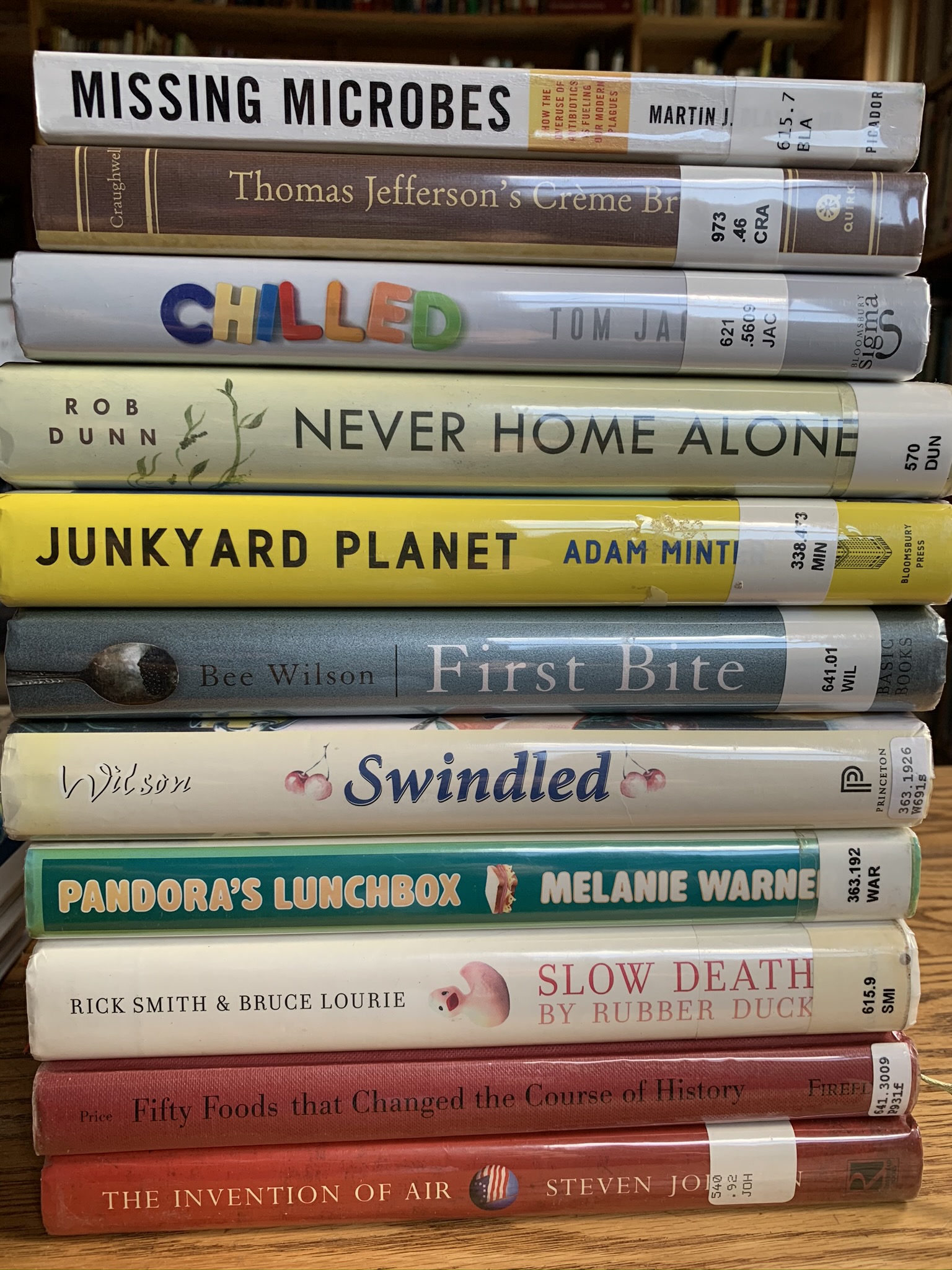

Guest Hollow Chemistry - This was our first year using a Guest Hollow course as written. I have pulled books from other Guest Hollow courses in the past, but I bought the full Chemistry plan this year. One caution I have if you use Guest Hollow Chemistry is to cull down. This was a great plan, but there are way too many books/videos/projects scheduled for a one year course of study....especially if you are taking a literature approach in other subjects. Riley had already read a few of the assigned books in former years, which allowed her to focus her time and energy on more of the videos and projects. She also notebooked through the course. In an effort to conserve words here, I plan to write a separate post about her overall Chemistry credit on the blog at some point. In addition to the Guest Hollow Chemistry, Riley read the following science and health books this year...

The Structure of Matter

Real Science 4 Kids Chemistry

Six Easy Pieces by Richard Feynman

Crucibles: The Story of Chemistry by Bernard Jaffe

Microbe Hunters by Paul de Kruif 

Total Health: Choices for a Winning Lifestyle

Nature Study


English 11

We take a literature approach to our learning in most subjects so Riley completed several books this year in other subjects like history, government, and science. In addition, she read and used the following books and resources toward her English credit...

Sir Gawain & the Green Knight by  J.R.R. Tolkien

The Divine Comedy by Dante - online Vita Beata Literature class

Beowulf by Seamus Heaney

Joan of Arc by Mark Twain

Idylls of the King by Tennyson

Fierce Wars & Faithful Loves  Edmund Spencer's Book I of the Faerie Queen

Poetry by Czeslaw, Milosz, and Edna St. Vincent Millay

Written narration, notebooking, and composition

Invitation to the Classics by Cowan and Gunness - continued from previous years - finished

IEW's Phonetic Zoo - continued from previous years - finished


Math

Teaching Textbooks Algebra 2

Overall, Riley had a great year! She also kept and harvested a garden, milked cows on an organic dairy farm, helped homeschool Levi, took an art class outside the home, and played volleyball. As you can see, she kept very busy! I can't believe she's already heading into Year 12 this fall. Time goes so fast!


Year 10

Ruben had a pretty unconventional year. He worked many long hours outside the home in the fall and spring operating heavy equipment to pump pits, which was a learning experience in and of itself. The focus of his traditional academic subjects was completed in the winter months and continues over summer. His subjects of study have been...

Bible - Ruben is reading select assigned passages.


World History & Geography - Middle Ages/Renaissance/Reformation - Ruben is currently reading When Knights Were Bold by Eva March Tappan and then will read The Story of Liberty by Charles Coffin. Ruben also completed an in depth study of this time period back in Year 7 so the goal this year was simply a recap, as he heads toward a World History credit. He is working through Memoria Press's Geography I course as well, which covers The Middle East, North Africa, and Europe. 


Biology - Ruben did a great deal toward his Biology credit in Year 9. However, I want him to finish up the Sabbath Mood Homeschool study using Men, Microscopes, and Living Things by Katherine Shippen


Math - Ruben is working through a set of math skills and concepts pulled from a variety of resources rather than a traditional text. 


English - He re-read The Hobbit  by J.R.R. Tolkien this year and has been reading through The Lord of the Rings trilogy by J. R. R. Tolkien, as well as other misc. books including....

My Side of the Mountain by Jean Craighead George

The Yearling by Marjorie Rawlings

Old Yeller by Fred Gipson

In addition, throughout the year, Ruben has taught himself  to weld, strengthened his abilities in auto mechanics, and engineered various small engine machines, such as repurposing a non-functioning pressure washer into a lawn mower, and combining a 4-wheeler and a mini bike into some type of ridable non-traditional looking machine. He also resurrected an old snowmobile from the 1970's and keeps all our vehicles on the road. Ruben is constantly building, tearing apart, and rebuilding any machinery he can get his hands on. He watches numerous YouTube videos and then spends hours outside and in his shop constructing and configuring. This is all part of his education! 


Year 2/3


Levi made great gains in his reading this year!! He has a summer birthday and bordered between 2nd and 3rd grade. Grades are a measure of public school standard. When home educating, we teach to the child, not any one particular grade. His books and resources were consistent with his age of 8 and included the following...

Bible & Character 

Assorted Old Testament passages from The Children's Bible. 

The Golden Bible Atlas

Oral Narration


History 

A Child's History of the World by Virgil M. Hillyer - will continue next school year

Kingfisher History Encyclopedia - excerpts

Usborne Pharaohs & Pyramids by Tony Allan and Philippa Wingate - excerpts

Seeker of Knowledge by James Rumsford

Tut's Mummy Lost...and Found by Judy Donnelly

Mummies, Pyramids, and Pharaohs: A Book About Ancient Egypt by Gail Gibbons

Growing Up In Ancient Egypt by Rosalie David

The Trojan Horse by Emily Little

Hidden Army: Clay Soldiers of Ancient China by Jane O'Connor

The Secrets of Alexander's Horse by Tony Palazzo

Cleopatra by Diane Stanley

Pompeii: Buried Alive by Edith Kunhardt

Our Island Story by H. E. Marshall - will continue next school year

Sword in the Tree by Clyde Robert Bulla

Marguerite Makes a Book by Bruce Robertson

Stories of Great Americans for Little Americans by Edward Eggleston

Oral Narration

Levi completed notebooking pages to correspond with this Bible and History study. Riley helped him compose a sentence or two from his oral narration to summarize each reading. Levi would then copy the sentence(s) and illustrate them in a notebook. I used this method with Riley when she was young and it turned out to be the start of a great thing, as her notebook pages have evolved over the years into beautiful scrapbooks of her education. You can read more about our notebook keeping here


Geography

Under the Home - Where We Live: A Home Geography, Part II

Notebooking pages


Science & Health

The Great Dinosaur Mystery & the Bible by Paul S. Taylor

Under the Home - Animal Nature Study

Notebooking pages

Naturalist Kids Podcast

Wild Kratts on PBS Kids

Oral Narration


Language Arts

Prairie School by AVI & Memoria Press Lit Guide

Animal Folk Tales of America by Tony Palazzo & Memoria Press Lit Guide

All About Reading 2

Core Skills Phonics 3

McGuffey Pictorial Eclectic Primer with The Lesson Book

Memoria Press Grade 2 Literature

A Child's Book of Poems by Gyo Fujikawa

Animals Animals by Eric Carle

Copywork

Oral Narration


Math

Rod & Staff Arithmetic 2


Fine Arts

Memoria Press Music Enrichment

Memoria Press Art Cards

Under the Home Studio Art - Drawing 2D and 3D Shapes

Levi also attended an art class outside the home. 

Overall, Levi had a great year! As mentioned before, he made tremendous progress in reading, as well as math. Due to me working outside the home, Riley guided him through most of his lessons. I chose the books/resources and created the schedule that she implemented. Some of his lessons had audio books/story components so Riley would set it up and Levi would listen, while she worked on her own lessons. Then they worked together on other subjects. Riley and Levi have very similar personalities and many common interests. She is nine years older than him, very mature, and kind, but firm so he respects her. 

I am very proud of all three kids and their accomplishments this year! It's been a little difficult to balance work with homeschooling, but they persevered and we have all been blessed by the fruit of our labor. 

I do plan to post a few follow-up blogs to showcase some of the new curricula and resources we used this year, namely Guest Hollow Chemistry, Under the Home, and McGuffey readers with The Lesson Book. These were all new to us and ended in success so I can't wait to share!


This post contains some, but not all, affiliate links. Proceeds from the links allow me to continue homeschooling and adding future content to this blog.  

Wednesday, April 17, 2019

Life Lessons From A Picture Book...


Last fall, I read aloud Columbus by Ingri & Edgar Parin D'Aulaire to Levi. I was very excited at the prospect of reading this series again, which has been reprinted by Beautiful Feet Books. This is my second go around with this particular picture book. However, it's been quite some time and I had forgotten some of the details. On this second reading, I was especially awestruck with the following passage from page 10....
When Christopher was thirteen, he left his father's house and sailed out in to the world to seek his fortune as a seaman. He felt free as the gulls as he saw his native town fade out of sight. Soon he rose above his shipmates, for he was clever and capable and could make others carry out his orders. He was still a very young man when he became captain of a ship. For many years he busily sailed his ship back and forth across the Mediterranean Sea and had little time to wonder whether the world was round or flat, small or big. 
Just think, Columbus left his father's house at age thirteen! I had a 13-year old boy at the time of re-reading so this idea really struck a cord with me. One of our goals in home educating is to nurture competent and capable adults. I would be heart sickened to see my thirteen year old leave home because I'm not ready to let go and yet, I feel he is quite able to do so. Our current culture holds young adults back from responsibility that they are more than capable of taking on. Don't be afraid to give your children chores. You are doing them a favor!

In reading this passage, I was also prompted with thoughts of our current culture's young people having failure to launch issues. I can't help but wonder if they were reading more stories with good moral character, virtue, and motivation, that they would gain those qualities as well and not fail to launch. Don't be fooled by the simplicity of picture books. They often give much food for thought!

Monday, May 21, 2018

Beautiful Feet Medieval History - 2017-2018 Third Term Review and Wrap-Up


Riley Ann completed her third and final 12-week term using Beautiful Feet Book's Intermediate Medieval History guide. You can read more about her first term here and second term here.

In the third term of her study, Riley covered Chaucer's Canterbury Tales, Joan of Arc, Johann Gutenberg, 15th Century Poland and Christopher Columbus, among others using the following books:

Canterbury Tales by Geoffrey Chaucer, adapted by Barbara Cohen
Joan of Arc, Warrior Saint by Jay Williams
Fine Print, A Story about Johann Gutenberg by Joann Birch
The Trumpeter of Krakow by Eric P. Kelly
The World of Columbus and Sons by Genevieve Foster

Riley is a fan of Genevieve Foster's work. She appreciates the fact that Foster can take one person from history and weave the story of what's happening around the world at the time of their life. Riley said she enjoyed each of the books she read this year, but her three favorites were The Adventures of Robin Hood, The Kite Rider, and The Trumpeter of Krakow.

Beautiful Feet Books sells a World Map to accompany their Ancient, Medieval, and Modern US & World history studies. Although, we didn't buy one. Instead Riley created her own map by drawing the world freehand on a piece of tag board....


Riley commented at the end of the year how much congestion there was in Europe on her Medieval map. She also asked if she could add Columbus' journeys and of course, I agreed!

Throughout the year, Riley created a series of notebooking pages. Most included research essays and biographical sketches of the people, places, and events she read about. She did not complete any of the hands on projects suggested in the BF guide. Here are samples of her third term notebooking pages...


Overall, Riley had a great year studying Medieval History using Beautiful Feet Books! We wholeheartedly recommend studying history with their literature guides. However, Riley will not continue with BF next year in 9th grade, as she has already read most of the books used in the BF Early American and World study. On the bright side, I will be using the BF Early American Primary set with Levi. It will be my second time around with that guide and I'm sure I'll be blogging about it throughout the year as I'm looking very forward to it.

Saturday, May 12, 2018

The Trumpeter of Krakow....


Ruben and I finished reading The Trumpeter of Krakow by Eric P. Kelly this week. Riley also read it a couple of weeks ago through her Beautiful Feet Medieval Intermediate History study. Kelly's 1928 historical fiction novel won the Newbery Award in 1929 and I can see why.

The Trumpeter of Krakow is a dramatic adventure set in the city of Krakow in Medieval Poland. It is also a coming of age story of young Joseph, a 15-year old boy, learning how to protect his father's 200 year old family secret. Kelly's tale left me longing for so much more information. Was there really a Great Tarnov Crystal? Was the Heynal a real song and is it still played today? Was the Church of Our Lady Mary a real place and is it still standing today? As it turns out, the answer to all of these questions is yes!

The legendary Tarnov Crystal, was more commonly known as the "philosopher's stone" as far back as about 300 AD in Greek history. It was an alchemist's substance, which could supposedly be used to turn base metals into gold or silver. For many years, it was the most sought after substance. The Crystal is also known as the "elixir of life", as it's believed to be useful in achieving eternal life. Some say, the stone dates back to Adam in the bible, who received knowledge of it directly from God. That knowledge was then passed down through the biblical patriarchs and was the reason for their long years of living. Either way, the stone's history intrigued me and I think The Trumpeter of Krakow would also be a wonderful living book to read for science/chemistry purposes.

It turns out the Heynal is a real song and is still played today with the broken note, out of all four windows, every hour, just as described in the story. It is a five note Polish anthem. The song is still played with the broken note that stemmed from a Mongol invasion in 1241. Legend has it that the trumpeter in the sentry tower was playing the anthem to sound the alarm of invaders, but the Mongols entered the city before the gates were closed and shot the trumpeter in the throat, causing the abrupt ending of the Heynal. His inability to complete the Heynal resulted in the broken note. The broken note is still observed today as a way to commemorate that 13th Century trumpeter.

I really enjoyed reading Professor Carol Reynold's piece on The Trumpeter of Krakow and watching the YouTube video she linked, showing the modern day Heynal player. For those that don't know, Professor Carol leads European tours for the Smithsonian Institute. She is a retired university professor of music history, who has also written/produced home education courses on music history, and culture. She's a wonderful speaker!

Lastly, the Church of Our Lady Mary is in fact, a real place. It is better known as St. Mary's Basilica, Krakow. The main part of the church as it stands today was completed in the 14th Century. Although, the foundation was laid in the 13th Century. The original church on that foundation was destroyed in the Mongol invasion. It is a Brick Gothic church situated next to Marian Square, the main square of Krakow. The interior images are absolutely stunning! On every hour, the trumpet signal (Heynal) is played from the top of the taller two towers of St. Mary's. I would love to travel there someday and see it.

For me, The Trumpeter of Krakow was definitely an example of a living book as the story caused me to want to dig deeper. I was sad to see it end and yet, I loved the ending, although, Riley and Ruben disagreed on the conclusion of The Tarnov Crystal. The story's end allowed for lively discussion. The characters were rich. The setting was of interest. The history was very intriguing and there doesn't seem to be many books written about medieval Poland for students. Overall, I highly recommend reading The Trumpeter of Krakow by Eric P. Kelly as part of your middle or high school medieval history study!

Thursday, March 1, 2018

The Kite Rider by McCaughrean...


We recently finished reading The Kite Rider by Geraldine McCaughrean. This was our second McCaughrean read this year, as we read One Thousand and One Arabian Nights in Term One. Both of these books are Beautiful Feet Intermediate Medieval History recommendations, as well as IEW Medieval History-Based Writing Lessons recommendations.

The Kite Rider is set in 13th Century China. It's the coming of age story of Haoyou, a young Chinese boy who needs to earn a living to provide for his widowed mother and baby sister. Haoyou begins making fanciful kites in the hope of selling them. However, an evil sailor burns him out in an effort to marry his mother. Together with his cousin, Haoyou sends the drunken sailor out to sea and joins the circus as a kite rider. Unfortunately, the money he earns and sends home doesn't make it to his mother because his greedy Great-Uncle Bo intercepts and gambles it away. There is much more to this adventure story, but I don't want to give away the ending.

As a family, we have come to love McCaughrean's writing. Her characters develop and show much growth as the story progresses, making them seem real and very interesting. Also, McCaughrean's language is beautiful and not dumbed down. We all found ourselves rooting for the protagonist, hoping for a happy ending to their plight.

Another McCaughrean title the kids have enjoyed in the past is Stop the Train, which is set in the American west. We would frequently get the audio from the library when they were younger, as they wanted to listen over and over again. If you haven't tried a Geraldine McCaughrean book, we highly recommend you do so!

Tuesday, February 27, 2018

Beautiful Feet Medieval History - 2017-2018 Second Term Review...


RileyAnn just finished her second 12-week term with Beautiful Feet's Intermediate Medieval History guide. You can take a peek back at her first term here. Today, I'll showcase the books and notebooking pages she worked on in the second term.

In week's thirteen through twenty-four, Riley covered a variety of topics, including the Magna Charta, medieval castles and cathedrals, 13th Century China, John Wycliffe, and 13th and 14th Century England by reading the following living books...

The Magna Charta by James Daugherty
Cathedral by David Macaulay
Castle by David Macaulay
The Kite Rider by Geraldine McCaughrean
Adam of the Road by Elizabeth Janet Gray
Morning Star of the Reformation by Andy Thompson
Crispin and the Cross of Lead by AVI

Riley has written many essays and research papers throughout this study, drawing from a variety of  websites and The European World 400-1450 by Barbara A. Hanawalt. She did have some trouble accessing the BF guide's suggested websites, but has been able to find subject material at other websites. Riley also watched the David Macaulay Cathedral documentary online. I had Ruben watch it with her after he read the Macaulay book as well.

Overall, Riley is loving the BF Intermediate Medieval History literature! The photo below shows a sampling of her notebooking pages for this term.


Thursday, February 8, 2018

Adam of the Road by Elizabeth Janet Gray...


Adam of the Road by Elizabeth Janet Gray is a book I've waited years to read. It's on many favorite lists suggested for study of the Middle Ages. Over the last couple of weeks, I finally got my chance.

Adam of the Road tells the story of Adam, an 11-year old son of a traveling minstrel in 13th Century England. Throughout their travels, Adam and his father acquire a horse, named Bayard, and a dog, named Nick. However, after a short time, Adam's father loses Bayard gambling and eventually Nick is stolen. Then while searching for Nick, Adam is separated from his father. The second half of the story becomes Adam's quest to find Nick and his father. Throughout which, he learns a few life lessons. I won't give away the ending, but will suffice to say, Adam of the Road is a worthy read.

Gray's tale gives a wonderful overview of minstrel life during the 1200's. It also gives a glimpse of time after the signing of the Magna Charta as England was beginning to establish and build the foundation for their modern day government. The portrayal of medieval culture and society is in line historically. Gray was awarded the 1943 Newbery Medal for writing Adam of the Road.

As mentioned, Adam of the Road is a suggested read on several lists, including Beautiful Feet, Memoria Press, Sonlight, and TruthQuest History. Our entire family enjoyed it as an evening read aloud.

Monday, January 22, 2018

Otto of the Silver Hand by Howard Pyle....


Otto of the Silver Hand by Howard Pyle is a charming book, originally published in 1888, about a motherless boy who grew up in the safety of a monastery for the first twelve years of his life. It's set in Medieval Germany at a time of robber barons. Eventually, the boy's father comes back for him and takes him home in the hope of training him in warring. However, Otto has been taught up to that point in the way of the Lord, where kindness and mercy abound. Upon leaving the monastery, the reader quickly finds young Otto out of his element. There is definite evil, brute force, and cruelty in his father's world. However, good prevails as Otto manages to overcome.

Pyle's story is engaging, albeit simply written. Otto of the Silver Hand would be suitable for younger elementary students as a read aloud or older students as an independent read. Pyle's illustrations are fabulous and really compliment the story. We were slightly disappointed with Pyle's lack of character development, but the illustrations do help the story come alive. The book is pretty fast paced as there is a lot of action so it felt like you never really got to know the characters like in a book such as Black Fox of Lorne by de Angeli, which we finished reading before Otto. We liked the characters in Pyle's tale, but were left wanting to know more about them.

Overall, we enjoyed Otto of the Silver Hand. It was our first book written by Pyle. I look forward to reading his other books in the future.

Wednesday, January 10, 2018

King Arthur and his Knights of the Round Table...


I recently finished reading King Arthur and his Knights of the Round Table by Roger Lancelyn Green aloud to Ruben. Riley read it as well as part of her Beautiful Feet Intermediate Medieval History study. The BF guide suggests reading selected stories. However, Riley and I decided she would read the book in its entirety, as did Ruben and I.

I have heard of King Arthur in the past, but never read his tales until now. King Arthur is a legendary British leader, who according to medieval sources, defended Britain against the Saxons in medieval England. The tales of King Arthur are thought to be mainly composed of folklore and legend, as their authenticity has been disputed by historians throughout the ages. However, these narratives continue to shape literature, history, and cultural values of Europe and Western Civilization today.

According to the Beautiful Feet Medieval History guide...
King Arthur and his Knights of the Round Table relates the story of the establishment of a code of chivalry that still influences British law and customs. The stories are an interesting mix of Christian references and pagan lore. Magic coincides with biblical stories, showing how European tribes mixed their ancient pagan beliefs with the newly arrived Christian faith. Nowadays we think of magic in terms of tricks and illusions. But in the days of Arthur people used it to explain things they did not understand. It also helped people distinguish good from evil - the dark arts were something to be feared and avoided at all costs. As you'll see in these stories, the element of magic is used to warn people of the dangers of evil and encourage right action. Good magic is often explained in terms of generosity, humility, courage, or honesty; whereas bad magic, or the dark arts, cause treachery, pride, greed, anger, murder, lust, and other moral failings. (p. 4)
In Book One, The Coming of Arthur, we learn of Arthur's beginning. He is an orphan of sorts, who is taken away by the wizard Merlin and raised by Sir Ector. At a time when the Saxons were taking over Britain, there was a gathering of knights in London, on Christmas Day. The Archbishop was performing a service in the abbey for these knights, when a "great square slab of marblestone" appeared in the churchyard. On the stone was "an anvil of iron, and set point downwards a great, shining sword of steel thrust deeply into the anvil." 

When the service ended, all went out to look at it. In gold letters on the great stone, was written:
WHOSO PULLETH OUT THIS SWORD FROM THIS STONE AND ANVIL IS THE TRUE-BORN KING OF ALL BRITAIN. (p.6)
Of course, all the men gathered tried to pull out the sword with none able. Therefore, a tournament was set for New Year's Day so that more could gather and try their hand at the sword to see who would be the king. No one was able to pull the sword, until Arthur tried and was successful. From there, he was crowned King Arthur.

The tales that follow tell the story of King Arthur's life, including how he gathered his knights of the Round Table. A physically round table so that there was no head and all would be equal. On the first day of the Round Table, the Order of Chivalry is laid down. It's a beautiful code, whereupon, each knight must return on the feast of Pentecost to swear the oath anew.

As the legends progress, there is much honor, courage and humility. As evil presents, we see the negative effects and how good overcomes. However, in the end when King Arthur and one of his knights succumb to their human desires rather than upholding the Code, we see the demise of the entire court. All is lost for lust.

Quite honestly, initially, I wasn't completely enthralled in King Arthur and his Knights of the Round Table. However, Book Four, clinched it. Once we finished, I totally saw the value in reading it. King Arthur's legend is a beautiful story of good vs. evil. It exemplifies character traits like courage, loyalty, and trust, as well as showing the negative side of war, revenge, greed, and lust.

Now that we've read Green's version, which I would liken to a beginner edition, I'd like to go back some day and read other versions, such as Malory's Le Morte d'Arthur or Alfred Tennyson's Idylls of the King. We started Idylls and The Once and Future King by T.H. White in Term One, but became bogged down for lack of understanding, and so quit. Green's narratives gave us a good base for understanding so we now have a foundation to build on in future years.

Monday, December 18, 2017

One Thousand and One Arabian Nights by McCaughrean...


One Thousand and One Arabian Nights by Geraldine McCaughrean  is a fresh retelling of King Shahryar's quest for love. When his first wife abandons him for another, he vows to kill each new wife before they can leave him too. After three years of killing a new bride everyday, the supply of young eligible maiden's in his kingdom is running low. In an effort to protect her, King Shahryar's trusted adviser, keeps his own daughter, Shahrazad, a secret. Eventually, she is found out and her time comes to marry the King. However, Shahrazad concocts a clever plan to tell the King a story every night before bed to spare her life. Her stories are so wonderful and exciting that the King must keep her alive until the next night to continue. This goes on for one thousand and one nights until Shahrazad tires and can no longer tell her tales. Will the King take Shahrazad's life? You must read this enchanting adventure to find out for yourself.

McCaughrean's One Thousand and One Arabian Nights is a part of the Beautiful Feet Intermediate Medieval History study. Only select chapters are assigned in their guide. However, you can certainly read more if you so choose. Ruben really enjoyed the tales I read aloud. I absolutely adored the beautiful ending, which made me want to go back some day and read the stories we missed.

Overall, I think McCaughrean's retelling is great for getting acquainted with these classic tales. They may not be as in depth as other translations, but certainly suitable for middle school or anyone looking to get a basic understanding for historical relevance.

Saturday, December 2, 2017

Beowulf by Michael Morpurgo...


Micheal Morpurgo's Beowulf is a wonderful retelling of this Old English epic. I first became aware of it through Beautiful Feet Books. It is included in their Intermediate Medieval History guide, which we are working through this year.

Morpurgo's Beowulf is easy to read and understand, yet doesn't dumb down the tale of the noble Scandinavian warrior. In his acknowledgement at the back of the book, Morpurgo gives credit for his understanding of the epic to Seamus Heaney, Rosemary Sutcliff, Kevin Crossley-Holland, and Micheal Alexander. The suggested reading level is ages 8-12, making it a very accessible retelling.

The story is written in three parts. First, Beowulf must conquer Grendel, a monster who consistently attacks the Danes. Then he must face Grendel's mother, the Sea-Hag, who comes to avenge her son's death. Many years later, after becoming King of the Geats, Beowulf decides to fight the Death-Dragon of the Deep in an effort to save his people. The dragon, who'd been asleep for over three hundred years, was awakened by a slave trying to steal a jeweled cup from his lair and has been blowing fire, burning the Geats' homes and land. I will not spoil the ending.

Beowulf is a classic good versus evil tale. It put me in mind of The Hobbit by J.R.R. Tolkien. Beowulf is a leader of incredible character. His strength, nobility, and virtue shine throughout the story. I highly recommend Morpurgo's retelling, particularly for 4th-8th grade or anyone looking to get a general handle on this epic. It has totally set the stage for Heaney's Beowulf, which I look forward to reading in the future.

Thursday, November 30, 2017

Beautiful Feet Medieval History - 2017-2018 First Term Review...


Riley finished her first 12 weeks of Beautiful Feet's Intermediate Medieval History today. So far, she has read from the following titles:

Beowulf by Michael Morpurgo
One Thousand and One Arabian Nights by Geraldine McCaughrean
King Arthur and His Knights of the Round Table by Roger Lancelyn Green
Queen Eleanor, Independent Spirit of the Medieval World by Polly Brooks
Robin Hood by Roger Lancelyn Green
The European World 400-1450 by Barbara A. Hanawalt

Only select chapters were assigned from Arabian Nights and King Arthur. However, since we decided to stop reading The Once and Future King by T.H. White, which was recommended by Ambleside Online, Riley opted to read King Arthur in its entirety. Also, The European World is a spine book, so select sections are assigned throughout the year. Overall, she has really appreciated the literature, though some of the assigned readings are long, taking well over an hour. Riley mentioned in particular, how helpful it was to read the Queen Eleanor book as background for Ivanhoe by Sir Walter Scott, which we are also reading per AO.

In addition, Ruben and I have read Beowulf, Arabian Nights and King Arthur as part of his history study. Given the length of the readings, I will not be able to read all of the books suggested in the Medieval guide, but we are planning to keep up with several of the assigned titles. I especially enjoyed Beowulf much more than I could have anticipated, where good versus evil abounds. Ruben was entranced by Arabian Nights. He loved hearing each day's tales. I've also been thinking about the virtue and valor in King Arthur and how as soon as one man broke the code of chivalry, the round table fell apart. When Satan is allowed to creep in, sin destroys us. There were many life lessons and much to think about in that story.

Aside from the reading, Riley has also been completing the suggested assignments in the BF guide. These have included mapwork, vocabulary, and writing prompts. She mentioned a couple of times that there has been more research and writing in this guide than in the BF Ancient History guide she completed last year. One of Riley's complaints has been the lack of drawing or illustrating assignments in the BF Medieval History. She felt the Ancient History guide allowed her more creativity in drawing, which she relishes. She's hopeful, there may be more drawing in future weeks. In the mean time, Riley's been adding in extra drawing where ever she can. Overall, the Medieval study is going well and we plan to continue.

Below are photo samples of Riley's notebooking pages completed thus far...


Thanks Beautiful Feet for giving us the opportunity to review the Intermediate Medieval History guide! Though we were gifted the guide, all opinions expressed are my own sincere thoughts and observations of the program.

Saturday, September 30, 2017

2017-2018 Reflections - Week Four...

At Home

Last school year, I wrote 2016-2017 Weekly Reflections, reflecting once a week on our academics, as well as various happenings at home and linking articles around the web. Since these were popular posts, this year, I hope to continue in that same vein. However, the posts may or may not be weekly, depending. I'm undecided at this point. I'm actually hoping to spend less time on the computer and more time with my nose in a book this school year, so we'll see how it goes.

For now, I want to report that we are four weeks into the 2017-2018 school year. Riley has begun in earnest. You can find her Year 8 books here. She's enjoying most of her studies, particularly her science selections. She's made some great notebooking pages based on her readings. She also likes that her online math class is two days per week this year, versus one day last year. She said it's good to be able to touch base more frequently with the teacher, particularly if you have questions.

Riley's also loving her Beautiful Feet Medieval History study. She drew by hand, this beautiful world map on tag board over the first couple weeks of school...


I have been reading the following titles along with her as part of my Mother Culture. Also, in order to be able to understand her narrations and have more meaningful discussions...

The History of English Literature for Boys and Girls by H. E. Marshall - AO Year 7
The Once and Future King by T. H. White -  AO Year 7
Watership Down by Richard Adams -  AO Year 7
Ivanhoe by Sir Walter Scott -  AO Year 7

This week, Riley and I have jointly decided to drop The Once and Future King. We had just finished chapter six in week three, when she came to me and wondered how it was going. Truth be told, my enthusiasm started strong, but quickly dissipated after week two. I was disappointed when they turned into sea creatures. At this same time, Riley was also reading King Arthur and his Knights of the Round Table by Roger Lancelyn Green for her BF study. She decided to continue one more week of The Once and Future King, reading chapters 7 and 8, at which time, we talked again and decided to drop it. My thought is, there are too many great books to read a just so, so book that's not sparking ideas. To some, The Once and Future King is excellent. To us, it is not. I believe we gave it a fair shot and who knows, maybe down the road, we will revisit it. For now, the BF King Arthur book is satisfactory.

Ruben is also reading Ivanhoe and Watership Down along with us via audio. Ivanhoe is going just OK, but I feel it's too important to give up. I want us all to have a Sir Walter Scott experience and so we shall keep plugging on with this book. We are all loving Watership Down! Ruben actually got way ahead of Riley and I, which was OK since we had to return the audio to the library and wait our turn to get it back again. I may just break down and use my Audible credits for it.

Ruben and I are also reading Beowulf by Michael Morpurgo as part of his IEW Medieval History Themed Based Writing Lessons. Riley already read this same version of Beowulf through Beautiful Feet. Ruben's written two papers so far with IEW and he's doing a great job! I'm really glad I chose this program for him. It seems to be a good fit. Here are Ruben's paragraphs....

Week 2

 Life in the Middle Ages
          In the Middle Ages, knights and kings were thought to have lived in massive castles. It was not a glorious time for Europe. In the 400s the Western Roman Empire was crumbling. Sadly, warriors stormed and seized parts of it. They were not interested in arts or learning so it was called the Dark Ages. Knights and castles did not appear until the late 900s. Peasants worked from sunup to sun down for the noblemen. There were many hardships. Education and the glorious Roman culture were forgotten.

Week 3

The Anglo-Saxons
When the Western Roman Empire fell, the Anglo-Saxons crossed the North Sea. They invaded Britain. Angles settled the southern part of the island. They called it Angleland, which is modern day England. The Angles gave us the English language. Anglo-Saxons brought pagan gods. Woden, who was an Anglo-Saxon god, gave us our word Wednesday. In 598 AD, a monk named Augustine intrepidly came and enthusiastically preached to the Angles. He converted many of them to Christianity. The Anglo-Saxons proudly ruled England until 1066 AD.    

I have not officially started math with Ruben yet. I've been so busy working on the Journey: An Education for Life retreat among other things that I didn't have time to get organized. However, we will begin soon. His Year 7 book list is here

In regard to Morning Time, I need to do some reassessing. You can see our original 2017-2018 plan here. I'm really on the fence about How to Be Your Own Selfish Pig by Susan Schaeffer Macaulay. We're three chapters in and I don't really feel it's applicable at this point. I think I may wait until Riley and Ruben are older and revisit it. I also dropped Idylls of the King by Tennyson this past week, which makes me a little sad. I couldn't find the beat and we were all suffering. However, I may bring this one back when life slows a bit. I think it's an important read and I want my kids to experience it, but with the busyness of life, now may not be the time. 

All things considering, we are off to a good start. I really do look forward to some down time over the next couple of weeks to focus more on our studies. We have also opted to take a semester off from participating in our local homeschool choir. This is bittersweet as it's such a great opportunity. Yet, as mentioned, we really need some down time right now. Riley actually thanked me when I shared our decision to wait until spring. This solidified that it was the right decision for now.

Around the Web

I hadn't been reading blogs or listening to podcasts for about 4-6 weeks prior to the Journey retreat because I didn't want my talks to be skewed by someone else's thinking. However, today, I broke my fast and read a few articles that I really enjoyed....

Will This Curriculum Prepare My Student for College Level Writing? by Lisa Kelly is a commonly asked question. As a matter of fact, I was asked it last Saturday after one of my talks. So many mamas want to know if a CM education really will prepare their kids for the modern world. My answer is there is no better time than the present for a Classical Christian Charlotte Mason education!

I really liked Karen Glass's post on The Perfect Charlotte Mason Curriculum. Again, this was right in line with my first talk last weekend, in which I outlined 5 key ideas of Charlotte's philosophy on education. Personally, Vol. 6, A Philosophy of Education, is my favorite so far, but our CM Study Group is currently reading Vol. 1, Home Educationand it's a close second. 

Have you seen Celeste's Reading Journal? It's beautiful!...and something I've been desiring to begin this year as I read along Riley and Ruben. I actually did something similar for a bible study a couple of years ago, but it became too time consuming so I gave it up. However, I'd like to get back at it this winter. I'll keep you posted on my progress. 

Lastly, I'm working through Richele Baburina's 3-part Physics series at Sabbath Mood Homeschool. I look forward to hearing Richele's ideas. I greatly appreciated her Mathematics guide published by Simply Charlotte Mason

Tuesday, August 22, 2017

2017-2018 Curriculum Preview - Beautiful Feet Medieval...


It's that time of year, where I start posting our back to school plans for the 2017-2018 academic year. Once again, RileyAnn will be using an Intermediate level of Beautiful Feet for her history. This year, she'll study from the BF Medieval History guide. One of my older daughters actually completed this same guide a few years back, but it was the original brown cover, comb bound guide. She really enjoyed it at the time. However, Beautiful Feet has since revised the guide, which is what Riley will use. The new guide includes the following books:

Beowulf by Michael Morpurgo
King Arthur and His Knights of the Round Table by Roger Lancelyn Green
One Thousand and One Arabian Nights by Geraldine McCaughrean
Queen Eleanor, Independent Spirit of the Medieval World by Polly Schoyer Brooks
The Adventures of Robin Hood by Roger Lancelyn Green
Magna Charta by James Daugherty
Cathedral by David Macaulay
Castle by David Macaulay
The Kite Rider by Geraldine McCaughrean
Adam of the Road by Elizabeth Gray
Morning Star of the Reformation by Andy Thompson
Crispin and the Cross of Lead by AVI
Canterbury Tales by Geoffrey Chaucer, adapted by Barbara Cohen
Joan of Arc, Warrior Saint by Jay Williams
Fine Print, A Story of Johann Gutenberg by Joann Birch
The Trumpeter of Krakow by Eric P. Kelly
The World of Columbus and Sons by Genevieve Foster
The European World, 400-1450 by Barbara A. Hanawalt

Doesn't that look like a delicious list!?! Ruben and I will be reading many of the same titles this year as part of his history and lit, of which I'm really looking forward to.

This BF guide holds 35 weekly lessons, which includes suggestions for the student to complete a portfolio of their work. This portfolio could include such things as reports, illustrations, poems, illuminated manuscripts, and other projects the student completes. There are also vocabulary lists, mapping and geography assignments, comprehension and discussion questions, which could be used for narration prompts, suggested websites to enhance the study, a time line, hands on activities, and additional suggested titles to read in order to further the study if the student desires. It is not recommended that you do everything in the BF guide and we won't! I'll be sitting down over the next couple of days to solidify Riley's plan and highlight the lessons I wish her to complete. I'll be posting her full list of curriculum for the 2017-2018 year here soon, so stay tuned!

Wednesday, July 12, 2017

2016-2017 Beautiful Feet Ancient History Wrap-Up...


RileyAnn finished the Beautiful Feet Ancient History Intermediate guide for the 2016-2017 school year. It was her assigned Year 7 history and she thoroughly enjoyed the study. Below are some thoughts on the various resources and literature books she used.

Resources

Streams of Civilization by Mary Stanton and Albert Hyma
The Student Bible Atlas by Tim Dowley
Streams of Civilization Test Booklet
Ancient History Timeline by Rea Berg              

I wasn't sure about scheduling Streams of Civilization, but we decided to go with it. Overall, Riley found it dry, but a necessary component as it provided good background information for the general study. She said the Bible Atlas was an extremely helpful resource and that she most likely would have been lost without it. We didn't use the test book or the timeline. Instead, Riley kept a Book of Centuries.

Literature

Pharaohs of Ancient Egypt by Elizabeth Payne-
Tales of Ancient Egypt by Roger Lancelyn Green
Pyramid by David Macaulay
The Golden Goblet by Eloise Jarvis McGraw
Ancient Greece by Christine Hatt
D'Aulaire's Book of Greek Myths by Ingri and Edgar D'Aulaire
The Children's Homer by Padraic Colum
Augustus Caesar's World by Genevieve Foster (also used in AO Year 6)
Galen and the Gateway to Medicine by Jeanne Bendick
The Bronze Bow by Elizabeth Speare (also used in AO Year 6)
City by David Macaulay
The White Isle by Caroline Dale Snedecker

Riley particularly enjoyed the assigned literature. Some of her favorites were Tales of Ancient Egypt, D'Aulaire's Greek Myths, The Children's Homer, Augustus Caesar's World, and The Bronze Bow, which was her number one not to be missed pick. There weren't any literature books that she didn't like.

Additional Recommended Literature

The Librarian Who Measured the Earth by Kathryn Lasky
Black Ships Before Troy: the Story of the Iliad by Rosemary Sutcliff (also used in AO Year 6)
The Wanderings of Odysseus by Rosemary Sutcliff (also used in AO Year 6)

We read Archimedes... last year and The Librarian Who Measured... several years ago so I did not reassign those. However, I did include the two Sutcliff books in Riley's study, which she appreciated. She felt they were meaty enough to hold her interest, yet easy enough to understand the plot. I'm glad we chose a retelling of these famous epics for her first experience with them. I do intend to assign the actual Iliad and Odyssey in high school. 

Books I Added 

In addition, to the Beautiful Feet Ancient History study, I added the following extra books and resources to Riley's history list...

The Boys' and Girls' Herodotus by John S. White
Genesis: Finding Your Roots by Ruth Beechick (also used in AO Year 6)
Adam and His Kin by Ruth Beechick
The Story of the Greeks by H.A. Guerber (Christine Miller) (also used in AO Year 6)
The Story of the Romans by H.A. Guerber (Christine Miller) (also used in AO Year 6)

Unfortunately, she didn't care for Herodotus as she found it dry and confusing due to the different names used by the same people. Also, she didn't like Genesis... because it was dull. She said she would rather read the actual Bible than an interpretation. Riley delighted in the Guerber books and felt they made a great spine, filling in details that Streams of Civilization and the literature didn't cover. She also particularly liked the story form of Adam and His Kin.

I still feel each of the added books was helpful in one way or another. I don't regret having her read Herodotus as I felt it was important exposure that she may find necessary or come to appreciate down the road. I also used the Genesis book with Ruben and was personally disappointed as it is held in high esteem. Although, I admire Ruth Beechick and her work for the homeschool community, I also found this particular work dull and would prefer to read Genesis straight from the Bible.

Regarding the Beautiful Feet Ancient History study, I know the Berg's are working on rewriting the guides, which seems appropriate given many of the books used in the intermediate guide are also used at the current high school level. There are few changes I would make at the Intermediate level, but more at the High school level. I would suggest using the Guerber books as the spine at the intermediate level and sticking with either Streams of Civilization at the high school level or possibly the Dorothy Mills' ancient histories as a spine. I would also definitely recommend reading either the Sutcliff retellings or some other variation at the Intermediate level and then assigning a higher level Iliad and Odyssey in the high school level, something like the Fagles translation. 


Overall, Riley had a great history year and spoke very highly of the books and resources used. She completed a variety of notebooking pages as she went along. If you'd like to track her progress from the beginning, here are some thoughts before Riley began the study. Here is an eight week review.  Here is a mid year review. The second two posts include sample notebooking pages she kept.

Also, I scrapped Ruben's history plan part way through the year and switched him to Beautiful Feet's Ancient History study of Rome. You can see which books I chose and what I added here. I much preferred Beautiful Feet Ancient History to Heart of Dakota's Creation to Christ for a variety of reasons. You can read about our Greek study changes here and our Rome study changes here. Beautiful Feet was a winner and RileyAnn will continue with their Intermediate Medieval Study in the fall.