Thursday, April 10, 2014

Homeschooling through High School 101...


I recently spoke to a group of homeschool moms regarding homeschooling through high school.  It's so hard to believe we only have a month left until Angel's graduation.  That time went really fast!  Today, I thought I'd share with you some of what I've learned along our high school journey.

Before beginning to homeschool high school (or any grade for that matter), it's important to know your state law. In Wisconsin, homeschoolers are considered private schools. To meet private school requirements, homeschooling families must check that they comply with Statute 118.165. This statute requires that educating families choose an educational program or curriculum based on a private or religious-based education that is privately controlled. The educational program must provide 875 hours of instruction with a curriculum that progressively increases instruction in each of the required subjects. The state of Wisconsin requires all children have regular instruction in the subjects of language arts, reading, mathematics, social studies, science and health.  Homeschooling families can provide this instruction in any way they wish to enhance their student’s educational opportunities such as utilizing field trips, community activities, co-op classes, educational games and community sports opportunities. Wisconsin homeschooling laws do not require homeschooling students to take standardized tests.

WI law further states the education program chosen by homeschooling families should not operate solely to avoid the compulsory attendance law. Based on these requirements, Wisconsin school officials can only check homeschooling students' attendance records, not their academic records. These requirements also state that parents do not have to pick any curriculum or educational program that conflict with their personal beliefs, giving homeschooling families in Wisconsin freedom to choose their own materials.

In other words, WI law does not require education as in you need so many credits of this or that to graduate.  WI parents award transcript and diploma based upon their family goals and ideals.  (Disclaimer - The above is my interpretation of the WI homeschooling law.  I am not an attorney and this is not an attempt at legal advice.  Please consider studying your state's homeschooling laws before beginning to homeschool.)  With that said, I sense that you want to do more than just keep attendance so let’s begin planning those wants. 

Planning is one of my favorite parts of homeschooling.  In all honesty, I may be a better planner than implementer of my plan.   When I began to plan Angel's high school, I considered each of the following:

- Plans after high school – college, military, work, missions, etc.

- Subjects required on PI-1206

- Potential college entrance requirements

- Local public school requirements


After considering all the above, we created our four year plan.  A four year plan is an outline or road map of your students projected four year high school experience.  The plan will be fluid in that it will change from 9th to 12th grade based on your student's finalized plans after high school and life's unexpected quarks.  Remember, some of the best laid plans can change at the drop of a pin, so be flexible.  Customize the plan accordingly by balancing easy/hard classes, fun/challenging classes, and huge time commitment classes with less time commitment classes.  Limit the number of classes on the plan to 6-8 per year.  

The next step is developing a system of record keeping.   Remember, in WI we are only required to keep attendance.  However, it's to your student's benefit to keep some record of their four year high school experience.  You may need this later in life, particularly for entrance to college.  Students can assist you in this process.  Give them a blank composition book and/or school planner; start a file with projects, field trips, plays, concerts, book lists, etc.  At the beginning of 9th grade, I gave Angel a blank composition book with sections tabbed: Jobs & Volunteer Work; Clubs & Organizations, Memberships; Camps, Civic Events & Conferences; Travel & Field Trips; Sports, Competitions, & Contests; Plays, Radio, TV, & Movies; and Books, Magazines, and Newspapers.  It was her job to log hours or cite any resources she used in each of these sections.   You may also consider photocopying the cover & table of contents from textbooks, being careful to honor copyright laws.

There are several ways to issue credits to your high school student.  For example, 1 credit can equal a number of hours; successful completion of high school textbook or yearlong correspondence class; parent established criteria (student reads and reports on 20 novels, 2 plays, book of poetry, & 2 research papers); parent set standard of proficiency (student reaches typing speed of 50 words per minute with 95% accuracy = ½ credit earned); or any combination.  The average number of credits given over four years of high school study is 20, which equates to five per year. 

A typical high school schedule equals approximately 5-6 hours per day, 5 days per week, 36 weeks a year, or 180 days per year (180 days x 5 hours per day will give you 900 hours total).  By using this calculation, you meet the required 875 hours that you committed to when filing the PI-1206. 

A general guide for determining credit hours is:

- Electives are typically 120 hours (40 minutes x 180 days)

- Required classes are typically 150 hours (50 minutes x 180 days)

- Classes with labs can reach up to 180 hours (60 minutes x 180 days)

You will need to determine how you will issue grades in your homeschool.   Don’t stress over this.  Public school districts vary on grading from school to school as well as within the schools.  Grading can vary from teacher to teacher.  Grades are subjective any way you look at it.  Regardless, I feel some sort of evaluation is important at the high school level.  Grades can be used for transcripts.  Scholarships can be awarded on grades.  I also believe at the upper levels you need some sort of accountability to teach or evaluate employability of your student. (i.e. Can they get up on time? Are they motivated self starters?  Can they manage their time wisely?  Can they meet deadlines?, etc.)  Whether entering college or the work force, these employability factors are necessary skills. 


Upon graduation, you will need to issue your student a transcript.  A transcript is a record of all courses taken and grades earned in high school.  There are free online transcript calculators.  Click here for one I plan to personally use.   Typically transcripts are one page.  You do not need to use your child's social security number, extracurricular activities, attendance records, or test scores on the transcript.  In addition to the transcript, some families keep a portfolio. A portfolio is a collection of materials or projects demonstrating what the student learned in a particular class or activity.  It's a scrapbook of sorts.

The following is an attempt to define some common high school terminology: 


- Elective = class chosen by your student, may or may not be required in your school; often interest driven – art, music, auto mechanics, home economics, agricultural studies, etc.

- Extra Curricular = activities that are not part of your school day – sports, theater, dance, recreation, etc.

- Life Skills = skills needed for life – automotive skills, obtaining drivers license, household maintenance, shopping, personal finance, cooking/baking, yard/garden maintenance, food preservation, self care, study skills, career skills, manners, character qualities, etc.

** It can be hard to differentiate between electives, extra curricular, and life skills in a homeschool setting.  Again, don't sweat it!  Take a look at the overall picture and look for holes.  Then plug these holes with the skills acquired.  Bible or scripture study can come under electives or life skills.

- Career Cluster Interest Survey – career guidance tool often given in middle school or early high school

- PLAN – ACT practice specifically for 10th graders; consists of 2 parts: academic component, which is a shortened version of ACT and a career component – results used as a tool for career planning and will give predicted ACT score

- PSAT – SAT practice, when taken in the 11th grade year, it’s the qualifying test for National Merit Scholarship Program

- SAT, ACT – college entrance exams

- Compass – CVTC entrance exam

- ASVAB – career exploration tool, if taken in 11th or 12th grade it can be used as a military entrance exam; scores are good for 2 years

- AP – advanced placement; college level classes usually for 11th and 12th grade; taken to prepare for advanced placement exams administered by college board and may or may not result in college credits or advanced standing

- CLEP – similar to AP, but not as rigorous; fewer colleges accept CLEP tests for credit – may consider for psychology or sociology or other philosophical courses that may be contrary to Biblical Worldview


In closing, I would recommend finding a mentor to guide you through your high school experience.  This person will not only answer any questions you may have, they will also pray with you and calm your doubts and fears.  This person should be a trusted source with whom you have a close alignment in thinking.  In other words, choose someone with a similar homeschool style as your own. 

Above all, “The function of education is not to give technical skill but to develop a person; the more of a person, the better the work of whatever kind” (Charlotte Mason Vol. 6, p. 147).  God has called each and every one of your students to be wise and accept instruction so that they may seek His glory.  Homeschooling through high school is a privilege and a gift.  I pray that you will take advantage of it :)


Homeschooling through High School Resources

Senior High: A Home Designed Form+U+La by Barbara Edtl Shelton (website)

From Homeschool to College and Work: Turning your Homeschooled Experiences into College and Job Portfolios by Alison McKee


The Well Trained Mind by Susan Wise Bauer & Jessie Wise – guide to classical education at home

Designing Your Own Classical Curriculum by Laura Berquist – Catholic classical education


https://www.amblesideonline.org/HighSchool.shtml Ambleside Online on Charlotte Mason high school 


http://www.hslda.org/highschool/ - HSLDA homeschooling through high school web page

http://www.homeschoolchristian.com/allabout/interviews/interviewwile.php - an interview with Dr. Jay Wile (Apologia Science) regarding homeschooling through high school

http://harmonyfinearts.org/category/high-school/ - Barb at Harmony Fine Arts at Home blog posts on homeschooling through high school – Charlotte Mason/Classical Education combo

http://www.squidoo.com/harmonyartmom#module136822871 – Barb of Harmony Fine Arts – high school lesson plans


Monday, April 7, 2014

Handicrafts Made Simple...


Our girls are loving this Handicrafts Made Simple series by Simply Charlotte Mason!  Angel and RileyAnn have spent the winter learning how to hand sew with Rebekah Shafer.

Thus far, there are five DVD's in the series including Cardboard & Paper, Crochet, Hand Sewing, Knitting, and Woodworking.  Each DVD offers step-by-step easy to follow instructions on individual handicrafts.  Each DVD is accompanied by a small book "which holds tips, techniques, refreshers, and ideas for how to use the finished projects".   The book also gives a 12-week suggested schedule as well as an introduction and supply list.  Both girls commented on the professional poise Ms. Shafer offers in each lesson.  She is an excellent teacher and role model.

Using cotton fabric fat quarters and craft felt, the Hand Sewing DVD gives instruction on learning the running stitch and whip stitch.  The student then uses those stitches to create such projects as a simple hem blanket, button bag, whip-stitch pillow, draw string bag, and four-square blanket. 

The DVD's are intended for students grades 1-12.  At 4th and 12th grade, the girls were able to take the DVD, watch the lesson, and then complete the projects on their own.  There are 8 sessions on the Hand Sewing DVD, each running approx. 8 minutes.  I also purchased the Crochet DVD.  However, we have not started that one yet.


“The points to be borne in mind in children’s handicrafts are: (a.) that they should not be employed in making futilities such as pea and stick work, paper mats, and the like; (b.) that they should be taught slowly and carefully what they are to do; (c.) that slipshod work should not be allowed; (d.) and that therefore, the children’s work should be kept well within their compass.” – Charlotte Mason Vol. 1 Home Education, p. 315


Based upon our experience, I believe Charlotte Mason would approve of SCM's Handicraft DVD series.  The short lessons are "taught slowly and carefully".  The finished projects are useful and simple enough to be accomplished by a novice.  If you are looking to implement handicrafts into your day, I recommend getting started with Handicrafts Made Simple by Simply Charlotte Mason. 

RileyAnn with her simple hem blanket and button bag

Thursday, April 3, 2014

Colonial America Term 2 Book List...

If you are a regular reader, you know that we LOVE great living books here on Drywood Creek.   A while back I shared this list of books that we read while studying Exploration & Early American History.  Today, I'm going to share our Colonial America book list.  Again, these are family read aloud books.  RileyAnn also has her own reading list that coordinates with each time period.  The books with asterisks (**) indicate books we did not read fully, rather we referenced or read sections from them. 

Stories of the Pilgrims by Margaret B. Pumphrey - We actually read the original version of this book online here.
William Bradford Pilgrim Boy by Bradford Smith (Childhood of Famous Americans)
John Billington, Friend of Squanto by Clyde Robert Bulla
On the Mayflower by Kate Waters
If You Sailed on the Mayflower in 1620 by Ann McGovern
The Story of the Mayflower Compact by Norman Richards
Across the Wide and Dark Sea by Jean Van Leeuwen
Tapenum's Day by Kate Waters
Squanto, Friend of the Pilgrims by Clyde Robert Bulla
The Pilgrims of Plimoth by Marcia Sewall
Three Young Pilgrims by Cheryl Harness
Squanto and the Miracle Thanksgiving by Eric Metaxas
The Thanksgiving Story by Alice Dalgliesh
Giving Thanksgiving: The 1621 Harvest Feast by Kate Waters
The Pilgrims Brave Settlers of Plymouth by Lynn Groh
Stranded at Plimoth Plantation 1626 by Gary Bowen
**The Story of the Thirteen Colonies by Clifford Lindsey Alderman
Champlain Northwest Voyager by Louise Hall Tharp
The Jews of New Amsterdam by Eva Deutsch Costabel
Sailing to America by James Knight
Tattered Sails by Verla Kay
**Thirteen Colonies series by Dennis Fradin
William's House by Ginger Howard
Finding Providence - The Story of Roger Williams by Avi
Nickommoh! A Thanksgiving Celebration by Jackie French Koller
**Meet the North American Indians - Step Up Books
**The Powhatan People by Kim Covert
**The Pequot Tribe by Alison Lassieur
**The Wampanoag Indians by Bill Lund
If You Lived with the Iroquois by Ellen Levine
**The Iroquois by Rachel A. Koestler-Grack
**Follet Social Studies: Exploring Our State Wisconsin (my old 4th grade textbook)
Little Runner of the Longhouse by Betty Baker
Fur Trappers & Traders by Beatrice Siegel
**Radisson & des Groseilliers: Fur Trappers of the North by Katharine Bailey
**Samuel de Champlain From New France to Cape Cod by Adrianna Morganelli
On the Day Peter Stuyvesant Sailed into Town by Arnold Lobel
**A New True Book: The Cherokee by Emilie U. Lepthien
If You Lived with the Cherokee by Peter & Connie Roop
**The Cherokee Native Basket Weavers by Therese DeAngelis
Pirate Diary The Journal of Jake Carpenter by Richard Platt
Thunder from the Clear Sky by Marcia Sewall
The Story of William Penn by Aliki
Benjamin Franklin by D' Aulaire
Amos Fortune, Free Man by Elizabeth Yates
If You Lived in Colonial Times by Ann McGovern
**Cotton Mather by Norma Jean Lutz
The Village by James Knight
The Farm by James Knight
**Settlers on the Eastern Shore 1607-1750 by John Anthony Scott
Homespun Sarah by Verla Kay
Struggle for a Continent: The French * Indian War 1689-1763 by Betsy & Guilio Maestro
Charlie's House by Clyde Robert Bulla
The True Book of Pioneers by Mabel Harmer
If You Lived with the Hopi by Anne Kamma
**Fire Upon the Earth by Norman Langford
The Courage of Sarah Noble by Alice Dalgliesh
Tomahawks & Trombones by Barbara Michell
Susannah The Pioneer Cow by Miriam E. Mason
Daniel Boone by James Daugherty
Wilderness Wife The Story of Rebecca Boone by Etta DeGering

You may notice this list is longer than the Exploration list.  However, many of these were picture books rather than chapter books.  We did spend 14 weeks on this term and the last three books will spill over into our Term 3 Revolutionary War study.   If you are studying the Thirteen Colonies and enjoy notebooking, you might consider checking out these notebook pages I created. 

Monday, March 31, 2014

Extending the Study of Literature....

It's no secret that we love great living books here on Drywood Creek.  We read and discuss literature daily.  It's the base of our education.  This is easy with early elementary kids because I read everything aloud and we're all on the same page.  However, as the kids progress and begin to read on their own, it becomes impossible to keep up with each and every book they read.  I believe this is where study guides can come into play.

I just found this awesome site with free literature study guides.  I printed the guide for Johnny Tremain and The Scarlet Letter since these are both books I'm currently reading.  Both guides are 22 pages long and offer an author biography, introduction to the novel, historic background information, pre-reading activities, vocabulary previews, story maps, personal response questions, analytical questions, writing prompts, and ideas for extending the study.  Though they are secular in nature, I did not find anything offensive in either guide that I printed.  Actually, I found questions that could easily tie into scripture or Biblical response.

As noted, I'm currently reading aloud Johnny Tremain by Esther Forbes.  Today, we also started America's Paul Revere by Esther Forbes.  Printing this study guide was very timely.  I read Esther Forbes' bio aloud as a spin off of Johnny Tremain and an introduction to America's Paul Revere.  The kids and I found the information regarding her life very interesting.  We also reviewed the vocabulary presented in the guide and I used a couple of the questions as prompts for discussion.

I would not recommend giving these guides to elementary age children to complete on their own.  I feel the guides are aimed for an upper middle or high school level.  I also feel it's not necessary to use a guide for every book read.  Completing 2-4 guides per school year at a high school level is enough.  It's OK to read some books just for pleasure.  I also think daily written narration is very important at the high school level and a study guide should not be a substitute for this.

I am reading The Scarlet Letter on the side as part of my attempt at "mother culture".  I plan to utilize this study guide to promote thought and understanding as I read.  May I encourage you to give it a try :)

Saturday, March 29, 2014

Struggle for a Continent....

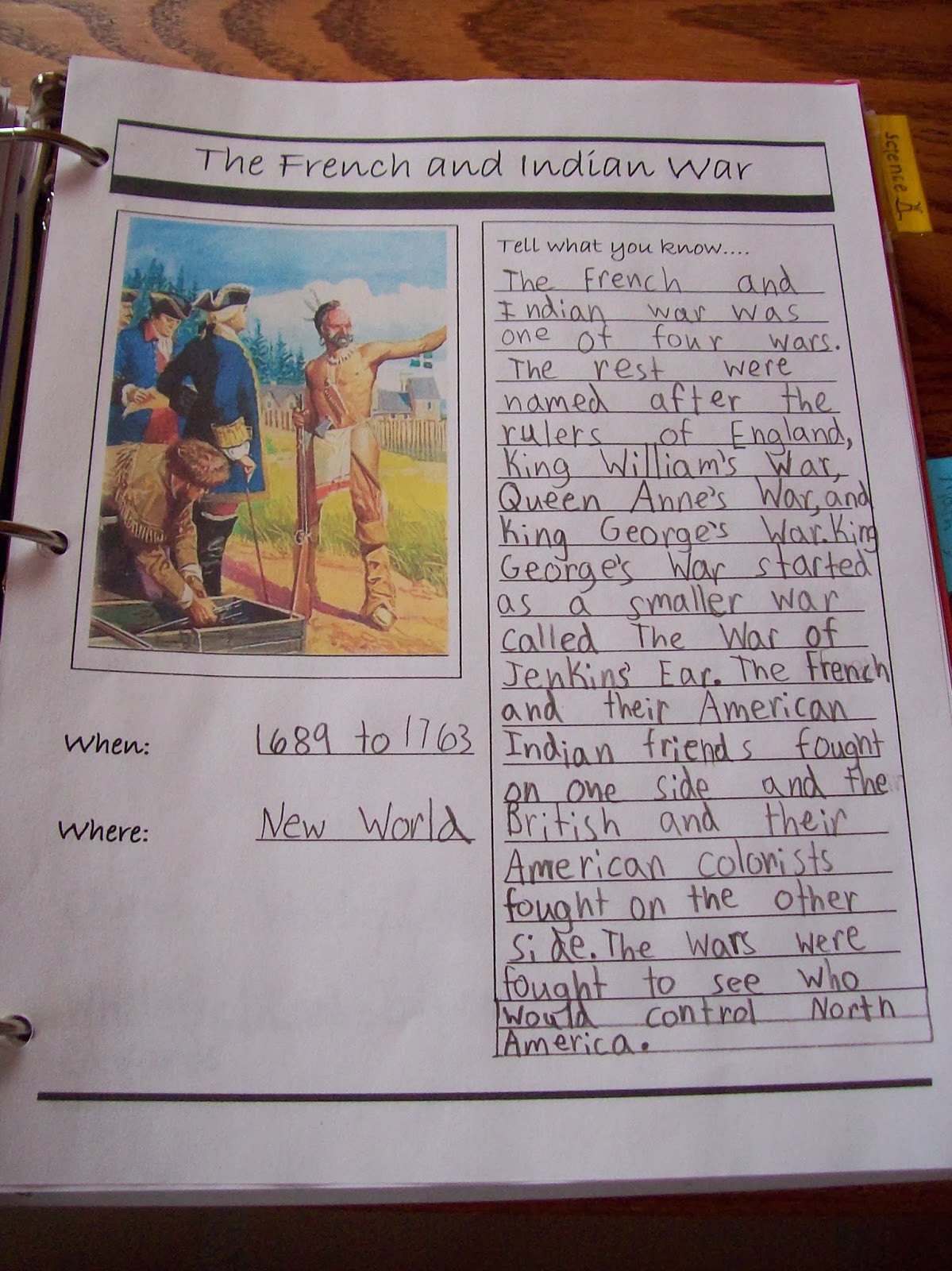
While studying The French and Indian Wars, I read aloud Struggle for a Continent by Betsy and Guilio Maestro. The French and Indian Wars took place from 1689-1763.  We learned that the wars were not in fact between the French and the Indians, but between the English and the French, who allied with the Indians and the Spanish.

I love Guilio Maestro's illustrations!  They are in depth, rich, and realistic.  Struggle for a Continent is one book in "The American Story Series" by the Maestros.  We have several others in the series, but have not read them yet.  However, based on our reading of Struggle for a Continent, I recommend the Maestro series.

Since the book covers four wars over a seventy year period, I spread the reading over several days.  After finishing the book, the kids each completed a notebooking page regarding The French and Indian Wars.  Ruben was still working on his when I took the photo.  He went on to write, "The French people joined forces with the Indians to fight the English for land in the New World.  The English won."

Thursday, March 27, 2014

Thursdays of Thanks....

After much thought, I've decided this will be my last regularly scheduled Thursdays of Thanks post.   I initially started this series as a way of holding myself accountable to keeping a gratitude list after beginning to read Ann Voskamp's One Thousand Gifts.  I now have a list of over 500 things to be thankful for :) ....but I feel keeping these posts has become a chore.  I have grown weary in my thankfulness.  Therefore, I have decided to continue my gratitude list personally and not scheduled publicly. I pray my thankfulness will be for the Glory or God and not for man. 

Thank you for your understanding....
Melissa


Ruben reading road side signs; Psalm 119; Long distance friends; 500 things to be thankful for; The thought of spring; Riley's excitement seeing her favorite nightgown clean; Farmers coming together.....

Saturday, March 22, 2014

Charlie's House.....

Charlie's House by Clyde Robert Bulla is a great read while studying indentured servant hood.  Charlie is a poor, homeless English boy, who is sold as an indentured servant in the New World.  Originally, he gets a nice master.  Unfortunately, his original master sells Charlie to pay off a debt.  After spending a short time with his new cruel master, Charlie runs away. I won't give away the ending, but, I will say it leaves you hanging.  We have read several of Bulla's books and enjoyed them all so far. 

You can read about Amos Fortune, Free Man here.  We read this book at the same time as Charlie's House.  Then the kids completed a notebooking page about slavery and indentured servant hood back in the 1700's as part of our Colonial History study.

Charlie's House is a fairly easy read that one may assign for student reading.  As follow up, a possible  language arts assignment may be to rewrite the ending of the story.  We recommend Charlie's House.


Thursday, March 20, 2014

Thursdays of Thanks....

Studying the life of Daniel and Rebecca Boone; Caledonia; Invite to church; Physics field trip; Dinner out with Riley and Ruben; Beautiful March day; A daughter asking me to go for a walk....

Monday, March 17, 2014

Amos Fortune, Free Man....

If the world could be like Amos Fortune, it would surely be a better place!  Elizabeth Yates' 1951 Newbery Medal winner, Amos Fortune, Free Man tells an amazing true story of a fifteen year old African Prince captured by slave traders and taken to Massachusetts Colony.  Although, Amos worked as a slave for forty-five years, he never gave up his dignity or hope.  His first owners were a Christian family that taught Amos to read the Bible.  Here he gained an unwavering faith and held an air of self-governance that carried him throughout his life into freedom and death.  Once free, he went on to help others gain their freedom.  He established himself as the best in his trade and became a respected business man.  Amos Fortune, Free Man tells of a man who persevered.  You will be inspired!

Saturday, March 15, 2014

Riley's Reviews - The Courage of Sarah Noble....

The Courage of Sarah Noble takes place in 1707.  It's about a young girl who is traveling with her father through the wilderness of the New World.  They are going to build a homestead on the land her father bought in Connecticut.  Before she leaves, Sarah's mother tells her to "Keep up your courage Sarah Noble".  But, Sarah has a hard time being brave on this new frontier.  The dark woods are filled with Indians and Sarah is afraid of them despite her father telling her they are friendly.  Along the way, Sarah learns that being brave even when you're afraid is really being courageous.  The Courage of Sarah Noble is a true story.

I read this book with my book club.  After discussion, we illustrated scenes from the story on butcher paper.  It was fun.  I recommend this book when you study American History or anytime you're looking for a good read! 

Thursday, March 13, 2014

Thursdays of Thanks....

Brunch with a friend; Human touch; Ruben's cardboard armor; Car wash; A ray of sun; Moving to Level 2; A nice day.....


Put on the full armor of God, so that you can take your stand against the devil's schemes.    

--Ephesians 6:11

Tuesday, March 11, 2014

Pirate Diary....

Pirate Diary The Journal of Jake Carpenter by Richard Platt is an excellent adventure story about life on board a pirate ship during the golden age of piracy in the eighteenth century. Young Jake Carpenter joins his uncle aboard a merchant vessel, the Greyhound, bound for the Caribbean.  But, when the Greyhound is taken over by pirates, Jake is forced to live the life of an outlaw.  Pirate Diary gives the account of the daily activities in the life of pirate.  The story is written in the form of a diary by 9-year old Jake Carpenter. 

Don't let the idea of pirate adventure give you an image for boys only.   The adventurous story line and lively illustrations will appeal to girls as well.  Pirate Diary gives an excellent account of piracy with historical accuracy.  It's historical fiction at its best!

While I was reading Pirate Diary, the kids worked on a notebooking page that I printed from New World Explorers Time Traveler CD-Rom by Homeschool in the Woods.  It's a little hard to tell from the photo, but each piece of pirate clothing and gear can be lifted to see the layers underneath.  The kids had fun with this and they turned out really well!

Monday, March 10, 2014

Riley's Reviews - Sarah Whitcher's Story....

Sarah Whitcher's Story is about a little girl who gets lost in the New Hampshire wilderness.  Her family are pioneers in the New World.  When little Sarah disappears, her family is very worried and starts to search for her with the help of settlers, neighbors, and friends.  Her father's trust in the Lord keeps her family steadfast in their search.  I don't want to give the ending away so I'll stop there.  Sarah Whitcher's Story is a New Hampshire folktale that holds truth about America's past.  It is a VERY GOOD book and I highly recommend it!  You'll be on the edge of your seat!

Saturday, March 8, 2014

Riley's Reviews - William Penn Friendly Boy....

William Penn is the story of a young boy, who later in life becomes a Quaker and founds Pennsylvania in the New World.  His father was an Admiral in the English Navy and he won a great battle against the Dutch.  The Admiral was hailed a hero and there were banquets in his honor.  But when he went back to sea after the celebration, he lost a battle and was put in prison.  It reminded me that pride goeth before a fall.

When William was growing up, a Quaker came to speak at his house.  When William got older, he met this man again and became a Quaker.  He gave up his finery to become a Friend of the Society.

After a while, the Quakers were persecuted  for their religious beliefs and they wanted to flee England.  The King owed William money.  It was decided to repay the debt, he would grant William a piece of land in the New World for the Quakers to have a safe haven.  Against William's wishes, the King insisted the land be called "Penn's Wood".  It later become know as Pennsylvania.

William believed all people were created equal.  He formed a peace treaty with the Indians in Pennsylvania and he founded Philadelphia.  It was called the "City of Brotherly Love" due to the Quakers love for all.

I recommend William Penn Friendly Boy by Miriam E. Mason.  It's one of the Childhood of Famous Americans books, which is an excellent series for young readers to study history. 

After studying William Penn, Ruben and I made wampum belts for our notebook.


Thursday, March 6, 2014

Thursdays of Thanks....


Pure white; Fuzzy pajamas; Pileated Woodpeckers; Surprise apple pie; Dinner with dad on his anniversary; Patterns in the snow; An adoption story.....

Saturday, March 1, 2014

Exploration & Early American History Term 1 Book List...


We've just begun the last term of our 2013-2014 school year and I've been looking back, reflecting on the good, bad, and ugly, as I look ahead to next school year.  We all love great living books and history is our favorite subject here so I will continue as usual with what we've been using.   You can read more about that here.  For now, I thought I'd share our entire Term 1 book list with you.  I read these books to our 3rd and 4th grader.  The books with asterisks (**) indicate books we did not read fully, rather we referenced or read sections from them. 

Brendan the Navigator by Jean Fritz
Leif the Lucky by D' Aulaire
The Vikings by Elizabeth Janeway (Landmark)
**America's Providential History by Beliles and McDowell
Marco Polo: Around the World Library by Webster-McGraw Hill
Columbus by D' Aulaire
**The Light and the Glory by Marshall & Manuel
Amerigo Vespucci, Scientist and Sailor by Ronald Syme
Discoverers & Explorers by Edward R. Shaw
Exploring the World: De Soto by Ann Heinrichs
Famous Explorers: Francisco de Coronado by Claude Hurwicz
**America's Story for American Children by Mara Pratt
**The Story of the Thirteen Colonies by H. A. Guerber
Virginia Dare by Augusta Stevenson (Childhood of Famous Americans)
Jamestown: The Beginning by Elizabeth Campbell
Blue Feather's Vision by James E. Knight
Exploring the World: John Smith and the Settlement of Jamestown by Robin Doak
This Dear Bought Land by Jean Lee Latham
With Pen & Sword: Adventures of Captain John Smith by Bradford Smith
A Lion to Guard Us by Clyde Robert Bulla
Pocahontas by D' Aulaire
**American Indian Prayer Guide (Sonlight)
Jamestown: New World Adventure by James E. Knight
Henry Hudson by Ruth Harley
Pocahontas and the Strangers by Clyde Robert Bulla