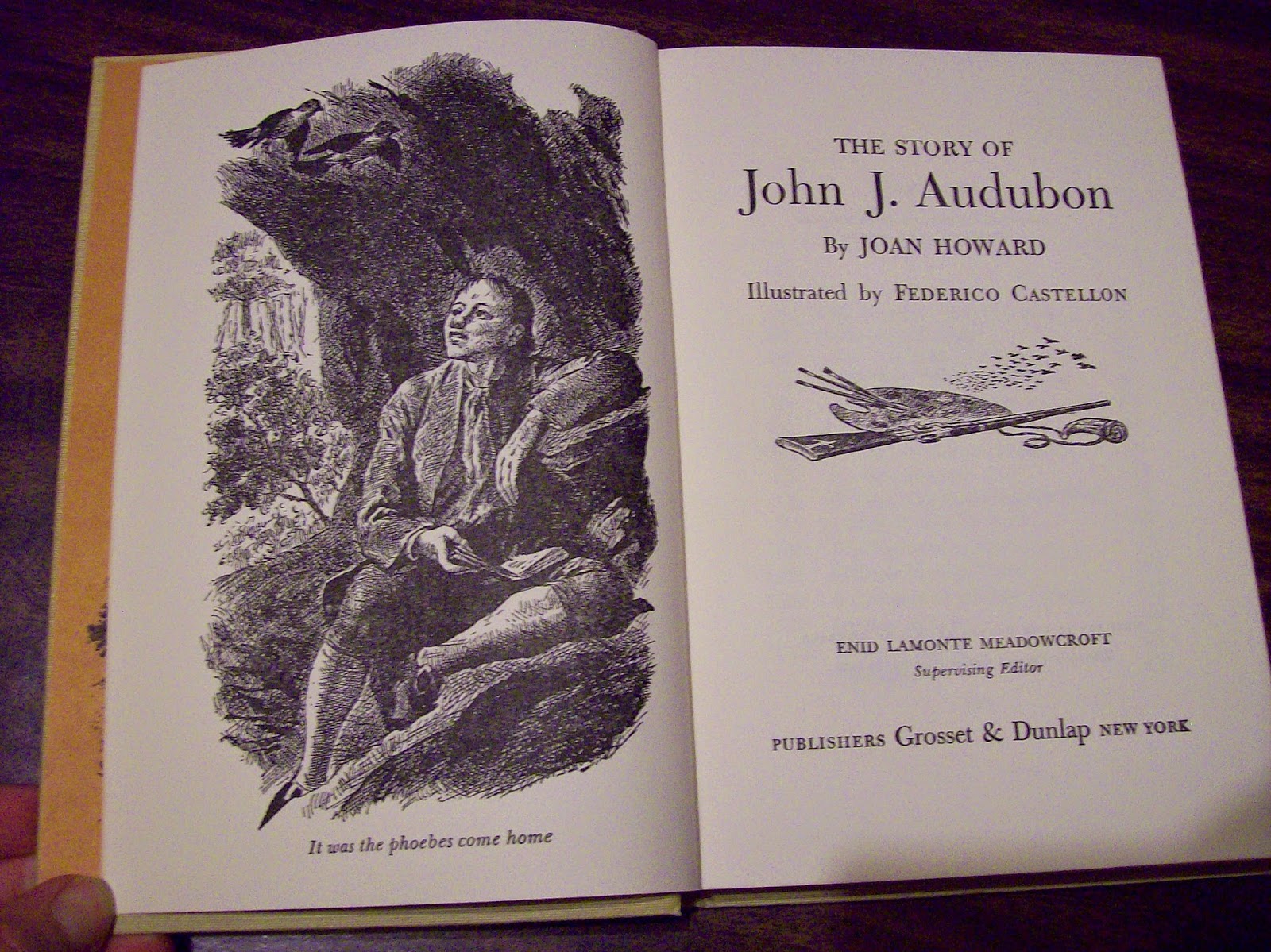
Last term, we studied Benjamin West and his work for our Artist/Picture Study. This term, we are studying John James Audubon. We started off reading The Story of John J. Audubon, which is a Signature Book by Joan Howard. I spent over a week reading the first five chapters aloud.
Initially, there was a small spark, but it just didn't catch fire. After some pondering with the kiddos, we decided to scrap it. Instead, reading The Boy Who Drew Birds: A Story of John James Audubon by Jacqueline Davies. It is recommended by both TruthQuest history and Beautiful Feet. Davies' book proved to be a suitable replacement. Obviously the picture book didn't afford the depth of the Signature Book. However, it provided an overview with a fascinating story and wonderful illustrations. Now that we have some history on Audubon, we will continue to study his drawings throughout the term using The Birds of America.
“For it is by grace you have been saved, through faith—and this not from yourselves, it is the gift of God— not by works, so that no one can boast.” -Ephesians 2:8,9
Monday, December 1, 2014
Friday, November 28, 2014
Term One Review - Including Book List 2014-2015
After having some minor panic attacks from feeling overwhelmed while planning last summer, I decided to cut back on the number of books we read per term. Instead, I'm working hard on choosing the best of the best. There really are many great books and a part of me still longs to read them all...ha! However, I was starting to feel burn out and that's a bad feeling!
Thankfully, our kids' favorite subject is still history and I want to continue to fuel that passion. I believe Beautiful Feet, TruthQuest, Veritas Press, and Sonlight can take much of the credit for this. Their book lists/suggestions haven't let us down. I will continue to pick and choose from their recommendations. Here were our 2014-2015 Term 1 read aloud picks...
The Story of Eli Whitney by Jean Lee Latham
Carry On, Mr. Bowditch by Jean Lee Latham
Benjamin West and His Cat Grimalkin by Marguerite Henry
A Head Full of Notions by Andy Russell Bowen
The Year of the Horseless Carriage by Genevieve Foster
The Louisiana Purchase by Gail Sakurai (Cornerstones of Freedom)
Open the Door to Liberty by Anne Rockwell
Diary of an Early American Boy by Eric Sloane
The Lewis & Clark Expedition by Richard L. Neuberger
The Story of Sacajawea, Guide to Lewis and Clark by Della Rowland
The Lewis and Clark Expedition by Peter F. Copeland (Dover Coloring Book)
My Name is York by Elizabeth Van Steenwyk (wonderful picture book about William Clark's slave)
The War of 1812 by Rebecca Stefoff
Old Ironsides: Americans Build a Fighting Ship by David Weitzman
James Madison by Mike Venezia (Getting to Know the U.S. Presidents)
Abigail's Drum by John A. Minahan
Cornstalks and Cannonballs by Barbara Mitchell
The Star Spangled Banner by Peter Spier
By the Dawn's Early Light by Steven Kroll
Samuel F. B. Morse: Artist - Inventor by Jean Lee Latham
Pioneer Plowmaker: A Story About John Deere by David R. Collins
Mill by David Macaulay - (We started this, but will not finish it at this time. The kids simply were not interested....and that's OK. Every now and then this happens. We usually make an honest attempt, but there are so many great books that I don't push through something they are not ready for.)
We are also doing our notebooks a little different this year. Rather than printing pages of activities, copywork, and coloring pages, I've resorted to composition notebooks. I do print an occasional page, but for the most part, Riley and Ruben create their own drawings. Copywork is taken from our reading. We like the way they're turning out....
After finishing our first twelve weeks of the 2014-2015 school year, we are taking a break this week to refresh, give thanks, and reevaluate our curriculum. Stay tuned for a few changes I am making....
Thankfully, our kids' favorite subject is still history and I want to continue to fuel that passion. I believe Beautiful Feet, TruthQuest, Veritas Press, and Sonlight can take much of the credit for this. Their book lists/suggestions haven't let us down. I will continue to pick and choose from their recommendations. Here were our 2014-2015 Term 1 read aloud picks...
The Story of Eli Whitney by Jean Lee Latham
Carry On, Mr. Bowditch by Jean Lee Latham
Benjamin West and His Cat Grimalkin by Marguerite Henry
A Head Full of Notions by Andy Russell Bowen
The Year of the Horseless Carriage by Genevieve Foster
The Louisiana Purchase by Gail Sakurai (Cornerstones of Freedom)
Open the Door to Liberty by Anne Rockwell
Diary of an Early American Boy by Eric Sloane
The Lewis & Clark Expedition by Richard L. Neuberger
The Story of Sacajawea, Guide to Lewis and Clark by Della Rowland
The Lewis and Clark Expedition by Peter F. Copeland (Dover Coloring Book)
My Name is York by Elizabeth Van Steenwyk (wonderful picture book about William Clark's slave)
The War of 1812 by Rebecca Stefoff
Old Ironsides: Americans Build a Fighting Ship by David Weitzman
James Madison by Mike Venezia (Getting to Know the U.S. Presidents)
Abigail's Drum by John A. Minahan
Cornstalks and Cannonballs by Barbara Mitchell
The Star Spangled Banner by Peter Spier
By the Dawn's Early Light by Steven Kroll
Samuel F. B. Morse: Artist - Inventor by Jean Lee Latham
Pioneer Plowmaker: A Story About John Deere by David R. Collins
Mill by David Macaulay - (We started this, but will not finish it at this time. The kids simply were not interested....and that's OK. Every now and then this happens. We usually make an honest attempt, but there are so many great books that I don't push through something they are not ready for.)
We are also doing our notebooks a little different this year. Rather than printing pages of activities, copywork, and coloring pages, I've resorted to composition notebooks. I do print an occasional page, but for the most part, Riley and Ruben create their own drawings. Copywork is taken from our reading. We like the way they're turning out....
After finishing our first twelve weeks of the 2014-2015 school year, we are taking a break this week to refresh, give thanks, and reevaluate our curriculum. Stay tuned for a few changes I am making....
Thursday, November 27, 2014
Commonplace Book....Tecumseh
When you rise in the morning, give thanks for the light, for your life, for your strength. Give thanks for your food and for the joy of living. If you see no reason to give thanks, the fault lies in yourself. - Tecumseh
Happy Thanksgiving from the gang on Drywood Creek!
Wednesday, November 26, 2014
By the Dawn's Early Light, The Story of the Star-Spangled Banner....
By the Dawn's Early Light is an unforgettable tale of how Francis Scott Key came to write "The Star-Spangled Banner". Steven Kroll's picture book seems to be an accurate account of this trying time in the history of our nation. I had no idea of the story behind the anthem and was utterly amazed by it. The words of the song took on a new meaning after reading By the Dawn's Early Light. And, not only is this a wonderful story, but Dan Andreasen's illustrations are absolutely gorgeous! This is a story that should be told and Kroll's book is a great way to do it. His book will captivate young and old Americans alike.
Tuesday, November 25, 2014
Old Ironsides, Americans Build a Fighting Ship....
Old Ironsides, Americans Build a Fighting Ship by David Weitzman gives a first hand account of the process used to build one of America's first navy frigates, the U.S.S. Constitution. The story is told through the eyes of John Aylwin, a boy whose father is one of the ship's carpenters, Weitzman's story will draw you in. His black and white illustrations are phenomenal.
Coming off last year's study of the American Revolution, Old Ironsides...was the perfect segue to learn about our new nation at the turn of the century. The process of building an American warship in the late 1790's was really quite amazing. The Constitution weighed in at 1,576 tons, carried 44 guns, and was made from more than 1,000 trees. Weitzman's description of selecting just the right oak trees for the masts, creating the casting of the cannon, and sewing more than two acres of sail are fascinating. I highly recommend this picture book!
Friday, November 21, 2014
The Year of the Horseless Carriage: 1801
For years, I've collected Genevieve Foster books. They're recommended on all the best reading lists. I even assign them to my children to read, but I confess, I had not taken the plunge myself. Oh, I've studied excerpts and read reviews, but I had not read one from cover to cover, until now, and I was pleasantly pleased.
The Year of the Horseless Carriage: 1801 by Genevieve Foster is a treat! Foster brings major world events from 1801-1821 together in an interesting, understandable fashion. These were the years of Napoleon's rise and fall. Who knew that he played such a major role in so many events around the world! From Richard Trevithick's "horseless carriage" to Robert Fulton's steam engine, from Thomas Jefferson's Louisiana Purchase to the Madison's and the War of 1812, and from Toussaint L'Ouverature's Haiti to Beethoven's symphonies, Napoleon's rule touched the lives of them all.
I look forward to reading more of Foster's books in the future! ....and so should you :)
The Year of the Horseless Carriage: 1801 by Genevieve Foster is a treat! Foster brings major world events from 1801-1821 together in an interesting, understandable fashion. These were the years of Napoleon's rise and fall. Who knew that he played such a major role in so many events around the world! From Richard Trevithick's "horseless carriage" to Robert Fulton's steam engine, from Thomas Jefferson's Louisiana Purchase to the Madison's and the War of 1812, and from Toussaint L'Ouverature's Haiti to Beethoven's symphonies, Napoleon's rule touched the lives of them all.
I look forward to reading more of Foster's books in the future! ....and so should you :)
Tuesday, November 18, 2014
Toppling Towers of Books....
Riley and I were book saling fools last week :) There were a couple of great used book sales in our area that we just couldn't pass up. We are now in the process of sorting and culling for our upcoming Christmas Sale....stay tuned for that.
Can you imagine Riley's dismay, after taking a break from sorting and stacking, when she came to find Levi's handwork in toppling and commingling her piles...YIKES! :(
Oh well, such is life here on Drywood Creek ;-) She has since resorted and stacked her piles.
A couple of books that I was especially excited to find were Henry David Thoreau, A Man For Our Time by James Daugherty and Badger Saints and Sinners by Fred Holmes. We are huge fans of Daugherty's work. This particular book of Thoreau's writing was selected and illustrated by Daugherty. I found the "Introduction" most fascinating.
Thoreau was born in 1817 in Concord, MA. He lived at a time when the American Constitution was young, Marcus and Narcissa Whitman were breaking ground for wagon trains heading west, the iron horse was pushing progress to the Mississippi, Yankee clipper ships were bringing back exotic cargo, and gold was discovered in California. To think, Thoreau's contemporaries, just to name a few, were Nathaniel Hawthorne, Herman Melville, Harriet Beecher Stowe, Walt Whitman, and Ralph Waldo Emerson. I was particularly intrigued by the last lines of the author's introduction (words in brackets are mine)....
"He (Thoreau) was a victim of consumption and bravely endured a long illness. In this last hours his aunt at his bedside asked that question always so dreadful to the Yankee soul: "Henry, have you made your peace with God?"
"I did not know that we had ever quarreled," he said."
In Badger Saints and Sinners, Holmes relates the adventures of people who helped shape Wisconsin history. The inside cover flap states, "Mr. Holmes has had a most extensive contact with the men, the places, the factual sources out of which this book was produced.....Mr Holmes knew personally many of the people he writes about." The book contains illustrations, maps, and photos archiving WI history. I'm excited to have what appears to be a primary source living book on the history of our state.
Oh the treasures! It's what I love about used sales, you just never know what you'll find!
Saturday, November 15, 2014
Charlotte Mason and the High School Years....
Yes, it is absolutely, positively possible to continue using Charlotte's methods through out the high school years! Sonya Shafer did an excellent job of pulling it together in the last SCM Learning and Living DVD. Shafer started off by reminding us to think about the big picture and to recommit our goals for each child in our homeschool. I loved the quote she used...
"But the function of education is not to give technical skill but to develop a person; the more of a person, the better the work of whatever kind." - Charlotte Mason
This is a powerful reminder that we are educating born persons, not simply checking boxes or cramming facts, but creating thinking persons with good habits and character, who can discern truth and beauty.
Shafer moved on to mention a couple of pitfalls we should avoid when teaching through the high school years. I must confess to being guilty right off the bat. I assigned too much reading too quickly, not allowing time to ruminate and think. I am coming to realize the value in a slower reading schedule. I hope to make adjustments in our future high school experiences.
Next, Shafer covered things that stay the same in a Charlotte Mason high school education. I can think of two things that fell by the wayside in our high school experience and they were oral narration and nature study. Angel did still orally narrate occasionally, but not because I required it. The narration was born out of excitement or a connection she made with a book she read. Nature study totally did not happen in high school. However, we were fairly new to CM's methods, therefore the habit wasn't developed early on so it was easy to drop. Again, hopefully, things will be different the next time around. Of course, Shafer also taught what changes in a CM high school.
Much of what Shafer covered regarding grades, calculating credits, and transcripts was review for me. I had previously posted quite a bit of the same information here.
A couple of things that I really appreciated about this DVD finale was when Shafer explained how a Charlotte Mason education does and does not prepare a student. The pros way out weighed the cons in my book. The cons were very minor and things you could easily discuss or walk through with your student near graduation such as how to use a textbook or how to take standardized tests, among other things. These are skills that certainly shouldn't take twelve years to teach. You should be able to give your student a brief 101 before graduation so they can practice these skills in college.
Sadly, our CM Study Group is finished meeting :( ...But, it was encouraging and fun to start building a Charlotte Mason community in my area. I heard many positive comments so I'm planning to continue with a Charlotte Mason book club in the new year, which I'm really looking forward to! We will read and discuss Charlotte's six volume series, which I'm sure will be the subject of many posts here :)
"But the function of education is not to give technical skill but to develop a person; the more of a person, the better the work of whatever kind." - Charlotte Mason
This is a powerful reminder that we are educating born persons, not simply checking boxes or cramming facts, but creating thinking persons with good habits and character, who can discern truth and beauty.
Shafer moved on to mention a couple of pitfalls we should avoid when teaching through the high school years. I must confess to being guilty right off the bat. I assigned too much reading too quickly, not allowing time to ruminate and think. I am coming to realize the value in a slower reading schedule. I hope to make adjustments in our future high school experiences.
Next, Shafer covered things that stay the same in a Charlotte Mason high school education. I can think of two things that fell by the wayside in our high school experience and they were oral narration and nature study. Angel did still orally narrate occasionally, but not because I required it. The narration was born out of excitement or a connection she made with a book she read. Nature study totally did not happen in high school. However, we were fairly new to CM's methods, therefore the habit wasn't developed early on so it was easy to drop. Again, hopefully, things will be different the next time around. Of course, Shafer also taught what changes in a CM high school.
Much of what Shafer covered regarding grades, calculating credits, and transcripts was review for me. I had previously posted quite a bit of the same information here.
A couple of things that I really appreciated about this DVD finale was when Shafer explained how a Charlotte Mason education does and does not prepare a student. The pros way out weighed the cons in my book. The cons were very minor and things you could easily discuss or walk through with your student near graduation such as how to use a textbook or how to take standardized tests, among other things. These are skills that certainly shouldn't take twelve years to teach. You should be able to give your student a brief 101 before graduation so they can practice these skills in college.
Sadly, our CM Study Group is finished meeting :( ...But, it was encouraging and fun to start building a Charlotte Mason community in my area. I heard many positive comments so I'm planning to continue with a Charlotte Mason book club in the new year, which I'm really looking forward to! We will read and discuss Charlotte's six volume series, which I'm sure will be the subject of many posts here :)
Tuesday, November 11, 2014
Commonplace Book....Carl Sandburg
"So came the birth of Abraham Lincoln that 12th of February in the year 1809 - in silence and pain from a wilderness mother on a bed of corn-husks and bearskins - with an early laughing child prophecy he would never come to much." - Carl Sandburg, Abe Lincoln Grows Up
Monday, November 10, 2014
Thanksgiving Picture Books
We're in for our first winter weather situation today here on Drywood Creek. It looks like our area is expecting about 12 inches of snow over the next 36 hours with blowing and drifting. What a great time to hunker down with a good book! With the season of giving thanks upon us, I thought I'd share some of our favorite Thanksgiving titles for young children.
On the Mayflower by Kate Waters
Across the Wide and Dark Sea by Jean Van Leeuwen
Squanto, Friend of the Pilgrims by Clyde Robert Bulla
Three Young Pilgrims by Cheryl Harness
Squanto and the Miracle Thanksgiving by Eric Metaxas
The Thanksgiving Story by Alice Dalgliesh
Giving Thanksgiving: The 1621 Harvest Feast by Kate Waters
Cranberry Thanksgiving by Wende and Harry Devlin - This is also a Five in a Row title. You can see the lapbook Riley completed here.
Stories of the Pilgrims by Margaret B. Pumphrey - We actually read the original version of this book online here.
What are your favorite Thanksgiving titles? Feel free to leave a comment below :)
Wednesday, November 5, 2014
The Lewis and Clark Expedition...
The Lewis & Clark Expedition by Richard L. Neuberger is a Landmark book originally copyrighted in 1951, recommended and reprinted by Sonlight. The story is high adventure and easy to read, covering the expedition from start to finish and hitting a few highlights in between. I did feel it was a little choppy as sometimes each chapter was a new story, but overall, we enjoyed the book.
We read other Lewis and Clark books at the same time and on a couple of occasions, facts came into question when compared. One area of contention was whether or not a compass was lost when the boat overturned. Some books give Sacajawea credit for saving the compass, one book even mentioned the compass being on display today at the Smithsonian historical museum, however, Neuberger's book stated the only compass on the expedition was lost forever. These types of discrepancies were minor annoyances to the kids and I.
In general, I think Neuberger's is a good overview of the expedition, particularly for younger children, knowing that you'll be covering this topic again in the future. However, I would caution against using it as an exclusive resource.
On a positive note, the last two chapters of Neuberger's book gave some follow-up to the expedition that other resources didn't. Specifically, the welcome received upon their return, as well as some of the main character's lives after the expedition. We found the speculation surrounding Lewis' death somewhat fascinating and ended up doing further research.
You can read more about the other books we used for our Lewis and Clark study through Beautiful Feet by clicking here.
Monday, November 3, 2014
Pulling Your Charlotte Mason Education Together...
The 11th DVD in the Simply Charlotte Mason Learning and Living series is titled "Putting It All Together". Shafer reviewed some basic CM principles including short lessons, the habit of attention, and varying the order of subjects. She then talked about scheduling your day. The information was practical. A couple of tips I found helpful and currently use when scheduling our school day are, work in outside commitments first and schedule everything else around them, and alter book learning with oral lessons.
For example, we currently travel Monday and Wednesday afternoons for Ruben's tutoring. When scheduling, I purposely allowed for a lighter load on those days knowing we would need to be done early. I also scheduled a light day or catch up time on Fridays honoring The Farmer's wish for a four day school week. Sometimes our "school" spills over into our everyday life, including Saturday and Sunday. In our home, "Education is an atmosphere, a discipline, a life." Though we do try to get the bulk of our book learning done before noon on the weekdays, education has become our way of life and does not fit into a Monday through Friday box.
Regarding varying the order of subjects, Charlotte altered oral subjects and book learning subjects. You can view sample schedules from Parents' Union School on the Ambleside website by clicking here. You will notice by looking at Monday on the Class I schedule, which I assume to be early elementary, the students started with Old Testament. This would have been a Bible reading to the students, followed by oral narration (book learning). Then the students moved to Printing (handwriting), then Poem Repetition (oral subject), and French, which also would have been oral at this age, listening and speaking. At 10:00, we see Number, which was math (book learning), followed by Drill or Dancing. I assume this to be Swedish Drill which involved movement. At 10:50, the students practiced their reading lessons (combination of book learning and hands on), followed by Natural History or as we say, Science, which again was more than likely a read aloud with narration. By varying the order of subjects, Charlotte naturally encouraged the use of different parts of the brain for learning.
The photo above shows cards that I downloaded from the Simply Charlotte Mason site here. You need to scroll down to "Planning" and click "Download your own copy of the subject cards used in the video". I printed them on cardstock for durability. You can also make headings on Post It Notes, rather than printing the cards, and use them the same way. I found there were not enough of some subjects and too many of others so you may prefer to write your own. For example, our family loves history and we prefer to study it 4-5 days per week, however, there were only 3 history cards on the print out, so I created extra history cards on index cards. One other note regarding the cards, there are only cards for group or family studies. Things like Math and Reading instruction or other individual subjects are not included.
The idea of the cards is to lay them out to get ideas for scheduling and to practice varying the order of subjects. I am a big picture kind of person so this was helpful to me. I like to be able to see it and move it around before it's "written in stone", for lack of a better phrase. Varying the order of subjects is a brilliant concept to me and it seems to work well, particularly with Ruben. I've also been very cognoscente of using short lessons with him.
You can view our term one schedules and checklists on some of these former posts...
Year 5 Sample Schedule
Year 4 Sample Schedule
Year 4 & 5 Checklists
I can tell you some of the best laid plans don't always come to fruition. We have already scrapped a couple of subjects on the plan because I wasn't organized enough or didn't make time to gather the resources or they just plain didn't work for that child. Riley loves her checklist and Ruben despises it. He already gave it back stating it was too confusing. I think the key thing when planning no matter what method you use, is flexibility, let your plan be your slave and not your master. If it's not working, try something else.
One last resource I'd like to mention regarding planning is also from Simply Charlotte Mason. It's titled Planning Your Charlotte Mason Education in Five Simple Steps. I purchased an older copy a couple years back and it's been very helpful.
What sorts of resources or ideas to you use to plan your CM education? Feel free to leave comments below.
Saturday, November 1, 2014
Studying Lewis & Clark with Beautiful Feet....
Last year, we started Beautiful Feet's Early American History for Intermediate Grades. I used it primarily for RileyAnn and then used the Primary Grades guide for Ruben. Because we ended our history study with the American Revolution, we didn't finish the guides. So this year, I'm picking up our history study with Lewis & Clark, finishing up the Intermediate Guide with both, Riley and Ruben.
I really love Beautiful Feet Study Guides. The simplicity of the open and go especially attracted me back this year. Yet, the intellectual stimulation is far from simplistic. The guides provide map work, narration opportunities and copywork. The questions are thought provoking. And, the book choices are absolutely fabulous!
A couple of the suggested books we read while studying Lewis and Clark were The Story of Sacajawea, Guide to Lewis and Clark by Della Rowland and The Lewis and Clark Expedition by Peter F. Copeland. The later is a Dover Coloring book, which I used to pull copywork from. The kids also used the illustrations for inspiration in their notebook drawings. Copeland's book is a TruthQuest History recommendation as well.
Rowland's book tells the story of Sacajawea while she served as guide to The Corps of Discovery beginning in 1804. It's quite amazing to think she was only sixteen years old when she set out with Lewis and Clark on their journey, with an infant on her back. The Story of Sacajawea... provides an excellent over view of the expedition, throughout which, Sacajawea shows real strength and courage.
Here are a few of Riley and Ruben's notebook pages covering this subject...
Wednesday, October 29, 2014
Carry On, Mr. Bowditch...
I've been reading Carry On, Mr. Bowditch by Jean Lee Latham aloud to the children before bed. We finished it last week.
Carry On, Mr. Bowditch is the story of Nathanial Bowditch, the founder of modern maritime navigation, quite possibly a subject we may not have been interested in studying. However, after reading another Latham book, This Dear Bought Land, we are excited to try all things Latham...and I'm so glad we did!
Nathaniel Bowditch (Nat) was an extremely intelligent man. He is often touted as a mathematical wizard. After his mother's death, Nat's father indentured him to a ship chandlery. Nat was devastated as he hoped to one day go back to school, but being indentured for nine years at age twelve, he knew his dreams of education were lost. Rather than sulk, Nat spent all his free time self educating. He studied Latin, French, Portuguese, Spanish, and Mathematics, among other things. I will not give away the ending, but suffice to say Nathaniel Bowditch was an inspiration and excellent role model!
We recommend Carry On, Mr. Bowditch. It is also a TruthQuest and Sonlight recommendation.
Carry On, Mr. Bowditch is the story of Nathanial Bowditch, the founder of modern maritime navigation, quite possibly a subject we may not have been interested in studying. However, after reading another Latham book, This Dear Bought Land, we are excited to try all things Latham...and I'm so glad we did!
Nathaniel Bowditch (Nat) was an extremely intelligent man. He is often touted as a mathematical wizard. After his mother's death, Nat's father indentured him to a ship chandlery. Nat was devastated as he hoped to one day go back to school, but being indentured for nine years at age twelve, he knew his dreams of education were lost. Rather than sulk, Nat spent all his free time self educating. He studied Latin, French, Portuguese, Spanish, and Mathematics, among other things. I will not give away the ending, but suffice to say Nathaniel Bowditch was an inspiration and excellent role model!
We recommend Carry On, Mr. Bowditch. It is also a TruthQuest and Sonlight recommendation.
Thursday, October 23, 2014
Oat Bran Applesauce Muffins...
I recently tried this new recipe off the Hodgson Mill Oat Bran Cereal box for Oat Bran Applesauce Muffins...
1/2 cup brown sugar, packed
1 1/2 Hodgson Mill Oat Bran Cereal
1 1/2 cups unbleached white flour
1 1/2 teasp baking powder
1 1/2 teasp baking soda
1/2 teasp salt
2 eggs
1 cup applesauce, chilled
4 Tbsp vegetable oil
Preheat over to 400-degrees. Grease 12 muffin pan. Blend together dry ingredients. Add eggs, chilled applesauce, and oil. Mix until well blended. Spoon batter into muffin cups. Let stand 10 minutes. Bake 15 minutes or until golden brown. Yield 12 muffins
We paired them with grapes for breakfast and the kids LOVED them! They were very delicious. I typically make my own applesauce so I can choose the apples and control the sugar. With the apple harvest in full swing, these muffins make an excellent treat on cool autumn mornings.
Tuesday, October 21, 2014
Reflections on a Charlotte Mason Education...
At our last CM Study Group meeting we reflected on our Saturday morning of CM style studies. After being led by Sonya Shafer of Simply Charlotte Mason through Natural History, Arithmetic, World History, Singing, Repetition, Writing, and Spanish, my two words for describing a CM education are "useful" and "challenging".
It occurred to me that Charlotte taught in a manner that showed each subject's usefulness in life. For example, Natural History was studied to build a love of God's creation and our natural surroundings, as well as learning about plants, animals, birds, weather, seasons, etc. I believe along with the study of Natural History, comes the habit of appreciation, attentiveness, creativity, and a desire to know...why are male birds more brightly colored than female?...why do leaves change color in fall?....etc. Also, in Arithmetic we used multiplication and division to figure answers to problems relevant to our lives. We memorized scripture for Repetition, which is certainly useful. We copied a meaningful quote for penmanship, not just a row of a's, b's, c's, etc. Each subject seemed to have a deeper meaning than just checking a box to get it done. I was actually left with thoughts to ponder from the day's studies.
A CM education is also challenging. I don't mean this in a frustrating sort of way, but in a fun sort of way. I was challenged almost as if I were playing a game or working on a puzzle that I couldn't wait to solve or watch come to fruition. It was a fun and meaningful challenge that left me with a positive anticipation for more. It also left me wanting to share my excitement, such as a child with a new found treasure.
The more I learn about a Charlotte Mason education, the more I know it's right for our family. In fact, I want to go back and relearn using Charlotte's methods...ha! I'm so excited for this opportunity to teach and learn beside our children!
It occurred to me that Charlotte taught in a manner that showed each subject's usefulness in life. For example, Natural History was studied to build a love of God's creation and our natural surroundings, as well as learning about plants, animals, birds, weather, seasons, etc. I believe along with the study of Natural History, comes the habit of appreciation, attentiveness, creativity, and a desire to know...why are male birds more brightly colored than female?...why do leaves change color in fall?....etc. Also, in Arithmetic we used multiplication and division to figure answers to problems relevant to our lives. We memorized scripture for Repetition, which is certainly useful. We copied a meaningful quote for penmanship, not just a row of a's, b's, c's, etc. Each subject seemed to have a deeper meaning than just checking a box to get it done. I was actually left with thoughts to ponder from the day's studies.
A CM education is also challenging. I don't mean this in a frustrating sort of way, but in a fun sort of way. I was challenged almost as if I were playing a game or working on a puzzle that I couldn't wait to solve or watch come to fruition. It was a fun and meaningful challenge that left me with a positive anticipation for more. It also left me wanting to share my excitement, such as a child with a new found treasure.
The more I learn about a Charlotte Mason education, the more I know it's right for our family. In fact, I want to go back and relearn using Charlotte's methods...ha! I'm so excited for this opportunity to teach and learn beside our children!
Monday, October 20, 2014
Benjamin West and his Cat Grimalkin...
Benjamin West and his Cat Grimalkin by Marguerite Henry is the story of a Quaker boy who has an extraordinary gift. West grew up in 1700's Pennsylvania territory . He could paint realistic pictures and portraits. The problem was Quaker's viewed picture making as belonging to this world and the things of this world.
Finally Papa place the drawing on the table. "The image of Sally should be carried in our hearts," he said, as he looked up over the rims of this spectacles. "Not on a piece of paper. Pictures fade; memories remain green forever." p. 42
Henry's story delightfully tells West's boyhood story. Benjamin West went on to become the Father of American painting. This book is recommended by Beautiful Feet and TruthQuest.
Saturday, October 18, 2014
Our New Project...
Introducing.....Molasses, our new Jersey calf. You may remember that the Farmer wanted to sell the sheep so he could use the pasture for a new project....raising calves. We came upon this little Jersey bull and I just couldn't resist!
We've had Molasses for a couple of weeks and boy is he finicky! We are learning you can't feed Jersey calves just any old milk replacer. We had to purchase specially formulated milk replacer for Jerseys. Unfortunately, he's currently recovering from scours as it's difficult to figure the proper ration. A couple years ago, I told you about Clarabelle, Riley's Jersey heifer calf that died. We are just hoping and praying Molasses fares better.
The kids LOVE Molasses, especially Levi....
Do you have experience raising Jersey calves? I'd love to hear about it! Feel free to leave a comment below.
We've had Molasses for a couple of weeks and boy is he finicky! We are learning you can't feed Jersey calves just any old milk replacer. We had to purchase specially formulated milk replacer for Jerseys. Unfortunately, he's currently recovering from scours as it's difficult to figure the proper ration. A couple years ago, I told you about Clarabelle, Riley's Jersey heifer calf that died. We are just hoping and praying Molasses fares better.
The kids LOVE Molasses, especially Levi....
Do you have experience raising Jersey calves? I'd love to hear about it! Feel free to leave a comment below.
Consider This....
Have you heard?...Karen Glass's new book Consider This: Charlotte Mason and the Classical Tradition is finished! I've been intrigued by this project for some time. The notion of Charlotte Mason being a classical educator came to mind while reading Teaching the Trivium: Christian Homeschooling in a Classical Style by Harvey and Laurie Bluedorn. There are definite differences between a Charlotte Mason education and a classical education. However, since researching Charlotte's methods more in depth, I'm finding more similarities than I would have once thought. I'm looking forward to reading Glass's book in hopes of gleaning a greater understanding of these similarities and differences.
Find out more about "Launch Week" and sign up to win a free copy here!
Thursday, October 16, 2014
Saturday, October 11, 2014
Diary of an Early American Boy....
Diary of an Early American Boy by Eric Sloane is so awesome, the kids asked for a sequel!
While exploring an old house, Sloane discovered a small leather-bound diary written in 1805. The diary was written by a fifteen year old boy named Noah Blake. It was a one year account of life on his father's farm. After researching early American life in that region, Sloane wrote Diary of an Early American Boy based on Noah's journal. The author included original diary entries and then wrote a story around them. The illustrations are outstanding showing many early American tools and explaining how things were done at that time.
Diary of an Early American Boy is a Sonlight and TruthQuest recommendation that I almost skipped. Then one day, I sat down and started reading the Author's Note and realized the treasure I held. I started reading it aloud to the kids and we were all hooked. We learned a great deal and highly recommend this book!!
While exploring an old house, Sloane discovered a small leather-bound diary written in 1805. The diary was written by a fifteen year old boy named Noah Blake. It was a one year account of life on his father's farm. After researching early American life in that region, Sloane wrote Diary of an Early American Boy based on Noah's journal. The author included original diary entries and then wrote a story around them. The illustrations are outstanding showing many early American tools and explaining how things were done at that time.
Diary of an Early American Boy is a Sonlight and TruthQuest recommendation that I almost skipped. Then one day, I sat down and started reading the Author's Note and realized the treasure I held. I started reading it aloud to the kids and we were all hooked. We learned a great deal and highly recommend this book!!
Wednesday, October 8, 2014
Changes to American Girl...for Better or Worse?
Have you heard about the new changes to American Girl? They've changed the historical doll outfits and created the Beforever line. RileyAnn is quite upset. In fact so much so, that she wrote a letter to the president of the company...
Dear American Girl,
In all due respect, I would like to tell you what I think of your new "Beforever" products. I think that they are cheap, unauthentic, and above all I do not think that they are the highest quality that you can make. For a long time, I believed that you put your best effort in the making of your products, but now with the launch of "Beforever", I think that you have "dumbed down" American Girl. I think that your new "Beforever" girl outfits are very unmodest. I also think that your new mini dolls look terrible and very cheap. I am very sorry if I have been too negative about "Beforever". I just thought that you would like to know my opinion.
Sincerely,
RileyAnn
I don't normally blog about these sorts of cultural, current event issues. However, I must confess, in looking through the catalog with Riley, I also was disappointed. The historical character outfits have been changed. They appear to reflect modern times with extremely short dresses and skirts and tank top built in shirts for the matching girl outfits. I wonder if Pleasant Rowland, original founder of American Girl Co., would approve of these changes?! I found her reasoning for creating American Girl quite interesting. It's my belief that she created the dolls, not only to get girls interested in history, but also to fill a need for life like dolls for girls ages 8-12.
As a mom of a tween, I always appreciated the modest innocence of American Girl. In addition, Riley learned so much about American History at a very young age from simply reading the books. She knew most of the major time periods and could associate many happenings. She actually taught me, ha!
I'm sure the change was a marketing ploy, but I wonder if they upset the integrity of American Girl by making the change? I'd love to hear your thoughts....
UPDATE...RileyAnn received a lovely letter back from AG. She realizes her opinion is that of a perch in the ocean. However, she still felt the need to express her thoughts.
Monday, October 6, 2014
A Charlotte Mason Morning of Study...
Our Charlotte Mason Study Group met Saturday morning to participate in SCM Learning and Living DVD's 7 & 8. We studied Natural History (Science); Arithmetic w/Drill; World History; Music/Singing; Repetition (Scripture Memory); Writing (Copywork); and Spanish. It was a great experience in which to participate.
Some comments from participants were, "We have really been dumbed down!"..."I feel inadequate teaching this."..."I feel ripped off that I didn't have this type of education." It was quite interesting. Overall, I believe everyone enjoyed it and found it very beneficial.
I feel the most difficult part of a Charlotte Mason education for me as a participant was narration. Because of distractions, I often have to read and re read passages several times to get the gist of it, especially with classic or older literature and in a room full of people...apparently, I have a poor "habit of attention". I find that because I'm accustomed to reading so much aloud to the children, I have better comprehension reading aloud. This is awkward and not practical in a room full of people. I can definitely see starting with small passages with beginning narrators and working up.
I'm looking forward to meeting again this Friday to reflect on our learning experience!
Some comments from participants were, "We have really been dumbed down!"..."I feel inadequate teaching this."..."I feel ripped off that I didn't have this type of education." It was quite interesting. Overall, I believe everyone enjoyed it and found it very beneficial.
I feel the most difficult part of a Charlotte Mason education for me as a participant was narration. Because of distractions, I often have to read and re read passages several times to get the gist of it, especially with classic or older literature and in a room full of people...apparently, I have a poor "habit of attention". I find that because I'm accustomed to reading so much aloud to the children, I have better comprehension reading aloud. This is awkward and not practical in a room full of people. I can definitely see starting with small passages with beginning narrators and working up.
I'm looking forward to meeting again this Friday to reflect on our learning experience!
Friday, October 3, 2014
Beautiful Feet American and World Modern History for Intermediate Grades
I am so excited to learn that Beautiful Feet has created a follow-up to their Early American History for Intermediate Grades guide!!
We started using the EAH last year to cover America's Discovery and Settlement; Colonial & Pre-Revolutionary America; and The American Revolution. I used the guide as an accompaniment to our TruthQuest American History for Young Students I study.
This year, I'm continuing the EAH BF guide, covering The Louisiana Purchase and The Civil War. This time period is the same as TQ AHYS II, 1800-1865.
Next year, I can use the NEW BF American and World guide alongside TQ AHYS III, covering 1865 to modern times.
Now, I must tell you, both TruthQuest and Beautiful Feet are totally stand alone programs and do not need supplementation!! However, I am a self proclaimed curriculum junkie ;-) I love to pull from, combine, and create my own program to match the learning styles of our kiddos.
Last year, I used TQ as my spine and supplemented with BF. This year, after a difficult summer, I became overwhelmed with the planning. Therefore, I decided to use BF as my spine and supplement with TQ. They are both AWESOME programs and you really can't go wrong with either one! I find most, if not all, the BF books are listed in the TQ guides.
I recognize many of the titles in the NEW BF A&W guide and have most on our shelves, some being Sonlight books. As you can see from the photo above, my BF EAH guide is an older one. It does not use A Child's First Book of American History so I'm wondering how it will match up with the new A&W guide. Looking at the book titles, there may be some overlap, but that's OK. We can either by pass a section or chalk it up as review. Either way, I'm super excited to see the new BF guide!
You can read more about it on the BF Blog here.
We started using the EAH last year to cover America's Discovery and Settlement; Colonial & Pre-Revolutionary America; and The American Revolution. I used the guide as an accompaniment to our TruthQuest American History for Young Students I study.
This year, I'm continuing the EAH BF guide, covering The Louisiana Purchase and The Civil War. This time period is the same as TQ AHYS II, 1800-1865.
Next year, I can use the NEW BF American and World guide alongside TQ AHYS III, covering 1865 to modern times.
Now, I must tell you, both TruthQuest and Beautiful Feet are totally stand alone programs and do not need supplementation!! However, I am a self proclaimed curriculum junkie ;-) I love to pull from, combine, and create my own program to match the learning styles of our kiddos.
Last year, I used TQ as my spine and supplemented with BF. This year, after a difficult summer, I became overwhelmed with the planning. Therefore, I decided to use BF as my spine and supplement with TQ. They are both AWESOME programs and you really can't go wrong with either one! I find most, if not all, the BF books are listed in the TQ guides.
I recognize many of the titles in the NEW BF A&W guide and have most on our shelves, some being Sonlight books. As you can see from the photo above, my BF EAH guide is an older one. It does not use A Child's First Book of American History so I'm wondering how it will match up with the new A&W guide. Looking at the book titles, there may be some overlap, but that's OK. We can either by pass a section or chalk it up as review. Either way, I'm super excited to see the new BF guide!
You can read more about it on the BF Blog here.
Wednesday, October 1, 2014
The Story of Eli Whitney
I had no idea Eli Whitney was such a fascinating man!! We just finished reading The Story of Eli Whitney by Jean Lee Latham. The book tells of Eli's life from childhood through adulthood.
After a late start to college by 1700's standards, Eli graduated from Yale. After college, he traveled to Georgia, where he met Catherine Greene, Revolutionary Hero Gen. Nathanael Greene's widow. Ms. Greene and her plantation manager, Phineas Miller, persuaded Eli to manufacture a cotton engine (gin). With the delay of the cotton gin's patent due to the Yellow Fever epidemic that hit Philadelphia, our nation's capital at that time, folks were pirating Eli's invention. Once the patent finally came, Eli fought and lost over sixty infringement battles before finally securing the rights only a short time before the patent expired.
In the interim, he obtained a government contract to mass produce interchangeable parts for muskets. Though there was a delay in the completion of the order, Eli was able to eventually successfully meet the contract. According to the story, Whitney's interest in muskets stemmed from a childhood friendship with a man killed in the Revolutionary War because of a broken musket hammer. I'm thinking that part of the story may be fictional, but I couldn't confirm it one way or another.
Due to his dedication to engineering, Eli married late in life. The Story of Eli Whitney ends after Eli's marriage and the birth of his first child. I was so enthralled by Latham's book that I did a little further research only to find that Eli died at age 59 of prostate cancer, leaving his widow with four young children.
Throughout his life, Whitney rubbed elbows with a number of prominent people, including Thomas Jefferson. Latham describes one scene in the book where Whitney is in the Executive Building in Washington. He has conversation with Meriweather Lewis, Jefferson's secretary. Both Jefferson and Lewis reference the Louisiana Purchase. However, Whitney doesn't put two and two together until a time later.
The Story of Eli Whitney helped me make many historical connections. Latham portrayed Whitney as a kind, generous, hardworking genius. It appears he is also a great role model. I highly recommend this book!
Subscribe to:
Posts (Atom)