Showing posts with label Classical Education. Show all posts

Monday, August 19, 2019

Journey: An Education for Life Retreat - Registration is Open!!


I've been busy working behind the scenes on school and retreat planning. I'm so excited to announce that registration is now open for Journey: An Education for Life retreat!! Join us, Saturday, October 19th for a day of homeschool encouragement and Christian Classical Charlotte Mason inspired camaraderie in West Central Wisconsin. Encounter ideas on mother culture, how to cultivate rhythm in your day, and spark a love of learning. Find renewed energy to start the year strong and continue throughout your homeschool journey.

Terri Woods, homeschool mom of 9 from Alabama will be our feature speaker. She has over 20 years experience home educating and has spoke at several homeschool events, including Wild+Free. You can find her on Instagram at https://www.instagram.com/woodsermom/ and https://www.instagram.com/field_and_forage/ I will be speaking as well. You can register, see the schedule, and read speaker bios here. I'm still finalizing a couple breakout sessions, but will post those as soon as information becomes available. 

Lunch will be provided with regular and gluten free options. Living books will be available for purchase. Door prizes will be given. Thirty minutes will be allowed between sessions for transition, networking, brainstorming, bonding, and discussion among participants. I hope this retreat will be a day of encouragement, inspiration, calming, and fun for all involved. I'd LOVE to meet you there!!

Saturday, July 28, 2018

High School Science Planning....


Once again, I'm back studying high school science...or maybe I should say still studying, since I never really stopped. Last summer I wrote a post on Rethinking Science: Aiming Toward Scientific Literacy. You can consider the present post part two as I continue to think about high school science while planning Riley's Year 9.
"What exactly do you mean by science?" 
This is a question posed by Kevin Clark and Ravi Scott Jain in The Liberal Arts Tradition. The modern word "science" stems from the Latin word "scientia", which in the ancient world, meant "knowledge" or to know. In Understanding Physics, Isaac Asimov begins by explaining the history of modern day science...
The scholars of ancient Greece were the first we know of to attempt a thoroughgoing investigation of the universe - a systematic gathering of knowledge through the activity of human reason alone. Those who attempted this rationalistic search for understanding, without calling in the aid of intuition, inspiration, revelation, or other nonrational sources of information, were the philosophers (from Greek words meaning "lovers of wisdom").
Philosophy could turn within, seeking an understanding of human behavior, of ethics and morality, of motivations and responses. Or it might turn outside to an investigation of the universe beyond the intangible wall of the mind - an investigation, in short, of "nature."
Those philosophers who turned toward the second alternative were the natural philosophers, and for many centuries after the palmy days of Greece the study of the phenomena of nature continued to be called natural philosophy. The modern word that is used in its place - science, from a Latin word meaning "to know" - did not come into popular use until well into the nineteenth century. Even today, the highest university degree given for achievement in the sciences is generally that of "Doctor of Philosophy."
The word "natural" is of Latin derivation, so the term "natural philosophy" stems half from Latin and half from Greek, a combination usually frowned upon by purists. The Greek word for "natural" is physikos, so one might more precisely speak of physical philosophy to describe what we now call science.
The term physics, therefore, is a brief form of physical philosophy or natural philosophy and, in it is original meaning, included all of science.
However, as the field of science broadened and deepened, and as the information gathered grew more voluminous, natural philosophers had to specialize, taking one segment or another of scientific endeavor as their chosen field of work. The specialties received names of their own and were often subtracted from the once universal domain of physics.  
Here we see how modern science has come to be known by it's name. According to online Oxford Dictionaries, science is:
the intellectual and practical activity encompassing the systematic study of the structure and behavior of the physical and natural world through observation and experiment
Science can be split into two main categories, biological and physical, but often both are related. Biological meaning the study of living things and physical being the study of non-living things. There are various branches of science within each of these categories.

Biological studies would include:

Biology - the study of life and living things
Ecology - the study of ecosystems
Botany - the study of plants
Physiology/Anatomy - the study of the human body and how it functions
Zoology - the study of the animal kingdom

Physical studies would include:

Physics - the study of matter and energy in space and time
Chemistry - the study of chemical elements and compounds
Astronomy - the study of outer space and everything in it
Meteorology - the study of atmosphere, or more specifically, weather phenomonea
Geology - the study of the earth's physical structure and substance
Oceanography - the study of physical and biological properties of the sea

This is not an exhaustive list by any means and you may have noticed that some of these sciences overlap. For example, oceanography not only includes studying the physical properties of the sea, but also the living/biological plants and creatures as well. In addition, there are social sciences, including anthropology, sociology, and psychology. There are also fields related to the sciences, such as medicine, mathematics, computer science, statistics, engineering, and alchemy.

The point here being, what used to be known simply as natural philosophy has now become numerous branches of science, but in many cases, they are still inter related. Therefore, it's a shame to compartmentalize them academically as so many modern schools do. As a matter of fact, Clark and Jain tell us that not only should the sciences be studied together along with a mathematical point of view, but also with a linguistic point of view, also known as the seven liberal arts.
A foundation in the seven liberal arts provides the common reason which is required to adjudicate the truth of arguments and justify or demonstrate the claims of reason. Natural philosophy offers students today a critical opportunity to hone their arts of reason in discussions of the natural world. When all the arts are employed, natural philosophy teaches students to think properly and promotes true wisdom. (The Liberal Arts Tradition)
This is very much in line with Charlotte Mason's holistic approach to education, which includes viewing the child as a born person, spreading a feast, and allowing for the science of relations through the use of living books and nature study.  
The only sound method of teaching science is to afford a due combination of field and laboratory work, with such literary comments and amplifications as the subject affords. (Vol. 6, p. 223)
It is for these reasons that I am choosing a multitude of books and resources for high school science, rather than one single text. The list for 9th grade includes:

Signs and Seasons by Jay Ryan
Galileo's Daughter by Dava Sobel
Great Astronomers by Robert Stawell Ball
Conceptual Physics by Paul G.Hewitt
A Briefer History of Time by Stephen Hawking
Napoleon's Buttons Penny Le Couteur and Jay Burreson
A Chemical History of the Candle by Michael Faraday
Phineas Gage: A Gruesome But True Story of Brain Science by John Fleischman
First Studies in Plant Life by George Francis Atkinson
Adventures with a Microscope by Richard Headstrom
Microbe Hunters by Paul de Kruif


In looking at the stack, you will notice books on Astronomy, Physics, Chemistry, Biology, and Botany. Several of these books are continued from last year and a few will be continued next year. Riley will also complete a combination of field and lab work through nature study and experimentation. In addition, she will continue the method of notebooking through her readings. Our aim is to provide a feast of ideas presented in a variety of books and activities so our children can see the relationships within the order that God created. Overall, we are excited about the year to come!

Monday, November 20, 2017

Classical Academic Press - Review & Giveaway! Latin Alive 1

Today I'm hosting a guest post from Carol at Journey and Destination and giveaway from Classical Academic Press....

'Hardly any lawful price would seem to me too high for what I have gained by being made to learn Latin and Greek.' 
C.S. Lewis


Some background
I’d always wanted our children to study Latin but, like many other home educators, I had no background in the language myself, unless the medical terminology I learned years ago counts. I’ve attempted Latin with all seven of my children but, like our French language learning, I spent quite a bit of money on curriculum that either wasn’t comprehensive enough, too difficult for me to teach or for them to use independently, or it was dull and lifeless. This was most noticeable around the ages of about 11 or 12 years when they were ready for a challenge, could handle the grammar, but also needed a creative, lively approach.

I started using French for Children by Classical Academic Press (CAP) with my daughter nearly two years ago just before she turned eleven & she loves it. She had also been studying Latin using some resources we already had, some of which were good introductions to the language, but as time went on she started to complain about the lack of explanations, that the material was boring, and that it all seemed rather pointless. This was the same scenario I faced with her older siblings. One day she said, “If Latin was taught like my (CAP) French I wouldn’t mind learning it.” Enough said.

Classical Academic Press kindly provided me with a free Latin Alive!1 bundle to use and review. This is our sixth week of using this approach and I’m very pleased with how much my daughter is actually enjoying Latin. Here are my honest thoughts on the curriculum and how we are using it:

Latin Alive! Book 1 by Classical Academic Press is the first in a series of three texts designed for about 7th to 8th Grade students and up. It is the next step after CAP's Latin for Children but it is also suitable for students with no previous Latin knowledge and the DVD’s allow the student to work independently. (see video samples on YouTube) 

My 12-year-old finds it challenging but not overwhelming. This is partly due to the grammar she has covered in her French studies and her ability to think more logically now that’s she’s older.

Classical Academic Press recommends that younger students follow one of two options, depending on their academic level (see their FAQ): 


1)      Complete all three Latin for Children Primers (Levels A–C), then start Latin Alive! Book 2
2)      Complete Latin for Children Primers A and B, then move into Latin Alive! Book 1.

I did consider using Latin for Children C before commencing Latin Alive! 1 and I have to admit that I was a little overwhelmed when this curriculum arrived and I started looking through it. I thought perhaps I'd made the wrong decision. Latin Alive! is extremely comprehensive and chock-a-block full, but after going through the introductory section of the first DVD, it was much less daunting. Now that we’re six weeks in, I’m confident that it’s an ideal fit for my daughter.

Latin teacher, Karen Moore, shares her own story of learning Latin on the first DVD: she explains how her love of Latin developed after her mother made her take Latin in Year 7, and why the study of Latin is relevant to us today. This was so good for my daughter to hear as well as being an encouragement to me.

The Latin Alive! bundle:

•    36 weekly chapters - 29 of these contain new material, the others are review

•    A section is included at the back of the Student Edition listing vocabulary chapter by chapter and reference charts for declensions etc

•    Latin Alive! Level 1 Teacher’s Edition - 323 pages; includes the complete student text & answer keys. The answer key to each chapter is found at the end of each chapter in the Teacher’s Edition; Student pages directly correspond with the Teacher’s pages

•   Teacher's Extras in the back of the book contain various worksheets, projects and seven unit tests to be given after the unit review chapters are included

•    Latin Alive! 1 - DVD & CD set with over fifteen hours of teaching on seven DVDs. The audio CD contains unit review Latin readings so that students can practice proper pronunciation and accent. The DVDs use the Classical pronunciation and a streaming option is also available

What Latin Alive! looks like in real life:

•    Each of the 7 DVD’s in Latin Alive 1 contain between three to five chapters, and each chapter is about 30 to 50 minutes long.

•    We decided to cover one chapter per week over three days. This usually takes about 15 to 30 minutes per day, although some additional time may be added for writing exercises. My daughter also keeps a Latin Notebook where she writes definitions or other material she wants to remember. It might be better for some students to spread the lesson over the week but this works best for us at present.

Last week we completed Chapter 5 and this is how it looked:

Day 1: Watched a section of the video that went over new vocabulary and explained transitive and intransitive verbs. The video teacher directs the student to stop the video and complete exercises in the student book as they go through the chapter together. Wrote definitions in Latin notebook.

Day 2: Continued with the DVD, going back where necessary to review the previous day’s explanations. Learned about the accusative case and direct object and completed assigned exercises. Finished watching the video for the chapter.

Day 3: Chapter reading - these readings started in Chapter 4 and at the beginning consisted of short sentences in Latin about Greece and Troy. By the time the student reaches Chapter 7, the readings are about two paragraphs long. Read the Culture Corner, a short section to help the student learn about the culture and history of the Romans. Derivative Detective - found a derivative for amat, nautical and specta Collaquamur or ‘Let’s Talk’ - used some questions and responses to review nouns; used ‘eye’ Latin to try to identify words.

I asked my daughter to say what she liked about this curriculum and this was her response:

Well laid out 
It doesn’t assume you know all your grammar, but teaches you everything step by step
Good teacher, explains things well 
Teaches you how to pronounce words properly
Nice music

The Student and Teacher editions plus the DVD & CD set include everything you need for this course, although it is suggested that you have access to a Latin/English dictionary. Here are some free online versions:

Lexilogos 
Online Latin

A support page for Latin Alive! is provided on the CAP website.

The only negative comment I have to make is that the Latin Alive! 1 text has recently been revised but the DVD won't be updated to match the text until next year. I understand that this primarily affects Chapter 1 and that CAP has created an errata sheet for families to use in the meantime. This wasn't an issue for us as it was only a matter of page or exercise numbers and it only took a few seconds to find the correct one.

Classical Academic Press is giving away three Latin Alive! 1 bundles to entrants with a USA residential address. Enter the Giveaway via the Rafflecopter widget below.

A 20% discount off the purchase of any Latin Alive product is available with the discount code LAJourney1 throughout the course of the giveaway for anyone to use.

If you order from CAP with the 20% off and then win the giveaway, you will be refunded.

Giveaway ends at midnight on December 5th. Winners will be contacted by email. Winners who do not respond by the deadline given in the winners’ email will be replaced by random drawing.

a Rafflecopter giveaway

Thank you, Classical Academic Press, for supporting this Giveaway. Learn more about them and their excellent products at the Classical Academic Press website. 

Monday, October 30, 2017

Sparking Ideas With a Variety of Books and a Lecture...


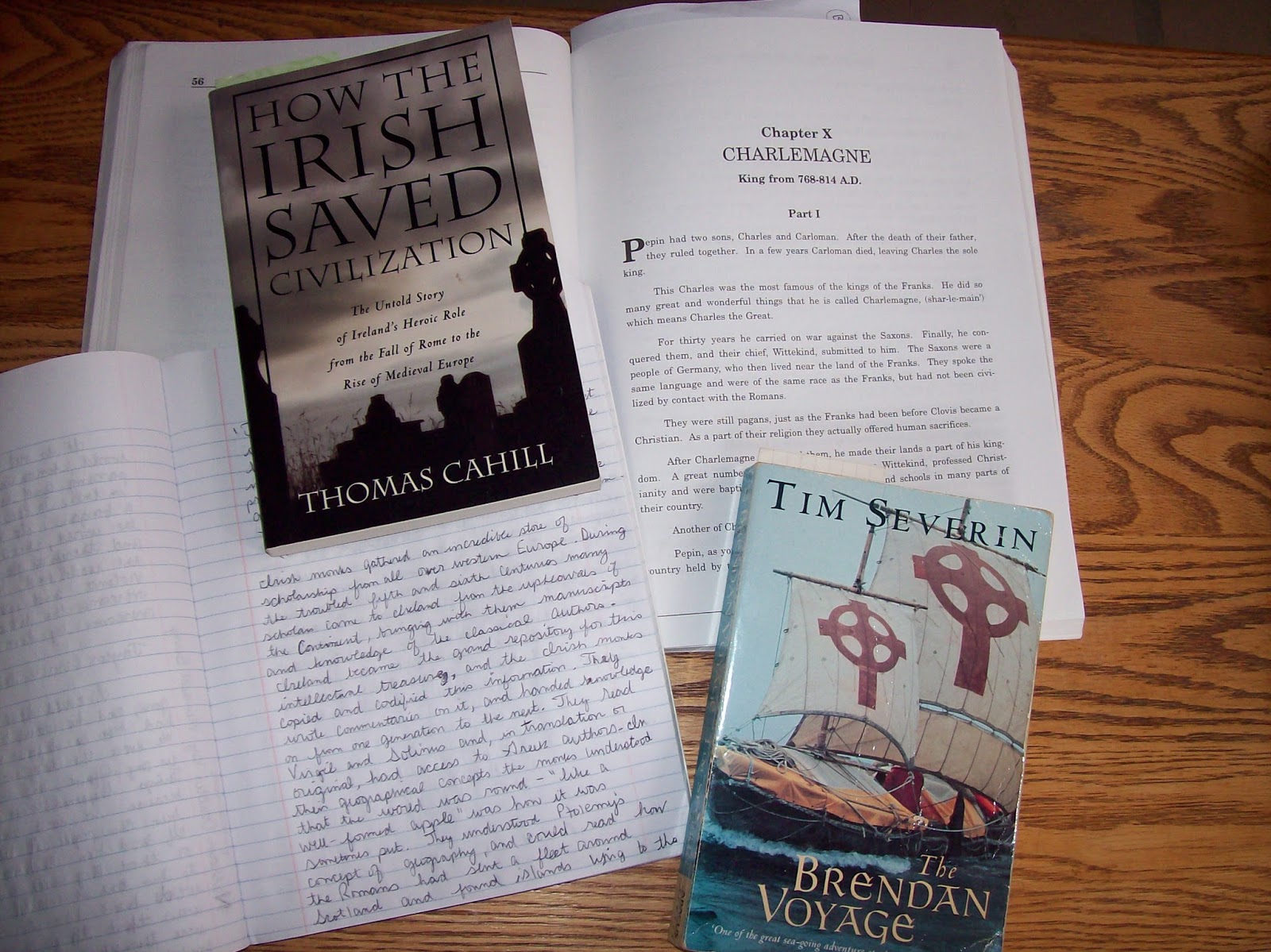
Last week I read this aloud in our morning time....
Irish monks gathered an incredible store of scholarship from all over western Europe. During the troubled fifth and sixth centuries many scholars came to Ireland from the upheavals of the Continent, bringing with them manuscripts and knowledge of the classical authors. Ireland became the grand repository for this intellectual treasure and the Irish monks copied and codified this information. They wrote commentaries on it, and handed the knowledge on from one generation to the next. They read Virgil and Solinus and, in translation or original, had access to Greek authors. In their geographical concepts the monks understood that the world was round - "like a well-formed apple" was how it was sometimes put. They understood Ptolemy's concept of geography, and could read how the Romans had sent a fleet around Scotland and found islands lying to the north. The flowering of early Christian culture in Ireland, about which so much has been written, was a process that lasted almost five hundred years. Irish monks were acknowledged to be the best-educated and best-informed men in all the western Europe; and in due course they set out to carry their knowledge back into the mainland. They founded schools, advised kings and even emperors (Charlemagne was a great admirer of Irish learning) and established monasteries from Lombardy to Austria. They and their pupils were regarded as Europe's wandering intelligentsia. As a Frankish observer put it, "Almost all Ireland, despising the sea, is migrating to our shores with a flock of philosophers." - The Brendan Voyage by Tim Severin, p. 80
Immediately, it brought me back to a talk by Dr. Christopher Perrin at the CiRCE Regional Conference last January titled something like: The Monastery School: How Classical Education was Preserved and Extended for Almost 1000 Years (and what we can learn from it). Dr. Perrin talked about an idea he got from C. S. Lewis in regard to sometimes when we have lost our way, the quickest way back is to return home. He went on to talk about going back to the monastic tradition to learn from them in an effort toward a classical education renewal, relating this idea of going back to go forward. One of the books Dr. Perrin referenced was How the Irish Saved Civilization by Thomas Cahill, which I happened to find at a library sale after. It has been on my shelf since. However, after reading that quote in The Brendan Voyage and looking back at my notes from Dr. Perrin's lecture, I have moved it to the bedside and am looking forward to reading it soon in an attempt to learn more about Irish academia in the monasteries and the preservation of Western civilization.

Also, in reading Ruben's history lesson last week, the chapter in Famous Men from the Middle Ages was about Charlemagne, who is also mentioned in the quote above from Severin's book. Because of that history reading, I understood who Charlemagne was and the significance of him being mentioned in the quote. Instantly, I was reminded how Education is the Science of Relations and how important it is to spread a wide feast for our children. My relations were sparked by a series of ideas obtained through a lecture and variety of reading. Had I not been exposed to Dr. Perrin's talk and a variety of books, I would not have had those ideas which prompted my desire to learn more about the scholars of Ireland.

Wednesday, August 9, 2017

Early Bird Registration is Ending for the Journey Retreat with Cindy Rollins...


Check out these door prizes, compliments of CiRCE Institute for....

Journey: An Education for Life

There's only three days left until early bird registration ends for Journey: An Education for Life! Don't delay, get your tickets while they're hot! Join us for a day of home education encouragement and camaraderie as we welcome Cindy Rollins, author of Mere Motherhood and A Handbook to Morning Time and co-host of The Mason Jar podcast, to WI on Saturday, September 23, 2017. 

Early bird pricing is $45, but after Sat, Aug 12th, the price goes up to $60. Registration will not be accepted at the door. A working schedule with descriptions and bios is as follows:


Schedule


8:30 a.m. Registration Opens

9:00 a.m. Keynote – Melissa Greene

10:30 a.m. Reflections on a Charlotte Mason Inspired Education – Gretchen Houchin

12:00 p.m. Lunch (provided)

1:00 p.m. Teaching Through Literature and Living Books – Melissa Greene

2:30 p.m. Charlotte Mason in Real Life: Courage for the Long Haul – Cindy Rollins

4:00 p.m. Q & A Panel Discussion – Cindy Rollins, Gretchen Houchin, and Melissa Greene


Session Descriptions


Keynote: The keynote will include a brief introduction to and comparison of Charlotte Mason and Classic Education. There will be highlights of several key principles of Mason's philosophy and what that looks like in the day to day, as well as her methods used and how to incorporate them.

Reflections on a Charlotte Mason Inspired Education: Encouragement from a retired homeschool mom with practical examples of what worked and what didn't. The focus will be on high school and older students, but will blend with methods used in the younger years to build the foundation for the upper.

Teaching Through Literature and Living Books: Description and examples of living books and practical application on how to use them in your homeschool to cover a variety of subjects. Book lists and suggestions will be shared.

Charlotte Mason in Real Life: Courage for the Long Haul: Find joy in the realities of homeschooling when the romance fades. Thoughts on what truth, goodness, and beauty look like in real life. Strategies will be given for the long haul.

Q & A Panel Discussion: All three speakers will be together answering questions from attendees regarding home education in real life.


Speakers


Cindy Rollins is a mom of nine with over thirty years of homeschooling experience. For more than ten years, she blogged her way through her efforts to homeschool under the principles of Charlotte Mason and classical education. Today, Cindy is an occasional contributor athttps://www.circeinstitute.org/, the co-host of The Mason Jar podcast on the CiRCE Institute Podcast Network, & the 2016 recipient of the Russell Kirk Paideia Prize, awarded for a lifetime spent cultivating wisdom and virtue. Cindy is the author of Mere Motherhood and A Handbook to Morning Time. She lives in Chattanooga, TN with her husband Tim and however many children happen to be home.

Gretchen Houchin is a retired homeschool mom of two boys, ages 21 and 18. the oldest was homeschooled through graduation and the youngest through 8th grade. Her homeschool was inspired by the Charlotte Mason method. She enjoys sharing her experiences with others and encouraging them in their homeschool endeavors.

Melissa Greene is a mother of five, who's been homeschooling since 2007. She has two graduates, one through homeschool and the other through public school. She is currently home educating her three youngest children. Melissa enjoys reading, cooking, and being with her family. She spends her free time studying different philosophies of education, facilitating a Charlotte Mason Study Group, and blogging athttp://reflectionsfromdrywoodcreek.blogspot.com/. There you will find ideas for planning your homeschool, book lists for reading, and thoughts about education through daily living. You can also find her on Instagram athttps://www.instagram.com/melissaondrywoodcreek/


Space is limited so sign up here now....

Wednesday, July 5, 2017

Rethinking Science: Aiming Toward Scientific Literacy...

I've been doing a great amount of research on science in regard to how it was studied by Charlotte Mason's students and other educators of the past in an effort to determine how to proceed forward as we near the high school level in our homeschool. Educators of modern science tend to focus exclusively on texts throwing in a few experiments. There is little field work and virtually no living books are used. The teaching of modern science is compartmentalized or divided out into the different branches of science.

In the past, educators used a more, what I would call, holistic approach to teaching science. There was copious amounts of field work or nature study. Journals were kept of each student's findings. Books written by naturalists, scientists' biographies, natural histories, and other scientific literature were used, rather than texts. In Vol. 6, A Philosophy of Education, Charlotte Mason said,
Books dealing with science as with history, say, should be of a literary character, and we should probably be more scientific as a people if we scrapped all the text-books which swell publishers' lists and nearly all the chalk expended so freely on our blackboards. (p. 218)
In addition, science educators of the past didn't separate or label the branches of science as is modern practice here in the U.S. For example, following the track of my local high school, a student is required to take three credits of science to graduate. Based on course offerings, a student's middle and high school science studies could look something like this:

7th grade - General Science
8th grade - Physical Science
9th grade - Physical Science A & B
10th grade - Biology A & B (required)
11th grade - Chemistry A & B
12th grade - Environmental Biology or AP Science Courses (optional)

As you can see, each year, the student studies a different branch of science. Once a particular branch is studied, it is most likely not revisited. The sciences are segregated by topic. Also, once entering high school, it's possible, that a student's science study involves classroom time only, never once stepping foot in the out-of-doors for any type of field study.

On the contrary, in Charlotte's schools, students studied the various branches of science concurrently, often having several streams of science going at one time. According to Nicole Williams of Sabbath Mood Homeschool,

  • CM was doing at least 4 different sciences at the same time - nature study, nature lore, which turned to biology in Form III, and science, which was more than one science topic at the same time
  • Over the course of high school, students generally read 17 books, breaking down to 3-4 per year (7 on biology/botany; 5 on earth sciences; and 5 on physics/chemistry/history of inventions)
  • Streams of science were not broke down by grade/age like modern (physical science in 9th grade, biology in 10th grade, etc.), but rather students studied multiple sciences each year - more comprehensive

Charlotte said,
The study of natural history and botany with bird lists and plant lists continues throughout school life, while other branches of science are taken term by term. (Vol. 6, p. 220)
Charlotte continued the study of botany and biology throughout. She further stated,
The only sound method of teaching science is to afford a due combination of field and laboratory work, with such literary comments and amplifications as the subject affords. (Vol. 6, p. 223)
Based upon Charlotte's words, we should be using science books of literary character, studying a variety of branches/streams of science term by term, and making sure to include lab and field work.

In addition, I've recently been reading a reprinted/updated edition of Science Matters, Achieving Scientific Literacy by Robert M. Hazen and James Trefil. In which, they make several good points. One being an explanation of scientific literacy and why it's so important.
For us, scientific literacy constitutes the knowledge you need to understand public issues. It is a mix of facts, vocabulary, concepts, history, and philosophy. It is not the specialized stuff of the experts, but the more general, less precise knowledge used in political discourse. If you can understand the news of the day as it relates to science, if you can take articles with headlines about stem cell research and the greenhouse effect and put them in a meaningful context - in short, if you can treat news about science in the same way that you treat everything else that comes over your horizon, then as far we we are concerned you are scientifically literate. (Introduction, p. xii)
Next, they admit their statement will be argued by some scholars. But most likely, it will be due to the following misunderstanding,
...that doing science is clearly distinct from using science; scientific literacy concerns only the latter. (Introduction, p. xii)
This is where I believe Hazen and Trefil are on to something that relates to Ms. Mason. Some of our students will go on to discover new scientific breakthroughs. However, many will not. Either way, we should avoid a utilitarian education in an attempt to persuade or steer our students toward a particular profession. Rather we should provide a broad and generous curriculum filled with living ideas that allow our students to use science in the day to day. Our aim should be scientific literacy.

If we look back to the work of Aristotle, DaVinci, Newton, Galileo, and the like, they weren't in a class room reading a text. Actually, they weren't even called scientists, but rather philosophers, astronomers, and mathematicians. These men were out in nature making observations, keeping journals of things they saw. They were studying the sky and testing theories, writing down their findings in notebooks. Charlotte Mason was also a huge proponent of nature note books and science journals. She said,
Certainly these note books do a good deal to bring science within the range of common thought and experiences; we are anxious not to make science a utilitarian subject. (Vol. 6, p. 223)
As students are out and about in the field, studying nature and revering God's creation, they will begin making connections between what they've read in their literary books, learned through their lab work, and observed in the natural world. This is what Charlotte referred to as the Science of Relations, through which, the student will make connections between what they are seeing, hearing, smelling, touching, and reading. They will learn a little bit about all the different branches of science.

In A Philosophy of Education, on page 222, Charlotte references the words of Sir Richard Gregory in his Presidential Address in support of, "affording children a wide syllabus introducing them at any rate to those branches of science of which every normal person should have some knowledge." Charlotte is advocating for scientific literacy as opposed to utilitarian teaching. She continues after the quote by saying,
The only sound method of teaching science is to afford a due combination of field and laboratory work, with such literary comments and amplifications as the subject affords....As a matter of fact the teaching of science in our schools has lost much of its educative value through a fatal and quite unnecessary divorce between science and the 'humanities.' (p. 223)
Not only shouldn't we separate the different branches of science from themselves, but we should not separate them from the 'humanities', the study of literature, philosophy, art, etc. Interestingly, Hazen and Trefil advocate for the same type of integrated bits of knowledge.
To function as a citizen, you need to know a little bit about a lot of different sciences - a little biology, a little geology, a little physics, and so on. But universities (and, by extension, primary and secondary schools) are set up to teach one science at a time. Thus, a fundamental mismatch exists between the kinds of knowledge educational institutions are equipped to impart and the kind of knowledge the citizen needs. (p. xviii - Introduction)
Based on my research and fruit from past practice with my children, I will continue to study science throughout high school using books of literary character, scientists' biographies, natural histories, nature study, and field work. I will draw from Charlotte's writings, Ambleside Online, Sabbath Mood Homeschool, and a variety of other sources for ideas. Scientific literacy should be our goal in science teaching.

Saturday, July 1, 2017

ANNOUNCING...Journey: An Education for Life...

I'm sorry I've been absent this week, but I think it's for a good cause. You see, I've been working diligently on a new home education conference and I'm so excited to announce it's finally here!!!


Join us for a day of homeschool encouragement and Christian Classical Charlotte Mason inspired camaraderie. Encounter ideas on how to cultivate rhythm in your day and spark a love of learning. Find renewed energy to start the year strong and continue throughout your homeschool journey.

Saturday, September 23, 2017


8:30 a.m.   Registration Opens
9:00 a.m.   Keynote – Melissa Greene
10:30 a.m. Reflections on a Charlotte Mason Inspired Education – Gretchen Houchin
12:00 p.m. Lunch (provided)
1:00 p.m.   Teaching Through Literature and Living Books – Melissa Greene
2:30 p.m.   Charlotte Mason in Real Life: Courage for the Long Haul – Cindy Rollins
4:00 p.m.   Q & A Panel Discussion – Cindy Rollins, Gretchen Houchin, and Melissa Greene
  

Not all those who wander are lost. – J. R. R. Tolkien

That's right! Cindy Rollins, author of Mere Motherhood and A Handbook for Morning Time is coming to WI. You can get all the details and register here. Hurry, early bird registration ends Aug 12, 2017 and space is limited! Please spread the word!

Wednesday, March 22, 2017

Reflections from Consider This - Chapters 10-12 and Beyond...


This will be the last post in the series, in which, I share my thoughts on Consider This, Charlotte Mason and the Classical Tradition by Karen Glass. You can find related posts on previous chapters linked below...

Introduction and Chapter One

Chapter Two

Chapter Three

Chapter Four

Chapter Five

Chapter Six

Chapters Seven through Nine

Chapter 10

Chapter ten of Consider This invites us to a clearer understanding of some classical education terminology. Glass spends time defining the words: university, trivium, and quadrivium. Of course, the trivium being grammar, logic, and rhetoric, three of the seven liberal arts. It's important to understand that the word trivium translates to "3 roads", which are to be taken simultaneously, or as Glass states, "a trivium may be understood as a three-way crossroad", not consecutively. The trivium is not aligned or tied to stages of development. It is part of a much greater whole, of which, Glass asserts, Charlotte expected her students to practice through a variety of exercises in their lessons. Also, Glass maintains that the trivium is in deed a set of skills or arts, and that Charlotte Mason implemented them in her program.
If we can get a vision of grammar, logic, and rhetoric not as subjects to be studied but as arts to be practiced and refined in the process of reading, narrating, and writing, we can see how beautifully Charlotte Mason's methods may be considered a synthetic implementation of the trivium of classical instruction, more especially when the ultimate goal of forming character and virtue is recalled. (p. 86)
Grammar, logic, and rhetoric may be employed synthetically, together, to make the most of every book, through the simple process of reading and narrating, while incidentally examining a grammatical construction or rhetorical trope - perhaps a metaphor - along the way.
Many of the exercises Charlotte Mason suggests for making use of schoolbooks fall within the realm of logical and rhetorical instruction. That is, she expects her students to employ logic and understand rhetoric devices, and to be able to express themselves adequately - to practice the liberal arts. (p. 87-88)
The quadrivium, being astronomy, geometry, arithmetic, and music should also be studied alongside each other as in "a four-way crossroad", as well as alongside the trivium. Together, these seven subjects or skills make up the seven liberal arts. Interestingly, according to Glass, the seven liberal arts were not ever intended for elementary students.
First of all, the seven liberal arts were not intended to be a course of study for elementary school-children, but rather for university students. The ancient universities of Europe were founded, either during the late medieval or Renaissance era, to pursue those arts. To be sure, students sometimes enrolled in universities as young as age twelve or thirteen, so we may consider the seven liberal arts appropriate for our high school students, but the seven liberal arts were historically a university course. (p.84) 
Chapter 11

Glass begins Chapter eleven by quoting Charlotte Mason on "applied philosophy" from her Vol. 3 School Education. Below are some questions that came to mind while reading this chapter were....

What is the link between principles and practices?
As she developed her methods, Charlotte Mason kept in mind the principle that a child's mind is a living organism that requires a varied diet. She made sure that her methods introduced children to every vital area of knowledge, so that their mental diet would be so nutritious as a well-conceived menu plan. (p. 96)
Principles and practices definitely go hand in hand. I remember listening to Schole Sisters Podcast #10 Which Comes First? The Principles or the Practical? in which Brandy, Mystie, and Pam unpacked the relationship between principles and practices.

In the quote above, Glass is specifically referring to Charlotte's Principle 12 on The Science of Relations, which was a principle Glass also referenced in Chapter 5. If the mind is a living organism, which requires a varied diet, living books were a part of that nutrition. Books were also at the center of classical education as a means to accomplish the classical ideal. One must have ideas in order to discuss ideas.

Glass goes on to give examples of how Charlotte provided nourishment through other subjects and areas of study, such as bible, history, literature, science, and geography.
In laying a wide and varied feast of knowledge before her pupils, Charlotte Mason was encouraging them to form relationships for themselves with their fellow man through literature and history, and with the natural world around them. In spite of the variety of books that appeared on her programs, she never lost sight of the synthetic understanding that all knowledge is connected, and she desired that the children should grow to understand that for themselves. (p. 102)
As an aside, I have often wondered about history and its place in the liberal arts tradition. On page 99, Glass writes,
History was not a traditional part of classical education. It is not, of course, one of the seven liberal arts. However, most contemporary educators who are interested  in the classical tradition, which is historical in itself, find that history is an area of knowledge - actually a framework for other knowledge - that must not be neglected. We desire to read the works of the thinkers of the past, and in order to fully appreciate their thoughts, we need to know something of the times that they live in, the forces that shaped their thinking, and the results that proceeded from their ideas. 
How does narration contribute to synthetic thinking?

According to Glass, as a child narrates day after day, he will make connections formed by living ideas, which will in turn lead to synthetic thinking as the child gets older.
Narration requires mental attention from the first word to the last. The mind must sift and evaluate everything that was included in the material.....
....Also, by not merely going over everything in his mind, but by actually speaking it aloud or composing it in writing, the learner is making the knowledge his own. What he has heard or read, then narrated, he knows. (p. 104) 
Where did this idea of narration originally come from? 
Charlotte never tells us where the idea arose to ask children to tell back their lessons, but it is unlikely that she imagined it herself. We know that she delved into the educational writings of history, and perhaps it was there that she picked up the whispers that led her try it....
....Wherever she encountered the idea, we know that Charlotte Mason tried it, and found it an effective method. (p. 103-104) 
What is the role of the teacher?
All of Charlotte Mason's practical methods - narration, nature notebooks, history notebooks, making notes in the margins of school books - are intended to contribute to synthetic thinking. (p. 107)
Teacher's task is to spread as wide and generous a feast before children as possible, and give them every opportunity to assimilate knowledge which will lay the foundation for lifelong interests in every area. (p. 107)
One of my favorite parts of this chapter was the following paragraph. I just love the image it paints.
The relationship between a teacher and a child should include a note of friendship, of sympathy, because they are fellow travelers on the path toward wisdom and understanding. The teacher has gone further and comprehended more, and so earned the right to lead others along the same path. Nevertheless, he remains humble in the task, knowing that he is only a guide, able to ensure that important things are not missed along the way, but aware that the path is not of his own making. (p. 109) 
Chapter 12

Glass spends the final chapter of Consider This developing the idea of synthetic thinking and a synthetic understanding of knowledge. She believes synthetic thinking is the means to being educated classically and reaching the classical ideal, even if one never reaches a "level of proficiency in any of the liberal arts". By synthetic thinking, Glass proposes we must consider all knowledge as a whole.

Next, Glass pits synthetic thinking against postmodernism...
Postmodern thinking has permeated our culture, and although it is difficult to define, the identifying feature of postmodernism is a rejection of all "metanarratives" - attempts to synthesize knowledge and experience in a unified, meaningful way. (p. 114)
Postmodernism thought is analytic. It is the deconstruction or fragmentation, which proclaims there is no absolute truth. In my mind, if there is no set measure or absolute, one would have to continually search each part or analyze to find meaning. Glass shows us how postmodernism goes against Charlotte's principle 12...
Postmodern literary critics assume that words have no absolute meaning; that is, they do not refer to real things but only to words. According to their system, the only real meaning in any text is what the reader chooses to find. The classical practice of giving language first place in education - of reading and understanding books and learning to communicate clearly and effectively through words - cannot coexist with rejection of a unified, absolute truth. "Education is the science of relations" is the exact opposite of "fragmentation". (p. 114)
Glass also points out that one must have a synthetic view of a human being if one is to adhere Charlotte's principle one, which states, "children are born persons".
We need to embrace her principle today and expand it to "we are all persons," which is in fact a synthetic way of viewing a human being. It is a rejections of the reductionist modern psychology, which would have us believe that we are animal beings only, and that our thoughts and emotions are no more than electrochemical impulses. If that is the case, there is no room, no reason, for classical traditions; we are without truth and meaning. (p. 115)
Glass goes on with a brief explanation of how to synthesize as well as giving one last push to encourage the pursuit of synthetic understanding. In closing, she states part of her purpose for writing Consider This,
Part of my purpose in writing this book has been to help its readers know classical education a little better through acquaintance, however brief, with the thinkers of the past, rather than merely knowing "about" classical education through the lens of modern thinkers. I have offered only a taste, but the authors I have quoted here are worth reading more fully. (p. 122)
Throughout reading Consider This, it was apparent to me that Glass is well read, not only in regard to thinkers of the classical tradition, but to the writings of Charlotte Mason as well. If I got anything out of this book, it was a desire to read widely, both ancient writings on education, as well as modern writings on education. A thirst to drink deeply from the ancient well. A hunger for a varied diet brought by a feast of living books. I look forward to continuing my pursuit of both classical and a Charlotte Mason education.

Friday, February 24, 2017

Reflections from Consider This - Chapters 7-9...


Let's continue our discussion of Consider This, Charlotte Mason and the Classical Tradition by Karen Glass by taking a look at Chapters 7, 8, and 9, in which Glass endeavors to show us how Charlotte Mason's Principles relate to the classical tradition.

Chapter 7
The Greeks and Romans did not call what they were doing "classical education", and they did not speak with a single voice. There were just as many conflicting educational methods then as there are now. (p. 49)
In spite of their different approaches or methods, however, the classical educators were generally consistent in one thing. They had in common the goal of producing virtue in their learners, and they understood that the outcome of education was meant to influence character and conduct, not intellect alone. (p. 50)
Charlotte Mason also understood this desired outcome of education and aimed to 'produce virtue'.  Virtue as in a commendable quality or trait; a particular moral, intellectual, physical, spiritual excellence. In What is Virtue?, Andrew Kern gives us a definition of virtue. Ms. Mason did this through religious teaching, the use of quality living books, and through habit training.
For the brain is the seat of habit: the culture of habit is, to a certain extent, physical culture: the discipline of habit is at least a third part of the great whole which we call education, and here we feel that the physical science of to-day has placed us far in advance of the philosopher of fifty years ago. We hold with him entirely as to the importance of great formative ideas in the education of children, but we add to our ideas, habits, and we labour to form habits upon a physical basis. Character is the result not merely of the great ideas,which are given to us, but of the habits which we labour to form upon those ideas. We recognise both principles, and the result is a wide range of possibilities in education, practical methods, and a definite aim. We labour to produced a human being at his best physically, mentally, morally, and spiritually, with the enthusiasms of religion, of the good life, of nature, knowledge, art, and manual work; and we do not labour in the dark. (School Education, p. 99)
The mother who takes pains to endow her children with good habits secures for herself smooth and easy days. (Home Education, p. 136)
...the habits of the child produce the character of the man, because certain mental habitudes once set up, their nature is to go on for ever unless they should be displaced by other habits. (Home Education, p. 118)
Forming good habits produces character.

In Chapter 7, Glass goes on state that the beginning of classical study is grammar, but grammar meant something very different to the Greeks and Romans, and even the later Renaissance educators, than it does to most teachers today.

According to Noah Webster's 1828 American Dictionary of The English Language, 'grammar' in Greek means from a letter. According to Glass,
Quintilian equates grammar - a word with Greek origins - to literature, a Latin word. If we have learned any Greek and Latin roots, we can see that gram and lit both mean "letter," and call to mind that slightly antiquated expression for someone who was classically educated - "a man of letters" - that is, a man well-read in great books. (p. 50)
Glass further states, Quintilian didn't limit the study of grammar to reading, but also comprehension. Next, she says, The idea that education should begin by reading literature was embraced by the Renaissance educators. However, these Renaissance educators were not native to the Greek and Latin language, which were the classical languages that all books were written in at that time, so in order to study/read any books, they had to study/learn Latin.
Latin was important to them, not for its own sake, but because it was the language of the books - no Latin was the equivalent of being illiterate. (p. 52)
Therefore, Latin was studied because it was the language of original text. As time went on and books were translated, the study of Latin became a "mental exercise in grammatical rules and translation". The purpose of studying Latin changed and according to Glass became more utilitarian, as it went from synthetic to analytic.

This led me to think about whether or not we should study Latin in our homeschool? And, why do I desire my kids to study Latin? Because as Glass points out, if we implement classical practices without the impetus of the classical ideals, we will never achieve those ideals. Given her argument, I really started to see that my reason and desire for my kids to study Latin is utilitarian and pragmatic.

According to Glass, Charlotte Mason also understood the history of Latin and did not want it to be eliminated from the traditional curriculum for purposes of reading and understanding literature. Charlotte didn't refute classical education, but rather knew that it must be used for the right reasons.
Those of us who want to revive a vital education according to the classical ideal in our own times, as Charlotte Mason did, must look past the practices and understand the purposes for classical learning. If we choose to use the traditional methods, such as the teaching of Latin and logic, we must use them for the right reasons and in the right way in order to achieve the desired outcome. (p. 60)
Chapter 8

Glass used Chapter 8 to explain a few of Charlotte's principles and to show how they relate to classical education, including:

Principle 1 - Children are born persons.

Principles 9. 10. & 11 - We must provide food for the mind, which is no mere sac - pabulum.

Principles 5, 6, 7, & 8 - Education is an atmosphere, a discipline, and a life.

Glass went into greater detail regarding the PNEU motto stating the classical relations of each, of which I will share my notes below...

Atmosphere - learning environment
  Classical Relation
  1. healthy interaction with world, experience of natural disappointments and failures, triumph of small successes keep a child humble
  2. natural interaction with world and people as well as natural enjoyment of labor, play, and exercise contribute to "poetic knowledge" or synthetic understanding of connectedness
  3. child can begin to put virtues into practice - sharing, helping neighbor, showing considerate behavior

Discipline - habit
  Classical Relation
  1. ordering affections, paving the way for a virtuous life

Life - living ideas
  Classical Relation
  1. diet of ideas must be appetizing and varied - earliest efforts in education were meant to inspire
  2. provide living ideas, not information (p.71)

Glass closes Chapter 8 with,
Everything that a person learns becomes a part of himself, and as his character is formed, he recognizes that he is made up of those experiences he has had, the people he has met, the books he has read, and the things that he has thought. This is not a process that ends with a semester, or a graduation, but goes on and on as long as we are alive and learning.  (p.73)
Chapter 9
In addition to the three instruments of education necessary for children's mental and spiritual growth, Charlotte Mason gave further consideration to that primary goal which was the business of classical education: the formation of character, shaped by the idea that right thinking leads to right acting. (p. 75)
So Glass begins Chapter 9 and continues with explaining Charlotte's Principles 16, 17, & 18 for the purposes of character development.

The way of the will - self-governance

The way of reason - do not lean on your own understanding

These two guides to self-management that were part of Charlotte's program of education serve no direct academic purpose, but do play a role in the shaping that right thinking which it is hoped will lead to right action, or forming a virtuous person. (p. 79)
Again, as in Chapter 6, at the end of Chapter 9, Glass summarized by reviewing the three elements that consistently underlie all of the endeavors of historical, classical education. These being virtue, humility and synthetic thinking. She closed by asserting that Charlotte Mason was indeed a classical educator.
Charlotte Mason consciously places her methods and philosophy within this classical tradition. She, and those who worked with her in the PNEU, deliberately looked to educational philosophies from the past to shape their contemporary practices. We may look at any one of her methods or ideas and see where it finds a place within the service of some part of the traditional classical ideal. (p. 81)
In doing a little further research attempting to flush this out, I found the following words written by Charlotte Mason and couldn't help but think there is some connection here to the classical tradition.
THREE FOUNDATION PRINCIPLES - Three principles which underlie the educational thought of the Union, and the furtherance of which some of us have deeply at heart, are: - (a) The recognition of authority as a fundamental principle, as universal and as inevitable in the moral world as is that of gravitation in the physical; (b) the recognition of the physical basis of habits and of the important part which the formation of habits plays in education; (c) the recognition of the vital character and inspiring power of ideas. (School Education p. 126)

Thursday, February 16, 2017

Why I've Decided Against a Reading Challenge This Year...

I've participated in the Back to the Classics reading challenge for the past couple of years, which has become an extremely popular venture. One year, I even took the Chunkster Challenge. However, this year, I've decided against online reading challenges and here's why.

The first year, it was fun. Coming back to classic literature was so rewarding and being bound by a challenge brought accountability. I couldn't wait to see how many categories I could read from. Oh, and the thought of winning an Amazon gift card simply for doing something I love was a bonus too.

The second year, things started to change. Being a homeschool mom, my personal reading time is limited. Since I was signed up for the challenge, I felt like I needed to spend the little time I had to read only on reading the classics in order to complete the challenge. Then I started to hear about Wendell Berry and a few other modern authors that I wanted to try, but since they didn't fit the challenge and my time was finite, it seemed like an impossibility. I started to put restrictions on myself and my reading, which led me to grow bitter. I even restricted my kids because if the book I was reading to them didn't fit the challenge, it wasn't happening. Truth be told, I was actually reading less because reading had become a burden and a chore.

Because of the spiritual warfare in my mind, I was already on the fence about joining another reading challenge this year. Then I heard Brian Phillips speak on Listening for Echoes: On Right and Wrong Reading Habits at the CiRCE Conference and it confirmed all that my mind was wrestling with. Below are a few notes I jotted down during his break-out session...

  • You will never get through your reading list.
  • You will never have enough time to read.
  • You will not have enough money to buy all the books you want to.
  • The more you read, the more there is to read. 
  • It's OK to read purely for enjoyment. 
  • It's OK to eat junk periodically as long as you admit what it is and sharpen your tastes. 
  • You can read through the right books in the wrong way. 
  • Make time to read everyday. You don't have to feel guilty. Feed your soul. 
  • Read and delight in what you are reading. 

After contemplating on these thoughts for the past month, I have decided against participating in an online reading challenge this year. Life is short and in this season my time is short. Therefore, I will not be shackled to someone else's ideally categorized list. I have enough book lists of my own. I love to read...and I love to read classics! I will continue with Homer and Augustine, Shakespeare and Plutarch, Dickens, Austen, and Bronte, but I will also throw in a little Wendell Berry and the like as I see fit. My chains are broken. I have been set free. The list of reading possibilities this year is endless and knows no bounds. I'm very excited about the prospect. It feels good!

Monday, February 13, 2017

Reflections from Consider This - Chapter Six....


In keeping on with our study of Consider This, Charlotte Mason and the Classical Tradition by Karen Glass, let's turn to Chapter Six, 'Drawing the Circle Closed'. Chapter Six is very short. Here Glass draws a circle based on her ideas presented in Chapters Three, Four, and Five. It was somewhat of a review of former chapters in what appears to be an attempt to connect the dots.

In Chapter Three, we learned that classical educators didn't separate character training from academics. Glass asserts that knowledge transformed into action becomes virtue.

In Chapter Four, Glass shows us that one must be humble in order to be teachable. This idea of humility aligns with Charlotte Mason's Principle 3.

In Chapter Five, we begin the study of was Glass has termed, 'synthetic thinking', which is based on Charlotte's writings. Basically, synthetic thinking is developing what Charlotte calls the 'Science of Relations' in her Principle 12.

circle

In Chapter Six, Glass states,
These three things - pursuit of virtue, humility, and synthetic thinking that motivates to right action - form a complete circle that is the essence, the heart of what motivated the classical educators. We might call it the "classical ideal." It is a pivot, or the hub around which all classical educational methods revolve. (Ch. 6, p. 47)
It appears that Glass has reduced classical education to three elements, virtue, humility, and synthetic thinking. She then pulls from Charlotte Mason's philosophy to mesh her ideas with these three elements. I'm interested to see what Glass has in store for the second half of Consider This and whether or not she can close the gap between Classical Tradition and a Charlotte Mason education.

Monday, February 6, 2017

Reflections from Consider This - Chapter Five...


Chapter Five of Consider This, Charlotte Mason and the Classical Tradition by Karen Glass is connected to Charlotte's Principle 12, which says,..
We, believing that the normal child has powers of mind which fit him to deal with all knowledge proper to him, give him a full and generous curriculum, taking care only that all knowledge offered to him is vital, that is, that facts are not presented without their informing ideas. Out of this conception comes our principle that,–

"Education is the Science of Relations"; that is, that a child has natural relations with a vast number of things and thoughts: so we train him upon physical exercises, nature lore, handicrafts, science and art, and upon many living books, for we know that our business is not to teach him all about anything, but to help him to make valid as many as may be of--
"Those first-born affinities that fit our new existence to existing things."
I have a whole post on Principle 12 so I will not go too deeply here regarding Charlotte's meaning of it. Instead, I'd like to keep to the ideas presented in Chapter Five of Consider This. In the second paragraph of Chapter Five, Glass states,
The ancient thinkers were always looking for universal principles to explain the world. They did not always agree on the principles, but they did agree on one think - that the universe was orderly and understandable, and that all knowledge was interconnected...
A few paragraphs later, Glass further states,
This primary understanding of the unity of knowledge was recognized as a fundamental truth by later Christian educators who had the advantage of divine revelation. Knowing the Creator, they were easily able to place the classical understanding of universal principles within the context of Scripture, and to see that the universal principles were in fact instituted by God, who created the world as a place of order. 
So the universe is orderly making it understandable and Christian educators, knowing a creator, are able to place understanding in the context of Scripture.  We know that Charlotte was well read in these ancient thinkers. Glass asserts that [Charlotte] admired the complete conception of knowledge having its origin in God. Glass calls this "synthetic thinking". "Synthetic" in Greek is syn, meaning with, and thesis, meaning to set forth. Therefore, according to Glass, synthetic thinking is "to place things together" or to make connections or relationships, which comes back to Charlotte's "science of relations"

Glass says, synthetic thinking is the opposite of  "analytic thinking", which in Greek means to dissolve or take apart. She argues that analytic thinking should not be our primary way of teaching, particularly in the early years. Unfortunately, this is the type of teaching modern public schools use most in their textbook/workbook programs. Read a few paragraphs, answer some comprehension questions, true/false, fill-in-the-blank; then at the end of the chapter, complete a review section with more of the above type questions and some vocabulary words. Lastly, take a test and move on. Glass gives us a more in depth explanation on p. 38, using a history lesson as an example...
...A synthetic approach to history will tell us a continuing story, a comprehensive sequence of events with people, places, or dates included as needed. The story will show us people interacting with each other. There will be choices and consequences; causes and effects. There will be promises made and kept or made and broken. There will be places or events that give rise to determinations or provocations; there will be the whole gamut of human experience and emotion - love, passion, hatred, war, reconciliation. We will not learn everything at once, but will learn each lesson in its turn as part of a whole pageant of human experience. there will be continuity, connection, and, it is to be hoped, compassion and fellow feeling, because the people of history were real people exactly like ourselves. 
...When we analyze history, we break it down into quantifiable components...Lists of names, dates, or discrete events - an election won by this percentage, or the battle fought by this number on one side, and that number on the other. Dates, sequences, bare facts - this is all an analytical approach can tell us of history. 
Analytical thinking concerns itself with things that may be measured, or quantified in some way. Just as the "good taste" of the apple is lost when it is taken apart, so the less-easily-measured parts of knowledge, such as truth and beauty and goodness, are lost when information is isolated from its illuminating context.  
This is exactly a point I was trying to make when writing In Response to "The Perils of Teaching History Through Literature". Synthetic teaching allows the student to develop relationships. One of the best means to synthetic teaching is living books. Or, in keeping with the example of history, teaching history through literature, biographies, autobiographies, accurate historical fiction, and primary source documents. Allowing the student to see into the lives of our historical ancestors helps to build a bridge of understanding, with which comes knowledge.

Glass goes so far as to say, "Our modern system of beginning education with analytic thinking, and in fact of teaching analysis almost exclusively, deprives our children of synthetic thinking and prevents them from developing relationships with all areas of knowledge. They never have the chance to create their own connection to all the delightful knowledge in the universe, and yet this is what they need most, what classical education ought to give."  Glass calls us to revive synthetic thinking in our homeschools, saying, "synthesize first, analyze later."

On the other hand, don't misunderstand. Analytic thinking is not bad or wrong, but it shouldn't be the first line method of teaching. Let your students develop relationships with history, science, and math before dissecting them. Teach the whole, not in parts.

Interestingly, as an aside, while talking within our CM Study Group, one of the moms mentioned having a hard time with this idea of synthetic thinking simply because of the name. She related synthetic to being chemically processed or something made in a factory, man made, to imitate something in nature, rather than Glass's organic approach. 

Thursday, January 26, 2017

Commonplace: The Golden Days of Greece...


     We have seen how a boy in Athens was taught Homer and music and athletics.  In his teens he received two years of military training. After this he was thought to be grown up; but he soon found that there was a great deal still to learn. In the age of Pericles, Sophists, or wise men, came to Athens from all over the Greek world, ready to teach in return for a fee. What a young man starting in life most wanted to know was how to get ahead.
     The most useful thing he could learn was the art of persuading other people, which was needed in politics, law, or business. Even nowadays we can hear a man say, "Because this is true that must follow," without ever seeing that it does not follow at all. The Sophists taught logic, which is the study of the rules of argument, showing what follows or does not follow, and why. It often happens, too, that we cannot explain ourselves, even when we are right. The Sophists taught grammar, which helps you to say what you mean. They taught how to group your thoughts together and make them interesting. They even taught voice production, because in those days few letters were written, and speeches took the place of our daily papers.
     In this way the Sophists showed people how to think and talk, but they did not entirely forget what people ought to think and talk about. Because they were paid for their lectures, Sophists taught only what people wanted to know. All the same, Hippias, who was an Athenian Sophist about twelve years older than Socrates, gave lectures on mathematics, astronomy, grammar, poetry, music, the heroic age, and handicrafts, as well as making his own discoveries in geometry. It is not a bad list. Others taught the meaning of dreams, which was a popular subject because dreams were thought to be messages from the gods. No doubt these lectures on dreams would seem strange to us if we heard them, but they often discussed religion, which is always an interesting subject.    
     During the age of Pericles, many people were thinking about religion. Older men, like Aeschylus, retold legends in ways which brought out great truths; but younger people, like Euripides, were discontented with Greek religion as a whole. It had grown up in an earlier world when gods were thought of as being like nature, strong and beautiful, but not always kind or good to men. By now many were beginning to despise the gods of the old legends because of evil deeds that they were said to have done. Men were seeking for a religion which reflected their own ideas about good and evil. In other words, they were looking for God, even if often in ways which were different from ours.
     Naturally the Sophists shared these ideas, but they were afraid of being unpopular with the people who paid them. Most of them felt it safer to keep some opinions to themselves. Other men, however, who did not earn their living by teaching, were brave enough to discuss what they pleased. Such people called themselves not Sophists, or wise men, but philosophers, or lovers of wisdom. 
     It would be impossible to sum up all the thoughts of the early philosophers about truth. Some of them, for instance, were what we should call scientists and invented the earliest theories about atoms. Others worked out a great deal of what we know as geometry. Others again made discoveries about space or the nature of the world. All of them tried to understand the human soul, to find out what was good and what was bad in life, and to know what the world was really like.
     We can well imagine that young Socrates was not much interested in chipping stone when there were such things to think about. He neglected his business to hang around in the market place where there were handsome colonnades for people to linger in, exchanging ideas. His wife used to get angry with him because he grew poor. But Socrates, as long as he was not actually starving, did not care.
     The first thing that he found out was that the Sophists did not really know what it was best to teach. Indeed, they did not care as long as they earned their money. Socrates saw that before he could teach anything he had to clear away a lot of rubbish from people's minds, to show them that they did not really know all they thought they knew. In order to do so, he used a method which people ever since have called Socratic.
     Socrates would start by getting someone or other to say something which was generally thought to be obvious. A man might remark, for instance, "Justice means doing good to your friends and ill to your enemies."
     "Well, let us consider this, " Socrates would say. "To start with , you will agree that this must be true..." And he would say something very simple.
     "Why, yes."
     "Well then, if that is so, does not this follow?...." And he would make another easy statement.
     "Yes, indeed."
     "Well then,..."
      By simple steps like this, in a short time Socrates would have so confused his opponent that he would have to admit that he did not understand "justice" or "good" or "friends" or "enemies," because he could not explain how reasoning that seemed obvious at the time was not correct... The Golden Days of Greece by Olivia Coolidge, Ch XII