Again, we know that the human hand is a wonderful and exquisite instrument to be used in a hundred movements exacting delicacy, direction and force; every such movement is a cause of joy as it leads to the pleasure of execution and the triumph of success. We begin to understand this and make some efforts to train the young in the deft handling of tools and the practice of handicrafts. - Charlotte Mason in A Philosophy of Education
“For it is by grace you have been saved, through faith—and this not from yourselves, it is the gift of God— not by works, so that no one can boast.” -Ephesians 2:8,9
Showing posts with label Handicrafts. Show all posts
Tuesday, May 26, 2015
Candlemaking...
RileyAnn finished up her last Keepers of the Faith club meeting for the school year. She learned many new handicrafts and life skills throughout the past two years including sewing, canning, cooking/baking, decoupage, card making, scrapbooking, first aid, and more! These photos were from the February meeting where she made three types of candles: a container candle, beeswax candle, and a dipped candle...see it grow below.
Again, we know that the human hand is a wonderful and exquisite instrument to be used in a hundred movements exacting delicacy, direction and force; every such movement is a cause of joy as it leads to the pleasure of execution and the triumph of success. We begin to understand this and make some efforts to train the young in the deft handling of tools and the practice of handicrafts. - Charlotte Mason in A Philosophy of Education
Saturday, September 20, 2014
Yellowstone Art Trail....so many handicrafts!!
We went on the Yellowstone Art Trail and it was fabulous!! Riley and I visited seven of the locations yesterday. Ruben, Riley, and I finished touring the other six locations today. We saw and spoke with a variety of artists including painters, potters, spinners, weavers, and woodworkers. I cannot even pick a favorite because they were all so impressive. And to think, there are so many wonderful artisans in my neighborhood, I had no idea!
While on the tour, I was struck by a particular artist who hand hooks wool rugs among other things. I was expressing my awe in all the talented folks along the trail and she said something about the importance of continuing to make "useful items". Once again, I was reminded of Charlotte Mason and her idea of handicrafts.
“The points to be borne in mind in children’s handicrafts are: (a.) that they should not be employed in making futilities such as pea and stick work, paper mats, and the like; (b.) that they should be taught slowly and carefully what they are to do; (c.) that slipshod work should not be allowed; (d.) and that therefore, the children’s work should be kept well within their compass.” – Charlotte Mason Vol. 1 Home Education, p. 315
I believe the crafts we saw on the Yellowstone Art Trail are exactly the types of handicrafts that Charlotte would have thought worthy. So many of these crafts are a lost art. Many of our products here in the U.S. are mass produced and imported therefore, the young people have no idea where they come from or how they are made.
After finishing the tour, I felt inspired to create. I definitely see the importance of teaching our children to make useful things whether for themselves or to give/sell to others. Riley learned several useful skills last school year while participating in a Keepers of the Faith group. I am so excited to continue that knowledge not only through Keepers this year, but possibly through apprenticing under some of the artisans we met on the tour. I want to create a mosaic, hook a wool rug, and hand paint a Russian & Byzantine Icon. :))
If you ever get the opportunity to follow the Yellowstone Art Trail, I highly recommend it!
Tuesday, September 16, 2014
Art, Music, and Mathematics with Charlotte Mason....
Art
There are few subjects regarded with more respect and less confidence in our schools than this of 'Art'. Of course, we say, children should have their artistic powers cultivated, especially those who have such powers, but how is the question. The neat solution offered by South Kensington in the sixties, - freehand, drawing, perspective, drawing from the round, has long been rejected; but nothing definite has taken its place and we still see models of cones, cubes and so on, disposed so that the eye may take them in freely and that the hand may perhaps produce what the eye has seen. But we begin now to understand that art is not to be approached by such a macadamised road. It is of the spirit, and in ways of the spirit must we make our attempt. We recognise that the power of appreciating art and of producing to some extent an interpretation of what one sees is as universal as intelligence, imagination, nay, speech, the power of producing words. But there must be knowledge and, in the first place, not the technical knowledge of how to produce, but some reverent knowledge of what has been produced; that is, children should learn pictures, line by line, group by group, by reading, not books, but pictures themselves. A friendly picture-dealer supplies us with half a dozen beautiful little reproductions of the work of some single artist, term by term. After a short story of the artist's life and a few sympathetic words about his trees or his skies, his river-paths or his figures, the little pictures are studied one at a time; that is, children learn, not merely to see a picture but to look at it, taking in every detail. Then the picture is turned over and the children tell what they have seen, - a dog driving a flock of sheep along a road but nobody with the dog. Ah, there is a boy lying down by the stream drinking. It is morning as you can see by the light so the sheep are being driven to pasture, and so on; nothing is left out, the discarded plough, the crooked birch, the clouds beautiful in form and threatening rain, there is enough for half an hour's talk and memory in this little reproduction of a great picture and the children will know it wherever they see it, whether a signed proof, a copy in oils, or the original itself in one of our galleries. - Charlotte Mason (Vol 6, A Philosophy of Education, p 213-214)
In Charlotte's schools, students studied art for both expression and appreciation. She describes her method of appreciation above, using picture study to get to know an artist. The children then drew on this appreciation of art, as well as the beauty of their natural surroundings, to create their own masterpieces through painting, drawing, clay modeling, etc. Charlotte also encouraged handicrafts as part of expression. Whereby, the children would create useful items through knitting, sewing, carving, leathercraft, sculpting, etc.
The points to be borne in mind in children’s handicrafts are: (a.) that they should not be employed in making futilities such as pea and stick work, paper mats, and the like; (b.) that they should be taught slowly and carefully what they are to do; (c.) that slipshod work should not be allowed; (d.) and that therefore, the children’s work should be kept well within their compass. – Charlotte Mason (Vol. 1 Home Education, p. 315)
We love Simply Charlotte Mason's Handicrafts Made Simple DVD series! Riley is working through Hand Sewing.
Music
Music, the Great Joy we owe to Hearing. - Hearing should tell us a great many interesting things, but the great and perfect joy which we owe to him is Music. Many great men have put their beautiful thoughts, not into books, or pictures, or buildings, but into musical score, to be sung with the voice or played on instruments, as so full are these musical compositions of the minds of their makers, that people who care for music can always tell who has composed the music, they hear, even if they have never heard the particular movement before. Thus, in a manner, the composer speaks to them, and they are perfectly happy in listening to what he has to say. Quite little children can sometimes get a good deal of this power; indeed, I knew a boy of three yeas old who knew when his mother was playing 'Wagner,' for example. She played to him a great deal, and he listened. Some people have more power in this way than others, but we might all have far more than we possess if we listened.
How to get the Hearing Ear. - Use every chance you get of hearing music (I do not mean only tunes, though these are very nice), and ask whose music has been played, and, by degrees, you will find out that one composer has one sort of thing to say to you, and another speaks other things; these messages of the musicians cannot be put into words, so there is no way of hearing them if we do not train our ear to listen. - Charlotte Mason (Vol. 4, Ourselves, p 30-31)
Again Charlotte taught music through appreciation and expression. The children studied various composers much in the same way as studying artists, by reading a brief biography about the composer and listening to some of their works. The children also sang and learned to play piano as part of their music study.
In Music their knowledge of theory and their ear-training should keep pace with their powers of execution. - Charlotte Mason (Vol 3, School Education, p. 302)
In an effort to use Charlotte's methods in our homeschool, this year, I've incorporated singing and artist study. The children and I are leaning to sing one hymn and one folksong per term. The first term we are singing The Star Spangled Banner and Come Thou Fount. We will also be reading about misc. artists and composers including Francis Scott Key, Benjamin West, and John James Audubon. The children draw as part of their nature study and narration. In addition, they produce handicrafts as noted above.
Mathematics
The practical value of arithmetic to persons in every class of life goes without remark. But the use of the study in practical life is the least of its uses. The chief value of arithmetic, like that of the higher mathematics, lies in the training it affords to the reasoning powers, and in the habits of insight, readiness, accuracy, intellectual truthfulness it engenders. There is no one subject in which good teaching effects more, as there is none in which slovenly teaching has more mischievous results. Multiplication does not produce the 'right answer,' so the boy tries division; that again fails, but subtraction may get him out of the bog. There is no must be to him; he does not see that one process, and one process only, can give the required result. Now, a child who does not know what rule to apply to a simple problem within his grasp, has been ill taught from the first, although he may produce slatefuls of quite right sums in multiplication or long division. - Charlotte Mason (Vol 1, Home Education, p 254)
Let his arithmetic lesson be to the child a daily exercise in clear thinking and rapid, careful execution, and his mental growth will be as obvious as the sprouting seedling in the spring. - Charlotte Mason (Vol 1,
Home Education, p 261)
Though Charlotte references mathematics many times in her six-volume series, there is not a lot of practical application. I find her writing on this subject to be more philosophical. This frustrates me since my black and white brain likes clear instruction, particularly in mathematics. This is one subject, and may be the only subject, where I want Charlotte to tell me exactly how to teach x, y, and z.
Some things I have come to learn over the years about Mason's teaching of mathematics are...
1. Charlotte used textbooks for math teaching. She did not use living books for math.
2. Mathematics was used to train both mental and moral habits in Charlotte's schools.
3. Children must learn the why behind the how. Charlotte believed in starting mathematics teaching with manipulatives so children could see and physically manipulate the numbers.
4. Charlotte believed the study of mathematics necessary, but she commented multiple times on being careful not to give math undue importance at the expense of a full and generous curriculum.
But education should be a science of proportion, and any one subject that assumes undue importance does so at the expense of other subjects which a child's mind should deal with.....In a word our point is that Mathematics are to be studied for their own sake and not as they make for general intelligence and grasp of the mind...To sum up, Mathematics are a necessary part of every man's education; they must be taught by those who know; but they may not engross the time and attention of the scholar in such wise as to shut out any of the score of 'subjects,' a knowledge of which is his natural right. - Charlotte Mason (Vol 6, A Philosophy of Education, p 231-233)
Simply Charlotte Mason published an invaluable book written by Richele Baburina titled Mathematics: An Instrument for Living Teaching. Baburina studied Charlotte's writings as well as several sources used by Charlotte's teachers and parents and then compiled the book as a means to practically apply Charlotte's methods to the teaching of mathematics. I own the book, but shamefully have not given it the habit of full attention. I'm adding this to my to-do-list ;-)
There are few subjects regarded with more respect and less confidence in our schools than this of 'Art'. Of course, we say, children should have their artistic powers cultivated, especially those who have such powers, but how is the question. The neat solution offered by South Kensington in the sixties, - freehand, drawing, perspective, drawing from the round, has long been rejected; but nothing definite has taken its place and we still see models of cones, cubes and so on, disposed so that the eye may take them in freely and that the hand may perhaps produce what the eye has seen. But we begin now to understand that art is not to be approached by such a macadamised road. It is of the spirit, and in ways of the spirit must we make our attempt. We recognise that the power of appreciating art and of producing to some extent an interpretation of what one sees is as universal as intelligence, imagination, nay, speech, the power of producing words. But there must be knowledge and, in the first place, not the technical knowledge of how to produce, but some reverent knowledge of what has been produced; that is, children should learn pictures, line by line, group by group, by reading, not books, but pictures themselves. A friendly picture-dealer supplies us with half a dozen beautiful little reproductions of the work of some single artist, term by term. After a short story of the artist's life and a few sympathetic words about his trees or his skies, his river-paths or his figures, the little pictures are studied one at a time; that is, children learn, not merely to see a picture but to look at it, taking in every detail. Then the picture is turned over and the children tell what they have seen, - a dog driving a flock of sheep along a road but nobody with the dog. Ah, there is a boy lying down by the stream drinking. It is morning as you can see by the light so the sheep are being driven to pasture, and so on; nothing is left out, the discarded plough, the crooked birch, the clouds beautiful in form and threatening rain, there is enough for half an hour's talk and memory in this little reproduction of a great picture and the children will know it wherever they see it, whether a signed proof, a copy in oils, or the original itself in one of our galleries. - Charlotte Mason (Vol 6, A Philosophy of Education, p 213-214)
In Charlotte's schools, students studied art for both expression and appreciation. She describes her method of appreciation above, using picture study to get to know an artist. The children then drew on this appreciation of art, as well as the beauty of their natural surroundings, to create their own masterpieces through painting, drawing, clay modeling, etc. Charlotte also encouraged handicrafts as part of expression. Whereby, the children would create useful items through knitting, sewing, carving, leathercraft, sculpting, etc.
The points to be borne in mind in children’s handicrafts are: (a.) that they should not be employed in making futilities such as pea and stick work, paper mats, and the like; (b.) that they should be taught slowly and carefully what they are to do; (c.) that slipshod work should not be allowed; (d.) and that therefore, the children’s work should be kept well within their compass. – Charlotte Mason (Vol. 1 Home Education, p. 315)
We love Simply Charlotte Mason's Handicrafts Made Simple DVD series! Riley is working through Hand Sewing.
Music
Music, the Great Joy we owe to Hearing. - Hearing should tell us a great many interesting things, but the great and perfect joy which we owe to him is Music. Many great men have put their beautiful thoughts, not into books, or pictures, or buildings, but into musical score, to be sung with the voice or played on instruments, as so full are these musical compositions of the minds of their makers, that people who care for music can always tell who has composed the music, they hear, even if they have never heard the particular movement before. Thus, in a manner, the composer speaks to them, and they are perfectly happy in listening to what he has to say. Quite little children can sometimes get a good deal of this power; indeed, I knew a boy of three yeas old who knew when his mother was playing 'Wagner,' for example. She played to him a great deal, and he listened. Some people have more power in this way than others, but we might all have far more than we possess if we listened.
How to get the Hearing Ear. - Use every chance you get of hearing music (I do not mean only tunes, though these are very nice), and ask whose music has been played, and, by degrees, you will find out that one composer has one sort of thing to say to you, and another speaks other things; these messages of the musicians cannot be put into words, so there is no way of hearing them if we do not train our ear to listen. - Charlotte Mason (Vol. 4, Ourselves, p 30-31)
Again Charlotte taught music through appreciation and expression. The children studied various composers much in the same way as studying artists, by reading a brief biography about the composer and listening to some of their works. The children also sang and learned to play piano as part of their music study.
In Music their knowledge of theory and their ear-training should keep pace with their powers of execution. - Charlotte Mason (Vol 3, School Education, p. 302)
In an effort to use Charlotte's methods in our homeschool, this year, I've incorporated singing and artist study. The children and I are leaning to sing one hymn and one folksong per term. The first term we are singing The Star Spangled Banner and Come Thou Fount. We will also be reading about misc. artists and composers including Francis Scott Key, Benjamin West, and John James Audubon. The children draw as part of their nature study and narration. In addition, they produce handicrafts as noted above.
Mathematics
The practical value of arithmetic to persons in every class of life goes without remark. But the use of the study in practical life is the least of its uses. The chief value of arithmetic, like that of the higher mathematics, lies in the training it affords to the reasoning powers, and in the habits of insight, readiness, accuracy, intellectual truthfulness it engenders. There is no one subject in which good teaching effects more, as there is none in which slovenly teaching has more mischievous results. Multiplication does not produce the 'right answer,' so the boy tries division; that again fails, but subtraction may get him out of the bog. There is no must be to him; he does not see that one process, and one process only, can give the required result. Now, a child who does not know what rule to apply to a simple problem within his grasp, has been ill taught from the first, although he may produce slatefuls of quite right sums in multiplication or long division. - Charlotte Mason (Vol 1, Home Education, p 254)
Let his arithmetic lesson be to the child a daily exercise in clear thinking and rapid, careful execution, and his mental growth will be as obvious as the sprouting seedling in the spring. - Charlotte Mason (Vol 1,
Home Education, p 261)
Though Charlotte references mathematics many times in her six-volume series, there is not a lot of practical application. I find her writing on this subject to be more philosophical. This frustrates me since my black and white brain likes clear instruction, particularly in mathematics. This is one subject, and may be the only subject, where I want Charlotte to tell me exactly how to teach x, y, and z.
Some things I have come to learn over the years about Mason's teaching of mathematics are...
1. Charlotte used textbooks for math teaching. She did not use living books for math.
2. Mathematics was used to train both mental and moral habits in Charlotte's schools.
3. Children must learn the why behind the how. Charlotte believed in starting mathematics teaching with manipulatives so children could see and physically manipulate the numbers.
4. Charlotte believed the study of mathematics necessary, but she commented multiple times on being careful not to give math undue importance at the expense of a full and generous curriculum.
But education should be a science of proportion, and any one subject that assumes undue importance does so at the expense of other subjects which a child's mind should deal with.....In a word our point is that Mathematics are to be studied for their own sake and not as they make for general intelligence and grasp of the mind...To sum up, Mathematics are a necessary part of every man's education; they must be taught by those who know; but they may not engross the time and attention of the scholar in such wise as to shut out any of the score of 'subjects,' a knowledge of which is his natural right. - Charlotte Mason (Vol 6, A Philosophy of Education, p 231-233)
Simply Charlotte Mason published an invaluable book written by Richele Baburina titled Mathematics: An Instrument for Living Teaching. Baburina studied Charlotte's writings as well as several sources used by Charlotte's teachers and parents and then compiled the book as a means to practically apply Charlotte's methods to the teaching of mathematics. I own the book, but shamefully have not given it the habit of full attention. I'm adding this to my to-do-list ;-)
Friday, August 8, 2014
Keepers of the Faith....
RileyAnn participated in Keepers of the Faith last year. It was a great experience. Her group met two times each month. They worked on a variety of skills as well as character traits. At the beginning of the year, the girls sold Pastry Puffins to earn money for projects throughout the year. Not all families chose to participate, rather they just paid out of pocket as we went along. Mom's took turns teachings skills and character traits. Some of the traits she worked on were diligence, attentiveness, and truthfulness. Here's a run down of each month's project(s)...
September - Tie Dye
October - Canning Vegetables & Applesauce
November - Card Making
December - Christmas caroling at a local nursing home
January - Hand Sewing & Cake Decorating
February - Sewing a Skirt
March - Cooking & Basket Weaving
April - Basket Weaving
May - Banquet
At the banquet, each girl was awarded a pin for each "badge" she earned throughout the year. They all wore their skirts they made in February. It was sweet.
I believe Keepers was a positive experience, where Riley learned a variety of useful handicrafts and life skills. Unfortunately, several families have opted out this year, due to time commitment. We are undecided as to whether or not our family will participate. Each meeting was approx. 70 minutes round trip from our home. I do intend to go to the upcoming planning meeting to learn what's involved this year. RileyAnn really enjoyed the group and loved the projects she created.
September - Tie Dye
October - Canning Vegetables & Applesauce
November - Card Making
December - Christmas caroling at a local nursing home
January - Hand Sewing & Cake Decorating
February - Sewing a Skirt
March - Cooking & Basket Weaving
April - Basket Weaving
May - Banquet
At the banquet, each girl was awarded a pin for each "badge" she earned throughout the year. They all wore their skirts they made in February. It was sweet.
I believe Keepers was a positive experience, where Riley learned a variety of useful handicrafts and life skills. Unfortunately, several families have opted out this year, due to time commitment. We are undecided as to whether or not our family will participate. Each meeting was approx. 70 minutes round trip from our home. I do intend to go to the upcoming planning meeting to learn what's involved this year. RileyAnn really enjoyed the group and loved the projects she created.
Monday, April 7, 2014
Handicrafts Made Simple...
Our girls are loving this Handicrafts Made Simple series by Simply Charlotte Mason! Angel and RileyAnn have spent the winter learning how to hand sew with Rebekah Shafer.
Thus far, there are five DVD's in the series including Cardboard & Paper, Crochet, Hand Sewing, Knitting, and Woodworking. Each DVD offers step-by-step easy to follow instructions on individual handicrafts. Each DVD is accompanied by a small book "which holds tips, techniques, refreshers, and ideas for how to use the finished projects". The book also gives a 12-week suggested schedule as well as an introduction and supply list. Both girls commented on the professional poise Ms. Shafer offers in each lesson. She is an excellent teacher and role model.
Using cotton fabric fat quarters and craft felt, the Hand Sewing DVD gives instruction on learning the running stitch and whip stitch. The student then uses those stitches to create such projects as a simple hem blanket, button bag, whip-stitch pillow, draw string bag, and four-square blanket.
The DVD's are intended for students grades 1-12. At 4th and 12th grade, the girls were able to take the DVD, watch the lesson, and then complete the projects on their own. There are 8 sessions on the Hand Sewing DVD, each running approx. 8 minutes. I also purchased the Crochet DVD. However, we have not started that one yet.
“The points to be borne in mind in children’s
handicrafts are: (a.) that they should not be employed in making futilities
such as pea and stick work, paper mats, and the like; (b.) that they should be
taught slowly and carefully what they are to do; (c.) that slipshod work should
not be allowed; (d.) and that therefore, the children’s work should be kept
well within their compass.” – Charlotte Mason Vol. 1 Home Education, p. 315
Based upon our experience, I believe Charlotte Mason would approve of SCM's Handicraft DVD series. The short lessons are "taught slowly and carefully". The finished projects are useful and simple enough to be accomplished by a novice. If you are looking to implement handicrafts into your day, I recommend getting started with Handicrafts Made Simple by Simply Charlotte Mason.
| RileyAnn with her simple hem blanket and button bag |
Saturday, October 12, 2013
Model Tree House....
Ruben has been on an "I want to build a tree house" kick lately. After researching various books, he decided to make a model tree house. His plans were quite elaborate so the girls stepped in to help. Using wood, cardboard, and other recycled materials, they nailed and hot glued it together.
Riley has since claimed it for her Polly Pockets.
I enjoyed seeing the fruit of their labor. I am so thankful for homeschooling the children and their exuberant creativity!!
Monday, December 17, 2012
Cowboy Crazy Kids...
We've had cowboy crazy kids here for some time. They love dressing up in their western attire. But, Ruben has been wanting chaps. Recently, I found vinyl material that was left over from recovering some chairs so I decided to get creative. I took an old pair of blue jeans with holes in the knee and rather than patch them, I thought I'd try my hand at turning them into chaps.
I cut the front of the leg out of the jeans. Then sewed the vinyl in place, leaving approx. 2 inches of vinyl hanging on the outside of the leg. I cut this piece into 1/2 inch strips creating a fringe effect. Notice Ruben feeling the fringes, trying to be patient while I complete the second leg.....
Finally, he was able to try them on....
He loved posing in them....
I had some material left so I thought I'd try my hand at a matching vest...
Ruben is one happy cowboy!! Although, I haven't figured out if it's safe to launder them yet. I'm afraid they'll fall apart in the washing machine :(
Oh, and I can't resist a photo of our cowboy baby....
"Mamas don't let your babies grow up to be cowboys..." - Waylon Jennings and Willie Nelson
Wednesday, May 30, 2012
Pinatas and Parties
After studying Mexico and reading about pinatas, RileyAnn wanted to surprise Angel for her Birthday. She decided to create a fish pinata.
Here are her steps:
1. Blow up a balloon
2. Use water and glue or Mod Podge and coat balloon with newspaper, leaving a small 2" section uncovered
3. Wait for it dry and repeat 3+ times, depending on desired strength
4. Pop Balloon through 2" uncovered section pull out the balloon
5. When final coat is dry, paint or decorate as your heart desires
6. Stuff with treats or money or whatever is fun through the 2" hole
7. Drill or cut a hole for string to hang
8. Invite friends and family
9. Blind fold them and hit away.......
Angel was surprised....
We had a great time breaking it....
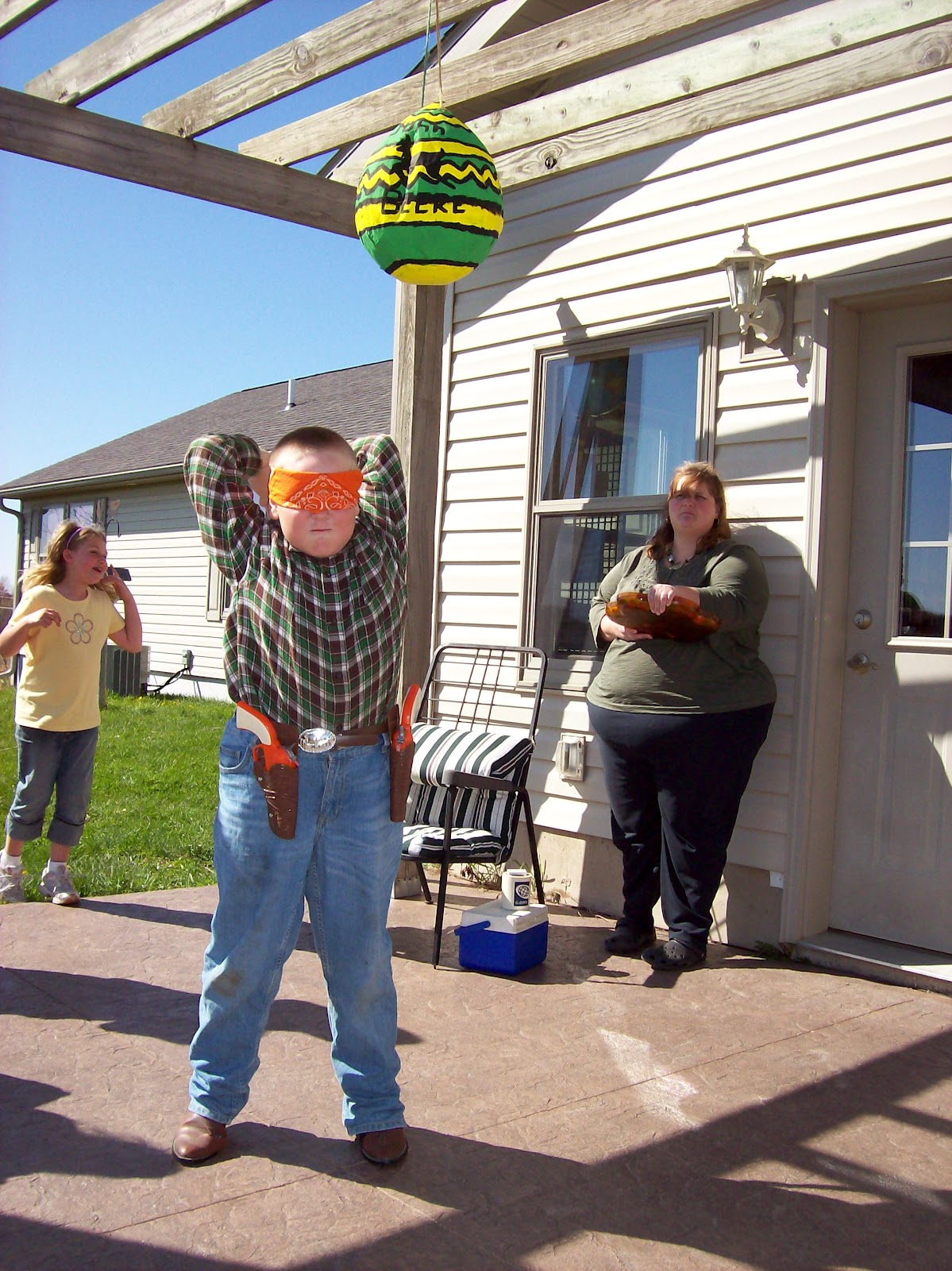
So much fun, that the girls decided to make another for Ruben's birthday. Of course it had to be green and yellow. You know....John Deere and Green Bay Packer colors ;-)
Here's our little cowboy trying to smash it....
Even his pregnant mom took a turn....
Unfortunately, we had trouble getting the string to hold it up. After several attempts at retying, the young kids just beat it open on the ground.
A good time was had by all!
Subscribe to:
Posts (Atom)