Monday, March 26, 2012

Galloping the Globe Plans

We are using Galloping the Globe and really enjoying it.  This is a geography unit study geared for K-4th grade.  I've stretched the lessons over a 2 year period.  There are 9 units including 38 countries and an introduction.

Here's how I've divided the plan over 2 years....

Month
2011-2012
2012-2013
September
Introduction to Geography
Europe
October
North America
Europe
November
North America
Europe
December
Christmas Around the World
Europe
January
South America
The Poles
February
South America
Africa
March
Asia
Africa
April
Asia
Africa, Oceana
May
Asia
Oceana


From there, I created a chart of possible Countries, People/History, Science, Geography, and Five in a Row books I could incorporate based on suggestions in the Galloping the Globe guide.  Here's that chart....

Galloping the Globe
9 units including 38 countries + Intro
Unit
Country
People/History
Science
Geography
FIAR
R&S Our Father’s  World
Introduction to Geography

(September)
Using a Map
Basic
Explorers
Mercator
Prince Henry the Navigator
Bartholomew Diaz
Christopher Columbus
Francis Drake
Leif Ericson
Cabeza de Vaca
Vasco da Gama
John Cabet
Hernando de Soto
Amerigo Vespucci
Juan Ponce de Leon
Vasco Nunez de Balboa
Ferdinand Magellan
CGC 2
Insects
CGC 13
Butterflies
Description of earth/globe
Continents  Oceans
How to Make an Apple Pie and See the World
Grandfather’s Journey
Miss Rumphius

Pg 31-48; 95-111


North America

 (October- November)
Canada
Royal Canadian Mounted Police
Henry Hudson
Jacques Cartier
Moose
CGC 23 Animal Food Chain
St. Lawrence River
Hudson Bay
Bay
Very Last First Time
The Bee Tree

Pg 8-30

Mexico
Charro: The Mexican Cowboy
Benito Juarez
Hernando Cortez
Mexican Independence Day
Pancho Villa
Volcanoes
Gulf
Gulf of Mexico


United States
George Washington
Thomas Jefferson
Abraham Lincoln
Current President
Native American Indians
American Flag
Barrack Obama
Buffalo
CGC 26a
Rabbits
Beaver
Otters
Squirrels
Skunk
Raccoons
Porcupine
Cougars
Prairie Dogs
Manatees
General Animal Books
Rocky Mountains
Mountain Range
Cranberry Thanksgiving
When I Was Young and in the Mountains
They Were Strong and Good
Lentil
Owl Moon
Gramma’s Walk
Higgens Bend Song and Dance
Amber on the Mountain
Roxaboxen
Down, Down the Mountain
Warm as Wool
All Those Secrets of the World
The Rag Coat
Mailing May
Climbing Kansas Mountain
The Finest Horse in Town
Paul Revere’s Ride
Cowboy Charlie
Night of the Moon Jellies
Stopping by the Woods on a Snowy Evening
The Finest Horse in Town
The Little Red Lighthouse
Follow the Drinking Gourd
Three Names
The Gullywasher
Daniel’s Duck
Snowflake Bentley
The Raft
Pg 50-53
Christmas Around the World

(December)
Japan
China
Russia
Great Britain
France
Italy
Germany
Spain
Mexico
Nigeria
St. Nicholas
Deer and Reindeer


South America

 (January- February)


Anteater
Chinchilla
Giant Armadillo
Jaguar
Sloth
Birds
CGC 18


Pg 54-61

Brazil

Rain Forest
Tamarin
Tapir
Capybara
Piranha
Amazon River
Jungle


Venezuela
Simon Bolivar
Anteater
Giant Armadillo
Jaguar
Highland


Peru
Francisco Pizarro
Sloth
Mountain Pass


Argentina

Squid
Rhea
Pampas


Asia

(March, April, May)
China
Hudson Taylor
Eric Liddell
Marco Polo
Lottie Moon
Qin Shi Huangdi
Ducks
Pandas
Sloth Bear
Orangutans
Snow Leopard
Yangtze River
Terra Cotta Army
Great Wall of China
The Story About Ping
Pg 62-70

South Korea
Bob Pierce
CGC 15 Animal Kingdom


Japan
Hokusai
Commodore Perry
Emperor Hirohito
CGC 19 Intro to Mammals
Japanese Macaque
Archipelago
A Pair of Red Clogs
Grass Sandals


India
Amy Carmichael
William Carey
Gandhi
Elephants
CGC 20
Tigers
Water Buffalo
Chevrotain
Sea


Israel
Jesus
Abraham
Isaac
Jacob
Children of Israel as God’s chosen people
David Ben-Gurion
Golda Meir
Donkey


Unit
Country
People/History
Science
Geography
FIAR
R&S Our Father’s  World
Europe

(September-December)
Russia
Catherine the Great
Peter Tchaikovsky
Peter the Great
Yuri Gagarin
CGC 22 Animal Structure
Bears
Wolves
Ural Mountains
Tundra
Another Celebrated Dancing Bear
Pg 76-80

Great Britain
William Shakespeare
Elizabeth I
Charles Dickens
Beatrix Potter
Florence Nightingale
Sheep
Channel
Mr. Gumpy’s Motor Car
The Tale of Peter Rabbit


France
Marie Curie
Louis Pasteur
Claude Monet
Joan of Arc
Trees
CGC 11
Palisade
Giraffe That Walked to Paris
Mirette on the High Wire
Madeline
Glorious Flight (English Channel)


Italy
Michelangelo
Leonardo Da Vinci
Galileo
Giotto
Astronomy
CGC 2 The Universe
CGC 3 Our Solar System

Papa Piccolo
Clown of God
Angelo


Germany
Ludwig Van Beethoven
Johannes Gutenberg
Albert Einstein
Johann Sebastian Bach
Brahms
Handel
Robert Schumann
Castles
CGC 10a Plants

The Duchess Bakes a Cake
A New Coat for Anna


Holland/
Netherlands
Rembrandt
Vincent Van Gogh
Johannes Vermeer
Flowers
CGC 10b Flowers
Polder


Spain
Queen Isabella
Bulls/Cattle/Cows
Cork
Peninsula
Story of Ferdinand
Spain
Queen Isabella
The Poles

(January)
Antarctica
Roald Amundsen
Ernest Shackleton
Sir James Ross
Robert Scott
Penguins
Iceberg
Floe
Ice Sheet

Pg 71-75


Africa

(February-April)


Giraffe
Apes & Monkeys
Chimpanzees
Gorillas
Hippopotamus
Lions
Ostrich
Rhinoceros
Zebras


Pg 85-94

South Africa
Nelson Mandela
Boer Goats
Meerkat
Cheetah
Cape


Kenya
Maasai
Verna Aardema
Giraffe
Hippopotamus
Lion
Ostrich
Zebra
Lake
Valley


Morocco


Strait


Nigeria
Mary Slessor
King Eyo Honesty VII
Warthog
Waterbuck


Egypt
Cleopatra
King Tutankhamen
Hatshepsut
Deserts
Nile River
Delta
The Giraffe that Walked to Paris

Oceana

(May)
Australia
James Cook
Robert Burke & William Wills
Matthew Flinders
Coral Reef
Kangaroo
Wombats
Koalas
Crocodile
Tasmanian Devil
Duck-billed platypus

Reef
Key
Pumpkin Runner
Pg 81-84;
Review & Test pg 112-117

New Zealand
Margaret Mahy
Fruits & Vegetables
Kiwi
Kune kune Pig
Island


Since we have a separate formal history and science course, we will not touch on all the subjects listed above.  This was just an idea guide in my initial planning stage.    

We are studying each country for 2 weeks.  Here's the daily break down for each of those 2 weeks....

Monday
         Locate continent/country on map
         Read -
         Color and label map
Monday
         Review country
         Vocabulary
         Literature -
Tuesday
         Children Just Like Me
         Color flag
         Missionary
Tuesday
         Animals
         Missionary
         Worksheet
Wednesday
         Read –
         Geographic features
         Map data box
Wednesday
         Literature -
         Activity
         Bible verse
Thursday
         Missionary
         Animals
         Worksheet
Thursday
         Animals
         Worksheet
         Literature -
Friday
         Read –
         Bible verse/copywork
Friday
         Animal report
         Make a meal

Again, there are not always enough suggestions to cover each idea for each day listed above.  For example, we may only cover 1-2 missionary stories over the 2 week period.  Or maybe there are fewer animals to study in some countries and more to study in others.  This is just an outline for each week.  It helps me stay on  task.  

We are currently studying South Korea in Asia.  The kids are really enjoying Galloping the Globe.  I feel it's a great over view of the world.  Obviously, we don't cover every country in the world, but it's enough for early elementary.  We also have a markable map on our school room wall.  This is were we keep track of each country we study.  

Each child has a binder with notebooking pages to complete with each country.  Some of them are printable worksheets from the Galloping the Globe book and some were downloaded from Homeschool Creations.  

Here's a list of recommended resources based on an old and new version of Galloping the Globe.  I've highlighted the ones we use regularly.  I feel they're more relevant to our study.  Of course, you would need to pick the areas you want to focus on and choose resources accordingly.  

Recommended Resources:
Considering God’s Creation (CGC)
Geography from A to Z
Our Father’s World (2nd grade Rod & Staff)
Missionary Stories with the Millers
Heaven’s Heroes – by David Shibley
Children Just Like Me – Kindersley
Profiles from History Volume 1 – Wiggers
Big Book of Books and Activities
Marvels of Creation series – by Buddy & Kay Davis
The Usborne Book of Famous Lives
Eat Your Way around the World
Zoo Guide
Aquarium Guide

Galloping the Globe is working well for our family.  I like that I can tweak it to make it our own.  Remember, let your curriculum be your slave, not your master.  

Saturday, March 24, 2012

A Little Tiger in the Chinese Night...

A Little Tiger in the Chinese Night: An Autobiography in Art

Last week, we finished reading this awesome living book by Song Nan Zhang.  It's an autobiography in art. The story tells of Song Nan's life growing up in Shanghai after WW II.  There were many ups and downs during this time period in China from the Great Leap Forward to the Cultural Revolution, then relaxing policies after Chairman Mao's death to the riot at Tienanmen Square.  "His story provides rare insight into the hopes and disappointments, dreams and nightmares, that almost every Chinese has experienced in our time and gives a human dimension to a people numbering more than one billion."  Song Nan tells the story in narrative form with beautiful paintings.

Though I found the book at the library in the juvenile section and it has only 48 pages, it's not your usual picture book.  Ruben was disappointed early on because the tiger turned out to be a part of the symbolism and not the focus of the story.  If you're going to read it to younger children, I would break it up into parts rather than a one time read.  The Farmer, Jennifer, Angel, and I really enjoyed the story.  Maybe because we had prior knowledge of the plight of the people in China during that time period.  I would definitely recommend this book as part of your China study for ages 10 and up.

Enjoy!

Wednesday, March 21, 2012

First Day of Spring 2012

It feels like summer here in the Midwest rather than mid March.  We've had 10+ days of record high temperatures this month.  My perennials are growing, the grass is greening and the birds are returning.  Yesterday, the first official day of spring, we saw a male bluebird.  Today, we saw a male and female!!  The robins have been back for a week or so.  I also saw a killdeer fly over head and a pair of whooping cranes out in the field.  The frogs and crickets are croaking and the turkeys are gobbling.  It's such a delight!


Budding trees

and babbling brooks.

Doing math with the door open


outside reading books.  
 
Green grass

 and a boy hanging from tree.
A bleeding heart growing

and mud up to your knees.
Ahhhhh.....spring!!!  

Monday, March 19, 2012

Tie Pillows

RileyAnn loves projects and making things.  A very kind homeschool mom recently gave us some pillow forms, so Riley set to work.  After choosing her fabric, I helped with the cutting, and Riley tied away...


Make it your goal to live a quiet life, minding your own business and working with your hands, just as we instructed you before.  1 Thessalonians 4:11

Saturday, March 17, 2012

Charlotte Mason Education - Part 4

I recently spoke to a group of homeschooling mom's regarding the Charlotte Mason method of education.  In this, the final post of the Charlotte Mason series, (part 1, part 2, part 3) I would like to address some of the questions that came from that group.


1. I'm worried about spending all my time planning a CM education and that I will miss out on other precious moments with my kids.  How do you find balance?

I am a planner/organizer type of person and thrive on researching books and resources.  So much so, that I've made planning our children's education a hobby.  One of my favorite planning tools that I recently purchased from Simply Charlotte Mason is Planning Your Charlotte Mason Education.  (Feel free to click on the link and download the free sample.)  This great resource helps you plan your Charlotte Mason education in 5 easy steps.  Sonya Shafer does a wonderful job of walking you through the Big Picture, Your Year, Your Term, Your Week, and Your Day.  The book is full of examples and there are appendixes with printable timetables, schedules, and charts.  SCM also offers an online CM Organizer, where you can schedule resources and create lesson plans.  I have not used the online resource because I'm more of pencil/paper planner, but I've read wonderful reviews about it.

In addition, there are online sites, where homeschool mom's have planned a complete CM education for you. You can just download and go.  I mentioned some in my last post, but will reference a few here as well....

Simply Charlotte Mason Curriculum Guide (grades 1-12) - http://simplycharlottemason.com/planning/scmguide/

Ambleside Online Curriculum (grades 1-12) - http://www.amblesideonline.org/curriculum.shtml

Charlotte Mason Help: Free Curriculum (kindergarten - 12th grade) - http://www.charlottemasonhelp.com/p/free-curriculum.html

Old Fashioned Education Christian Homeschool Education (kindergarten -  12th grade) - http://oldfashionededucation.com/fullcurriculum.htm

Also, in the last post I mentioned various companies who sell Charlotte Mason resources/curriculum.  They include, but are not limited to:

Simply Charlotte Mason
Heart of Dakota
TruthQuest
Nothing New Press - Christine Miller (All Through the Ages)
Living Books Curriculum
Lifetime Books & Gifts
Queen Homeschool
Sonlight - use book lists
Bethlehem Books
Five in a Row
WinterPromise
Yesterday's Classics
Beautiful Feet
Greenleaf Press

There is no need to spend countless hours planning.  There are a wealth of resources available to assist you.

2. Formal Charlotte Mason education started at age 6. Are there resources or things I can do with my pre-school/kindergarten age child?

Ambleside Online offers a Year 0 book list for children prior to age 6 - http://www.amblesideonline.org/00.shtml

Simply Charlotte Mason offers an Early Years Guide for children age 3-5 - http://simplycharlottemason.com/planning/eyguide/

In those early years, the most important things you can do with your child are habit training, play outside, read aloud, and read scripture.  There will be plenty of time for formal education in your child's future.

3. How do you keep track of grades and transcripts for high school when using the Charlotte Mason method?

While using the Charlotte Mason method for high school, we keep track of hours and books read.  Angel has a notebook where she logs various events and hours under tabs for Jobs & Volunteer Work; Clubs & Organizations; Camps, Civic Events & Conferences; Travel & Field Trips; Sports, Competitions, & Contests; Plays, Radio, TV, & Movies; and Books, Magazines, & Newspapers.  This idea was based on a resource by Alison McKee titled From Homeschool to College & Work: Turning Your Homeschooled Experiences Into College and Job Portfolio.  Another great resource for tracking homeschool high school is Senior High: A Home Designed Form+U+La by Barbara Shelton.

I do use some packaged curriculum for high school with a CM flair including My Father's World, Beautiful Feet, TruthQuest, Notgrass Exploring...series, Apologia, and Math-U-See.  Many of these provide grading guidelines and rubrics.  In addition, when your student is reading Living Books and narrating or having meaningful discussion with you, more than likely they get it and there's no need for pages of comprehension questions and tests.

Keep in mind, Charlotte Mason is a method of educating.  It's really not about specific books or curriculum.  I believe it's more about incorporating Charlotte's ideas into whatever subjects you're teaching.  You would log and track progress as with any other method.

Again, there is a wealth of information online regarding using CM through high school.  Here are a few sites:

Ambleside Online: High School - http://www.amblesideonline.org/HighSchool.shtml

Hepburn Family Homepages provides a great overview of Ambleside Online High School with sample transcripts - http://homepages.rootsweb.ancestry.com/~cheps/highschool.html

Simply Charlotte Mason provides a forum with various tags including High School - http://simplycharlottemason.com/scmforum/tags/high-school

Barb at Handbook of Nature Study has posted various articles on using the Charlotte Mason method of nature study for high school
http://handbookofnaturestudy.blogspot.com/2012/03/nature-study-3-steps-to-better.html
http://handbookofnaturestudy.blogspot.com/2009/08/nature-study-as-part-of-high-school.html
http://handbookofnaturestudy.blogspot.com/2011/08/door-to-fuller-lifenature-study-for.html
http://handbookofnaturestudy.blogspot.com/2009/10/keeping-things-fresh-with-electives.html

Barb also blogs at Harmony Art Mom Here's a few more blog posts on CM High School
http://harmonyartmom.blogspot.com/2009/05/charlotte-mason-high-school-or-not.html
http://harmonyartmom.blogspot.com/2012/03/homeschooling-for-life-and-not.html
http://harmonyartmom.blogspot.com/2012/02/how-do-you-organize-your-homeschool.html
http://harmonyartmom.blogspot.com/2009/08/keeping-things-real-in-our-homeschool.html

Charlotte Mason High School Study Guide - http://homepage.bushnell.net/~peanuts/CMhighschool.html

4. What are some of your favorite Charlotte Mason books/curriculum? 

Updated February 2015

I hesitate to recommend particular books because each individual homeschooling family should use what works for them and that's not always going to be the same.  The Charlotte Mason method is certainly not an end all be all method.  Feel free to pick and choose, alter, and use what works best for your family.

Here are some of our top picks so far:

Bible
The Child's Story Bible by Catherine Vos - I've used this with our younger kids for the past two years in early elementary. We read the Old Testament along side our Ancient History Study for Creation, Mesopotamia, Egypt, and Greece.  We used the New Testament along side our Ancient History Study of Rome.  I also have my kids narrate from this Bible.

History
We've used a variety of things including Beautiful Feet, TruthQuest, SCM History Modules, H.A. Guerber The Story of .....series, Mystery of History, and many living books.  We are an avid read aloud family.  I intertwine much of our home education around the subject of history, including Bible and language arts. 

Geography
Galloping the Globe has provided us with great living books and ideas to make geography come alive.  We also do map work and cook recipes from other countries. Here's a more recent post listing our geography resources.

Math
Math-U-See has been working for us worked for us in the past.  It provides manipulatives and supports Charlotte's idea of teaching kids why they are performing certain math functions, not just how. I've also used RightStart, Singapore and Practical Arithmetics.  One thing I've learned regarding math is, it's not so much the curriculum, as how you teach/implement it. 

Science
We use Apologia and Master Books at the high school level and a variety of things at the elementary level including Outdoor Secrets, Thornton Burgess books, and Among the Farmyard People Lesson Plans.  Our kids love nature study and spend time outside nearly every day.  RileyAnn is the most consistent in keeping a nature journal.  I would recommend getting each child a spiral bound sketchbook rather than a lined paper notebook.  Here's a couple of links regarding this...
http://handbookofnaturestudy.blogspot.com/2008/05/nature-journal-or-nature-notebook.html
http://handbookofnaturestudy.blogspot.com/2011/04/outdoor-hour-challenge-blog-carnival.html


Riley's also done several animal drawings though our Galloping the Globe study.  In addition, The Story Book of Science is a wonderful living book for elementary science. 

Poetry
We've enjoyed poems from Favorite Poems Old and New and A Child's Garden of Verses.  I just simply read misc. poems aloud several days a week.  Occasionally, we discuss them, but usually we just savor the language. Once the children are old enough to study on their own, I really love the Poetry for Young People series.  I assign RileyAnn one book/poet, per twelve week term. 

Copywork
My kids do use copywork for handwriting.  One of our favorites has been Pictures in Cursive from Queen Homeschool.  They also provide a variety of other copywork books including manuscript handwriting, as well as copywork for boys and girls.

Spelling & Dictation
We like All About Spelling.  You can find out more about this program by clicking the link on the right side bar.  AAS is based on the Orton-Gillingham method of teaching.  It's scripted, open and go, which I really like.  Yet, you can choose how much or how little you want to teach per lesson.  This allows you to go at each child's pace and can be adjusted to fit well with Charlotte's method of short lessons.   AAS also provides dictation exercises.  We did take a sabbatical from AAS to try Logic of English.  However, it was not a good fit for us.  I do not start formal spelling until at least 2nd grade, when the child has some reading lessons fully under their belt.  In addition, I have used dictation passages from Spelling Wisdom and Sonlight Language Arts. 

Language and Grammar
The girls LOVE Language Lessons by Queen Homeschool.  After a couple of years, the girls tired of these books.  Particularly at the younger level.  Each book is much the same.  Around 4th/5th grade we've used Easy Grammar and Michael Clay Thompson for formal grammar.  At the high school level, I used My Father's World, Lightning Lit & Comp, Commas Are Our Friends, and Beautiful Feet history guides.  I typically tie language arts and history together at the upper levels.

This is certainly not an all inclusive list but it may give you some ideas to spring from.  Feel free to comment or ask further questions pertaining to the Charlotte Mason method.

To me, the bottom line is the motto from Charlotte herself saying, "Education is an atmosphere, a discipline, a life."   By using Charlotte Mason's methods, I hope to nurture a love of learning so our children will be life long learners.  

Friday, March 16, 2012

Charlotte Mason Education - Part 3

So why did I choose the Charlotte Mason method/approach for teaching our children?

Simply to create a love of learning. I started homeschooling five years ago with textbooks. After a period of time, I felt like I was recreating school at home. As I began networking with other homeschooling moms, I learned there was a whole other world of methods out there.

I then began to study the Classical Education Method, which still intrigues me. However, when our younger kids were old enough to school, it seemed so unnatural to have them memorizing dates and times. They got so much out of me reading aloud. Ruben's vocabulary grew to great proportions. Riley's love for nature became very apparent. Angel much preferred reading literature and historic works rather than her textbook. We started having family conversations about various people and historic events. As I continued researching, I found the Charlotte Mason method, it really seemed like an answer to prayer.

I'm enamored with the idea of living books, short lessons, reading history about people's lives rather than memorizing dates and events, copywork, nature study, reading scripture daily and incorporating it into our history, poetry, and picture study. I have seen these methods of teaching work in our family. It was that natural fit that I'd been hoping for. I wouldn't claim to be a Charlotte Mason purist, but we do incorporate many of her methods in our day to day education and we're loving it!


Charlotte Mason Style Websites & Free Curricula

Here are some online links for further information regarding Charlotte Mason education. They are in no particular order...


Ambleside Online   http://www.amblesideonline.org/index.shtml  - here you will find a free k-12 Charlotte Mason curriculum including book lists and weekly lesson plans. Just click on "Ambleside Online Curriculum" and choose the year/age/grade you'd like.

An Old Fashioned Education  http://oldfashionededucation.com/index.html  - here is another free Charlotte Mason curriculum. Just click on "Full Curriculum" in the upper left and then choose what year you'd like.

Higher Up and Further In  http://higherupandfurtherin.blogspot.com/2006/01/our-curriculum.html  - Lindafay has created a Charlotte Mason friendly free curriculum that's based on Ambleside, but incorporates more Bible into the curriculum. Her curriculum is K-6th, then switches over to House of Education, which is the Ambleside model for upper grades.  http://www.charlottemasonhelp.com/  is an updated version of the website.

Simply Charlotte Mason  http://simplycharlottemason.com/  - I love this site and have gleaned many things from it. In the blue box on the left you will see the "Free Curriculum Guide". Once you click this you can see how they've laid out their Charlotte Mason curriculum for 1-12th grade. If you click on each individual subject, you can see the resources they recommend. In addition, in the blue box in the left, you will see a "CM Organizer/Book Finder", here you will find "living book" lists. One last thing on this site is also in the blue box on the left, you will see "Discussion Forum". If you click on this, it will take you to the forum. I check this regularly. You do not need to be a member to read this forum. In the middle, you'll find the latest discussions. On the lower left, you'll see popular tags. If you click on Kindergarten, you'll see former posts on this topic from the past 2 years. Oh yeah, and there is a SCM Blog in that blue box at the beginning. You'll find great articles there regarding homeschooling, Charlotte Mason, and habit training. Again....I love this site!

Queen Homeschool Supply  http://www.queenhomeschool.com/bookpage/bookframe.html  - this is Charlotte Mason curriculum designed by a homeschool mom (as most of the above are).


The Baldwin Project   http://www.mainlesson.com/  - free online books

Project Gutenberg  http://www.gutenberg.org/ - over 38,000 free online books


http://www.livingbookscurriculum.com/  Living Books Curriculum
http://www.pennygardner.com Great resource for Bible lesson plans, handwriting instruction, math, etc.  
http://materamabilis.org/ma/ Catholic Charlotte Mason site
http://www.tanglewoodeducation.com/ Charlotte Mason mixed with Classical Education
http://www.heritage-history.com/www/heritage.php  Heritage History - excellent living books in chronological order
http://harmonyartmom.blogspot.com/ - Homeschoool Art & Music Plans
http://handbookofnaturestudy.blogspot.com/  - Nature Study for Homeschoolers


What is twaddle?

There are a wealth of online free resources for educating using the Charlotte Mason method. As mentioned in a former post I believe you could educate at no cost with a Bible and library care. However, for those who aren't as confident or need a guide to follow, here are some Charlotte Mason types of curriculum....

Simply Charlotte Mason
Sonlight Book Lists
Heart of Dakota
Living Books Curriculum
Lifetime Books & Gifts
Ambleside Online
House of Education
Queen Homeschool
Lamplighter Publishing
Nothing New Press
All Through the Ages by Christine Miller
Bethlehem Books
Five in a Row
WinterPromise
TruthQuest
Yesterday’s Classics
Higher Up and Further In
Beautiful Feet
Mott Media – Ruth Beechick books & website
Greenleaf Press
Math-U-See
RightStart Math


Hopefully, this series gives you a good place to start. If you are truly interested in the Charlotte Mason method, I would highly recommend reading her original writings It's a 6 volume set available in hard copy or online. I confess I have not read them all, but I aspire to :)


See also Part 1, Part 2, and Part 4 of this series. 

Thursday, March 15, 2012

Charlotte Mason Education - Part 2

What are the basic methods of a Charlotte Mason education?


As mentioned in a the former post, Charlotte believed in spreading a feast before the children and allowing them to take what they were ready for.  Her method incorporates all core subjects including history, geography, Bible, math, science, foreign language, writing, spelling, grammar, art, music & hymn study, literature, poetry, and handicrafts.  She used the best books, the best music, and the best art possible.  Charlotte's methods throughout the subjects included:

1. Short Lessons - beginning around age 6 for approx. 15-20 minutes, increasing around age 10 to 20-30 minutes, and continuing around age 14 to 30-45 minutes

2. Emphasis on Good Habits - develop the habit of attention by doing things only one time; develop the habit of best effort by encouraging quality not quantity 

3. Varying the Order of Subjects - lessons should range in a large variety of subjects altering between concentrated intense subjects and less intense subjects including those that allow for physical movement; using different parts of the brain allows for better attention span

4. Living Books - books usually written by one person who is passionate about a subject;  they make the subject come alive by pulling you in and involving your emotions; avoid dry, factual textbooks, written by various authors with snippets on various topics

5. Narration - start by reading a short passage from a living book, ask the child to retell (either orally or in writing) what they just saw, heard, or felt about what was read; this method requires a higher thinking level vs. fill in the blank "comprehension" type questions; start oral narration around age 6 (not before); move to written narration around age 10; Don't interrupt a narration, narration puts emphasis on what the child knows, not on what they might have missed; when the child can rename or recite it, they observably know it;  It's not necessary to narrate every book read.  

6. Copywork - used to teach and give practice in handwriting skills; rather than write a full page of the letter "a", a full page of the letter "b", a full page of the letter "c", Charlotte Mason chose poems, scripture, inspirational quotations, and great passages from living books for the child to carefully copy; emphasize quality not quantity, the goal is legible handwriting.  Charlotte Mason continued copywork through 9th grade.

7. Nature Study - Charlotte believed children, as well as adults, should spend time out of doors regularly, regardless of weather, studying God's creation by walking in fields, meadows, woodlands, and along streams; children should be encouraged to look carefully at their natural surroundings, then enter their observations in a notebook/journal; these entries can include sketches, descriptions, watercolor paintings, weather observations, thoughts, feelings, poems, etc.; upon return, use field guides to follow up and help identify child's findings; The nature journal is the child's possession and should not be corrected.


You can read more about these methods as well as detailed descriptions of each subject at:


After daily lesson are complete, the child is given free time to pursue other interests and hobbies.  With the Charlotte Mason method, there is no need to buy curriculum, but a Bible and library card are important.  The Charlotte Mason method can be used solely or along side other educational methods.  It's often paired with unit studies and classical education.

Charlotte's methods are gentle and simple, yet work remarkably well.  She believed that the development of good character and good habits was essential.  As parents model great traits and capitalize on teachable moments, the child will develop completely.  This method supports each child's learning style and abilities.   

Continue with Part 3 and Part 4 of this series. 

Wednesday, March 14, 2012

Charlotte Mason Education - Part 1

   
Who was Charlotte Mason?


Charlotte Mason was a British educator who lived at the turn of century from 1842-1923. She lived in the era of: Beatrix Potter, Winston Churchill, Helen Keller, and Charles Darwin. Charlotte was orphaned at the age of 16, after which she enrolled in the Home and Colonial Society for the training of teachers. After earning her teaching certificate, she taught school for more than 10 years in Worthing, England.


During this time, she began to develop her vision of a “liberal education for all”. English children in the 1800’s were educated according to their social class. The poor were taught a trade. The fine arts and literature were reserved for the wealthy. Charlotte’s idea of “liberal” was a generous and broad curriculum or all children, regardless of social class.


Charlotte was convinced that parents would be greatly helped if they understood some basic principles about raising children. She was invited to lecture. Parents came and immediately liked her ideas so much that they wanted her to train their governesses. Eventually, schools were formed devoted to her principles; teachers were trained in her methods and then went into employment in the English public school system.


Though her methods were widely used both in Britain and U.S., the Christian principles on which they were founded were left behind. By the mid 20th century, public education had become increasingly secular and her methods were overlooked in favor of more “progressive” forms.


In 1984, Susan Schaeffer Macaulay wrote a book titled For the Children’s Sake, introducing readers to Charlotte’s ideas on educating the whole child – body, soul, and spirit – as well as her ideas on character development. At that time the homeschooling movement was gaining momentum and Charlotte's ideas were welcomed. Many people found the methods refreshing compared to changes happening in public education.


Since that time, appreciation for Charlotte Mason’s work has rapidly increased in the U.S. Many parents homeschool their children using her methods. Charlotte Mason’s method is centered on the idea that education is three-pronged: “Education is an Atmosphere, a Discipline, a Life”.


By “Atmosphere,” Charlotte meant the surroundings in which the child grows up. A child absorbs a lot from his home environment. This is referred to as the relative or relational prong. Charlotte believed in respecting children as persons, in giving them all a broad education by using a generous curriculum. She believed you shouldn’t talk down to children. She said children are naturally curious and if you spread a feast before them, they will take what they’re ready for. She sought to nurture a love for learning, not just present a body of information.


By “Discipline,” Charlotte meant the discipline of good habits — and specifically habits of character. Cultivating good habits in your child’s life make up another third of his education. This is the objective or physiological prong. Laying Down the Rails , a Habits Handbook by SCM, is an excellent resource for learning more about habit training.


The other third of education, “Life,” applies to academics. Charlotte believed that we should give children living thoughts and ideas, not just dry facts. This was the subjective or spiritual prong. All of her methods for teaching the various school subjects are built around this concept. For example, Charlotte’s students used "living books" rather than dry textbooks. Living books are usually written in story form by one author who has a passion for the subject. A living book makes the subject “come alive.” Charlotte taught spelling by using passages from great books that communicate great ideas rather than just a list of words. She encouraged spending time outdoors, interacting with God’s creation firsthand and learning the living ways of nature. This is where the idea of “nature study” comes from.


Students in Charlotte Mason schools wore a brooch with the motto “I am, I can, I ought, I will”.


I am – a unique person, created in the image of God

I can – do it. I believe in myself in a balanced, realistic way. "I can all things through Christ because he gives me strength."

I ought – duty, responsibility; unfortunately, we currently live in a society of I want. Many people believe anything goes. But in reality, it shouldn’t be about what I want or what you want. It’s about a sense of what is right. It’s about responsibility and I ought to do what is right.

I will – the student must; If we’ve clarified what is right, we realize we are able to chose. I will do it even though it’s hard, I don’t feel like it, everyone else isn’t doing it, etc.


Online Resources:


http://www.amblesideonline.org/WhatIsCM.shtml

http://simplycharlottemason.com/basics/started/whowascm/

http://www.charlottemasoneducation.com/

Charlotte Mason Resource Books


Original Homeschooling Series by Charlotte Mason - 6 Volume Set

Charlotte Mason Companion by Karen Andreola

Pocketful of Pinecones: Nature Study with the Gentle Art of Learning by Karen Andreola

A Charlotte Mason Education by Catherine Levison

More Charlotte Mason Education by Catherine Levison

For the Children’s Sake by Susan Schaeffer Macaulay

When Children Love to Learn by Elaine Cooper

Educating the Whole Hearted Child by Clay & Sally Clarkson

The Read-Aloud Handbook by Jim Trelease

Honey for a Child’s Heart by Gladys Hunt

The Three R’s by Ruth Beechick

You Can Teach Your Child Successfully by Ruth Beechick

Easy Homeschooling Techniques by Lorraine Curry

The Handbook of Nature Study by Anna Botsford Comstock

Charlotte Mason Study Guide by Penny Gardner


Continue with Part 2, Part 3, and Part 4 of this series.

Monday, March 12, 2012

Making Maple Syrup

My father and grandfather made maple syrup when I was a kid.  I have very fond memories of chugging through knee deep mud or snow collecting the sap.  Then cooking it down in the big pan in the woods over an open fire. If we were lucky, we could roast hot dogs and marshmallows while waiting for the sweet brown liquid to finish.

Since then, Grandpa's farm was sold, along with all the tapping equipment and memories.  He and my mom passed away and my dad moved to a different property.

Now, after years of hearing stories and reading books, our kids wanted to try making syrup.  The Farmer was game, so here's our story...

Preparation - building the fire pit, drilling holes, pounding in taps, and hanging buckets....


The sap starts running and eventually fills the pails....


Gather the sap and dump it into the pan.  Gather wood and start the fire to cook...


It takes 40 gallons of sap to make 1 gallon of syrup.  Unfortunately, it started to rain before the sap was cooked down.  So the Farmer brought the unfinished sap to the house to finish on the stove.  We had 3 large kettles to finish.  It took all night and day.


We use a special thermometer to test when the syrup is ready.


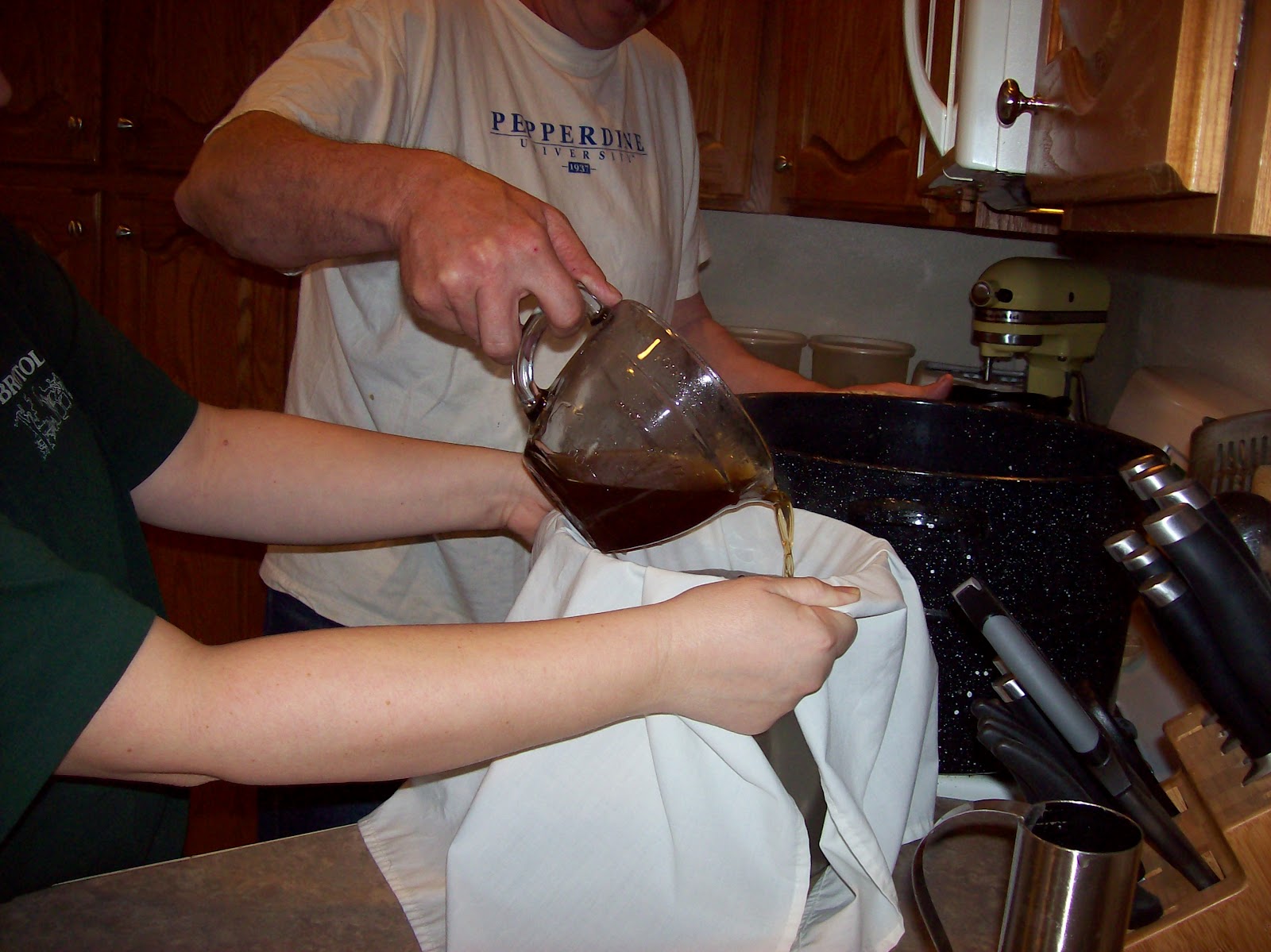
When it's ready, you must strain the syrup to clean debris and sediment. 


Once it's strained, we bottle it in quart jars and warm in the oven on a low heat to seal.  


We enjoyed some for supper on our french toast....YUMMY! There's nothing like fresh maple syrup :)