Wednesday, December 31, 2014

Reflecting Back on 2014

This is one of my favorite posts because I make time to go back and look at photos from the year.  I reflect on our accomplishments and struggles as time puts them in new light.  I'm always amazed at the growth and change in the kids.  In the daily grind, the lists don't seem to get done.  Yet, somehow in the big picture, we keep putting one foot in front of the other and it all works out.  For this last post of the year, I've put together a little month by month of life here on Drywood Creek.  Enjoy....


January - blog posts
Cakes baked, reading, writing
Studying Colonial America...exciting!


February - blog posts 
Sewing skirts, painting scenes
Building helicopters and machines


March - blog posts
Big snow, books read
Handicrafts and bellies fed


April - blog posts
Boys with go karts, melting snow
Ruben's birthday, robins show


May - blog posts
Graduation, ball, and bear
Spring time is in the air


June - blog posts
Summer comes with sunshine days
Gardens, farming, babies, and play


July - blog posts
Farm kids, frosting, birthday cake for dad
Barefoot, LEGO trains, and RileyAnn with lambs


August - blog posts
Traveling west for wedding of a friend
Hatching caterpillar to the very end


September - blog posts
Fall came, back to school
Slimy worms, weather turned cool


October - blog posts
Molasses came, leaves fell
Harvest time, books to sell


November - blog posts
American girl, learning to knit
Books abundant, stacks tipped


December - blog posts

Cutting up venison, a load of wood
Christmas morning, God is good!


Thanks so much for logging on here at Drywood Creek.  Blessings to you in the New Year! ...Melissa

Monday, December 29, 2014

Reading to Kick Off the New Year...

I didn't keep my New Year's resolution in 2014 to read four classic works of literature as part of my quest for "Mother Culture".  It isn't that I haven't been reading.  It's just that the majority of my reading is aloud to the kids.  In the hustle and bustle, I haven't made time for myself.  It took me a whole year to read The Scarlet Letter.  But, I'm not giving up!  Instead, I have a new plan for 2015.  Rather than focus on one genre, I'm going to try to incorporate books into the areas of Academic, Spiritual, and Pleasure.  I'm not going to focus on setting number goals, but will try to maintain a steady pace fulfilling my desire to acquire "Mother Culture".  Here are my choices to kick off the year....


Spiritual - Ruth: When Fairytales Come True by Stephen Davey, Wisdom Commentary Series - A friend sent me this book and I'm anxious to get started.

Academic - Consider This by Karen Glass - I actually started this about six weeks ago, but have yet to finish.  So far, I've learned a great deal.  I can't wait to give a full report when finished! 

Pleasure - O Pioneers! by Willa Cather - I've been collecting her novels for some time, but have never taken the opportunity to read one.  I figure no better time than the present!

I'd love to hear what you're reading.  Feel free to leave a comment below...

Saturday, December 27, 2014

The Scarlet Letter - Part 2

Whoo-hooo...I finished reading The Scarlet Letter!  It only took me a year ;-)  You may remember from a former post that I started reading Nathaniel Hawthorne's classic novel last January (2014).  Then restarted it in July and I'm excited to report that I finally made it through.

The Scarlet Letter tells the story of Hester Prynne, a Puritan woman punished for adultery in 17th century New England.   At the beginning of the story, Hester emerges from prison, carrying her newborn daughter, taking her place on the scaffold where she will be publicly condemned.  She refuses to admit the father of her baby and is sentenced to forever wear the scarlet letter "A", for adulter on her chest.

As the story unfolds, we find that Hester was sent to the New World from Europe by her husband, expecting that he would come later.  However, when he didn't arrive, she assumed him to be dead.  At some point, she had an extra marital affair and became pregnant.  Eventually, her husband surfaces under the pseudonym Roger Chillingworth posing as a physician who ends up taking care of the father of Hester's child.  From there, it becomes a twisted tangle of drama. 

I appreciated Hester Prynne's struggle.  I felt her character really developed and matured throughout the story.  In the final chapter, Hawthorne writes...

"And as Hester Prynne had no selfish ends, nor lived in any measure for her own profit and enjoyment, people brought all their sorrows and perplexities, and besought her counsel, as one who had herself gone through a mighty trouble.  Women, more especially - in the continually recurring trials of wounded, wasted, wronged, misplaced, or erring and sinful passion - or with the dreary burden of a heart unyielded, because unvalued and unsought - came to Hester's cottage, demanding why they were so wretched, and what the remedy!  Hester comforted and counseled them, as best she might.  She assured them, too, of her firm belief that, at some brighter period, when the world should have grown ripe for it, in Heaven's own time, a new truth would be revealed, in order to establish the whole relation between man and woman on a surer ground of mutual happiness."

I thought Hawthorne's use of alliteration and assonance (wounded, wasted, wronged,...unyielded,...unvalued...unsought...why...were....wretched....what) really brought it home.  As I read each word, I could almost feel myself sinking into despair.  And then, in that final sentence words like assured, brighter period, Heaven, new truth, revealed, surer ground, and mutual happiness, brought me back up again.  In the beginning of the story, Hester fell to the bottom of this despair.  As a result of her sin, she suffered extreme loneliness under the burden of the scarlet letter, raising a "devil like" child, loving and losing multiple times.  However, by God's grace she rose above her suffering to minister to others.  

This passage got me thinking how so often, in the midst of our struggle, we really long for someone to connect with and confirm our validity.  Someone who is/was broken and may even have danced in our shoes.  How time heals if we repent and accept God's grace.  Some of the best ministers, counselors, therapists have walked that mile in those shoes of hardship.  They know what it is to climb from the bottom of that barrel.  Hester was one of those counselors.  In my brokenness, I was struck by her strength and redemption.  I have thought of Hester a few times over the past week.  I wonder if we would have been friends...

I enjoyed The Scarlet Letter, however, Hawthorne is wordy.  I got bogged down more than once in his descriptions and had to go back and reread.  I personally think the story could have been rewritten to omit some of the descriptions without losing a bit of depth.  "In 1850, when the first edition of The Scarlet Letter was published, Hawthorne was known as a writer of tales, many of them having appeared in magazines and gift annuals, though three volumes of his tales saw publication in the decade before the novel appeared".   I recognized the first volume, Twice-Told Tales.

After finishing The Scarlet Letter, I'm ready to try something a bit lighter for my next read.  Stay tuned for new books I'm reading into the New Year....

Wednesday, December 24, 2014

Merry Christmas!...2014

Merry Christmas from the gang at Drywood Creek....
The Farmer, Melissa, RileyAnn, Ruben, and Levi


And the angel said to them, “Fear not, for behold, I bring you good news of great joy that will be for all the people. For unto you is born this day in the city of David a Savior, who is Christ the Lord. - Luke 2:10-11

Monday, December 22, 2014

Along the Santa Fe Trail...

Along the Santa Fe Trail, Marion Russell's Own Story by Marion Russell/Adapted by Ginger Wadsworth is a wonderful picture book describing 7-year old Russell's 1852 journey from Kansas to California over the Santa Fe Trail.  Much of the text is taken from Marion Russell's biography, Land of Enchantment: Memoirs of Marian Russell along the Santa Fe Trail.   Wadsworth's adaptation gives younger children a taste of life on the trail in the mid 19th century.  James Watling's illustrations add real value to an already marvelous story.  

Prior to reading Along the Santa Fe Trail, I read aloud The Santa Fe Trail by Judy Alter.  This Cornerstones of Freedom book gave us great historical background information on the trail, how it came to be, and the importance of the trail bringing the Southwest into the United States. 

Saturday, December 20, 2014

Jed Smith, Trailblazer of the West....


When I wanted to read aloud Jed Smith, Trailblazer of the West by Frank Latham, Ruben pitched a fit.  It was a bad day.  After some quick talking, I coerced him into trying one chapter.  Ironically, Chapter One held the rough and tough, good versus evil that my 9-year old outdoor adventurous boy loves.  He was hooked!  So much so, that I had to re-read the first couple chapters for The Farmer at Ruben's request....and when I finished all sixteen chapters of the book, he asked me to read it again :)

Jed Smith was a mountain man, explorer, hunter, and skilled trapper.  He explored "the white spaces" on the map in the west shortly after Lewis & Clark's expedition.  One thing that set Jed Smith apart from most mountain men of his time, was his faith.  He was clean shaven, didn't drink, didn't curse or use rough language, and he read his Bible nearly every day.  His explorations "opened up major portions of the wilderness territory to settlers traveling west of the Rocky Mountains".

Latham's book is not only historic, but high adventure.  At least twice, Smith's party was massacred by Native American Indians.  He was partially scalped by a grizzly bear and survived crossing the Great Salt Lake Desert.  Jed Smith was a great frontiersman in his time and proves to be an excellent role model to this day. 

Thursday, December 18, 2014

Kaya, An American Girl...

As some of you may know, RileyAnn is very into American Girl.  She's been through most of the books more than once, but wanted an opportunity to read them again and complete a lapbook for each girl's historical time period we study.  Therefore, I've tried to incorporate them whenever possible.  Last year, when we studied Colonial Williamsburg, I made Felicity part of our study. 

Because Kaya is part of the Nez Perce tribe in the northwest part of our nation, I decided to wait until this year and study her with Lewis & Clark, as they encountered the Nez Perce on their expedition.  We used the American Girl Lapbook Templates found here at Homeschool Share


Typically, I help her assemble the folders and she completes the rest on her own in her free time.   One of the beauties of homeschooling is being able to teach to your child's strengths and interests.  Each of our kids will tell you history is their favorite subject.  I contribute this to great living books and hands on projects that interest them.


Wednesday, December 17, 2014

Commonplace Book... Nathaniel Hawthorne

 
"Hatred, by a gradual and quiet process, will even be transformed to love, unless the change be impeded by a continual new irritation of the original feeling of hostility."  ....Nathaniel Hawthorne, The Scarlet Letter

Monday, December 15, 2014

Elementary Christmas Books....

Some favorite Christmas memories here on Drywood Creek are books we've read during the season.  One particular book, The Birds' Christmas Carol by Kate Douglas Wiggin tells the heartwarming tale of Carol Bird.  Born on Christmas day, Carol falls ill at the age of five.  Though she is bed ridden, she is determined to bring Christmas joy to the poor Ruggles children next door.  Young Carol is so inspirational, The Birds' Christmas Carol just may bring a tear to your eye.  You can download a free copy here.

Lion in the Box by Marguerite De Angeli tells of a poor family living in New York City in the early 20th century.   This special Christmas story of a widowed mother and her five children is based on a true story of a friend from De Angeli's childhood.  It's an absolutely delightful tale reminding us of the spirit of giving.

I must confess, I'm not a fan of cartoons and comics.  However, after reading A Charlie Brown Christmas by Charles Schulz to Levi, I was moved by the love of the Peanuts gang.  Charlie Brown sets out to find a Christmas tree for the play.  When he brings back a pathetic looking branch, Linus and others set out to turn the branch into something extra special.  In the end, they gather round the tree to sing Hark, the Herald Angels Sing and I was hooked.


A couple other picture books for younger children to include this holiday season are Cranberry Christmas by Wende and Harry Devin and An Early American Christmas by Tomie dePaola. 

This week we will begin reading A Tree for Peter by Kate Seredy.  I'm excited with anticipation as I've heard so many wonderful things about this story...

What are your favorite Christmas books?

Saturday, December 13, 2014

Real Fath for Real Life....

I recently finished reading Real Faith for Real Life, Living the Six Marks of Discipleship by Michael W. Foss for a book study with a group at church.  We studied one chapter per week for seven weeks. 

In Real Faith for Real Life, Foss invites readers on a journey of spiritual growth through applying six basic principles to their lives.  According to Foss, these "spiritual aids", prayer, worship, daily Bible reading, serving in and beyond the congregation, nurturing relationships, and tithing, "are biblical and have grown out of the Christian Church...they can help us find our way."  He says, "our spiritual calling is not to reach a particular destination and then stop.  It is an eternal invitation to grow, to become all that we are most capable of becoming."

Each chapter of Real Faith for Real Life focuses on a different mark of discipleship.  The chapters are broken down into 3-4 page sections with thoughtful discussion questions after each section.  It is readable and user friendly wherever you are on your spiritual journey.  

Personally, I felt the first three chapters were the strongest.  Maybe it was the content, prayer, worship, and daily Bible reading.  Foss gave practical ideas for strengthening each of these areas in our daily lives.  His anecdotal illustrations are realistic and support the theme.  Real Faith for Real Life is a great book for a group study. 


Friday, December 12, 2014

Facebook VS. Yahoo

I am a member of several online Yahoo Groups regarding homeschooling, various curricula, dyslexia, etc.  Recently, there was a debate with one group as to whether or not to switch the Yahoo Group to a Facebook Group.  This is not the first time the subject has come up among the Yahoo Group crowd.  A few of the Yahoo Groups I belong to have already made the switch.  However, this particular group held firm. 

There were several interesting posts throughout the debate.  However, one really stood out to me.  So much so, that I asked the original poster if I could reprint it here.  It was written by a homeschool mom, who also happens to be a University of Maryland professor.  She granted me permission, but wished to remain anonymous other than the information I've disclosed.   The following is her post regarding whether or not the Yahoo Group should switch to Facebook....
 
If I may, I would like to clarify a couple of points in the Facebook (ie, social media/mobile) vs Yahoo (ie, email-based) discussion.

I have been a professor of Computer Science for a very long time, and I have developed and taught a course specifically on social media.  Now, my focus is more on technology and less on psychology, but it's not possible to separate the two because they interact and interweave thoroughly.  It may be convenient to think of the "under 30" crowd and the "over 30" crowd, but those are not the true demographics.  Statistically speaking, the "over 65" age group has a higher percentage of people online than the "50-64" group.  The new digital divide is not between "those who do" and "those who don't", but more along the lines of frequency + location and high-speed access at home, which reflects more of an urban and rural divide.  

Anyway, the research about these frequent discussions is truly not about comfort level with technology or age or anything else.  It's more a matter of time and reflection.  Some platforms are better for quick, immediate response.  For example, finding directions or replying to an RSVP does not require much thought or consideration.  Facebook and Twitter and other "broadcast" media work fine for those sorts of conversations.  They are not the place for a considered response to a question or for anything that should demand reflection. 

Social media has only been in "always-on" mode for less than 7 years.  The first iPhone was released in 2007 and took some time to spread, due to the global economic crash, production problems, and lots of other things.  While those who are "under 30" might feel as if they have always been connected, it's more of a habit than a reality.  From an academic perspective, the issue of social media vs email is of a different nature.  Social media, by its very nature, is "ME" centered and addictive; the psychological rewards are immediate.  Imagine a spider web of connections (this is the engineering model of a social abstraction), but "ME" is always at the center.  Social media is about a broadcast (in the media sense) of something that concerns "ME" and spreads to whoever is connected to "ME".  Email is more closely related to blogging, except that blogging is really one-directional (going outwards) while email is bi-directional.  Email demands more time and more attention and more consideration.  It's not surprising that email and blogging are the preferred platforms for those for whom words and critical thinking matter, but are not as popular with those who want an 8-second reply.  

As an aside, the current lifespan of a FB post is considered to be 5 hours, although most of the "reach" happens within 2 hours. Their algorithm ranks the priority of items to add to a news feed, and anything over 5 hours old does not rank highly.  Most users believe that they are seeing everything that their connections produce, but that is not true.  Research shows that FB users see only 57% of the total posts made by their connections due to the ranking algorithms.  FB decides what is relevant to you, based on what you typically click on.

Another current big debate is that of "opting out".  At this time, Facebook is almost a global directory of everyone online, and it is not only pervasive, it is ubiquitous.  It's everywhere, and it's convenient.  Choosing to "opt out" means that you are no longer "in the group".  You have to decide how important this is to you.  Many groups fall apart over this because one crowd will not yield to the other; the mobile/social crowd will not accommodate the email/group crowd, and vice versa.   There are a multitude of ways to connect and many hybrid platforms as alternatives, but they usually don't get this far. 

The most significant problem is that the billions of users think that FB (and other social platforms) is free.  It is not.  The overwhelming majority of users believe that it is supported by advertising.  It is not.  When you choose to use FB (in particular, although this applies to any large platform), YOU are the product.  You sign a "Terms of Service" agreement, and in that agreement you allow FB to own whatever content you upload.  You do not own your words or your images or anything at all.  FB owns it all, and they sell it in various ways.  A great many researchers pay to use the data that FB provides because never before in history has such an overwhelming amount of data been available.  There have been a number of huge experiments allowed without informing the users by FB that have been in the news recently; one even went so far as emotional manipulation to test the theory of "contagion".  Another point is that when someone dies, their online content is not something that can be willed to someone else.  It is owned by the social platform.  Because the user is no longer providing a benefit to the social platform business, and maintaining information is expensive, nearly every company disables the account and deletes its related content.  There have been a number of recent court cases on this issue.  At the moment, FB allows a page to be converted to a "memorial", but that will be changing as the number of "memorial" pages approaches and exceeds the number of "active" pages.

Finally, the other major concern is that of security and privacy. Never before have the professional lives of a person intersected their personal lives so completely.  For example, if a person "likes" a homeschooling page or a diabetic recipe page or a coping with depression page or whatever on FB, that will influence opportunities in the career world.  There are no clear boundaries on social media, and there should be.  Social media advocates often talk about complete transparency, but that is not possible without full loss of privacy.  The "anonymity" and "Real Name" debates are headed to the courts.

There are no easy answers to any of these questions, but decisions should be fully-informed rather than based on personal preference, personal convenience, and unconsidered emotional reactions.  

I really appreciated this poster's perspective.  I felt it was a thoughtful and educated response. There are so many things to consider before hopping online.  In this media driven world, our quest for bigger, better, faster, may not always produce the best long term results.  Hopefully, this post gives food for thought. 

I should note, I am not a Facebook user.  Apparently, I'm in the "email/group crowd".  I do love words!  

Saturday, December 6, 2014

Logic of English Review....

After finishing All About Spelling Level 3 last year in 4th grade, I felt RileyAnn was ready for a change.  I had done extensive research the year before, but decided to stick with AAS one more year.  She was doing well with the program and liked it.  She is a gifted writer with well organized thoughts.  However, after completing Level 3, her spelling was still weak and hindering her writing fluency.  Hence began my pursuit for yet another spelling program.

I initially heard about The Logic of English among other homeschool circles.  I spoke with a few acquaintances that were using the program.  I also listened to seminars at the local homeschool convention.  I felt this new program could be the answer to our need.  After watching videos on The Logic of English website and corresponding with author Denise Eide, we decided to make the switch.  Riley started off this fall, 5th grade, with Logic of English Essentials.  

The Logic of English (LOE) was created "for students ages eight through adult who want to improve their reading, spelling, and/or sentence level writing ability.  The program systematically teaches how and why English words are spelled in a particular manner and how to build words into phrases and sentences, thereby providing students with the tools needed to decode, spell, and write."   The program is based on the Orton-Gillingham method of multi-sensory instruction. 

I think the idea behind The Logic of English is brilliant.  English really is a complex language.  Most people are not natural spellers.  We don't have photographic minds.  Rules and reasons explaining the why behind the how we spell English words are helpful.  For example, did you know the phonogram /ough/ has six different sounds?   Check out each of these words and notice the position of your mouth when pronouncing the vowel sound: thought, though, through, bough, rough, and trough.  How in the world do you know to used /ough/ rather than just plain o, ow, uff, or off?  Well, if you know the logic behind English, you know that /ough/ is used "only at the end of a base word or before a "T".  The Logic of English gives you the rules and reasons, "104 tools", behind the spelling of 98% of English words.   

The large LOE Teacher's Manual offers several sample schedules and much teacher support in the sixty-seven page Introduction.  As noted in the quote above, LOE not only provides spelling remediation, but also vocabulary, reading, grammar, and composition instruction.  Riley reads well above grade level and has fine vocabulary and composition skills.  However she needed spelling help so I decided to go with the "Struggling Spellers" schedule.

For spelling remediation, LOE suggests the possibility of completing one lesson every one to two days, finishing the entire 40 lesson course in 8-16 weeks.  This seemed a rather rapid pace to me so I modified it to spend three days, completing one lesson per week.  I figured with this schedule, we could complete the entire course in approximately one school year, which I felt sufficient.

Each LOE lesson is broke into three parts.  Part one introduces and reviews phonograms, explores spelling sounds, and includes teaching new spelling rules.  Part two provides spelling word dictation which includes syllabification and marking words according to their sounds.  Part three teaches grammar. It also gives phrases and sentences for dictation, using spelling words with various learned phonograms.  In addition, there are composition and vocabulary exercises.

We were excited about starting fresh.  It seemed to be going very well.  Then suddenly we hit a snag!  Every fifth lesson in LOE is an assessment and review.   Even though the beginning four lessons/weeks were review for Riley from previous school years, lesson five, the first LOE Assessment & Review, was very difficult for her.  We went back and reviewed a bit more and pushed through, as I attributed the struggle to starting a new program.  I figured we just needed to smooth out the bumps.  The next couple lessons went OK, but it became apparent around lesson eleven that LOE was not the right fit for us.

The multi-sensory piece of LOE is playing the phonogram and spelling games.  We tried a few games from the game book and they did not appeal to Riley or I.  Learning all six sounds of /ough/ in one lesson, as in the sample above, was too fast paced and confusing for Riley and I.  I couldn't remember the clues to cue her during dictation.   Riley is also currently using Michael Clay Thompson for English and grammar so the added grammar from LOE was sometimes repetitious and sometimes confusing.

Because LOE is more of an all in one program, covering spelling, reading, composition, vocabulary, and grammar, it felt like overkill to me.  I really just want a program for spelling remediation.  If improvement comes in those other language arts areas due to better spelling, it's a bonus.  However with RileyAnn, I am not interested in an all in one program.  I feel like in using Charlotte Mason's methods she has a great grasp on language arts and is heading in the right direction. 

I think we gave LOE a fair shot.  Needless to say, after twelve lessons in twelve weeks, we've decided to go back to the simplicity of All About Spelling.  The smile is back on RileyAnn's face.  I have learned if your child likes and buys into the program you're using, stick with it, you've conquered half the battle!

Monday, December 1, 2014

John James Audubon....

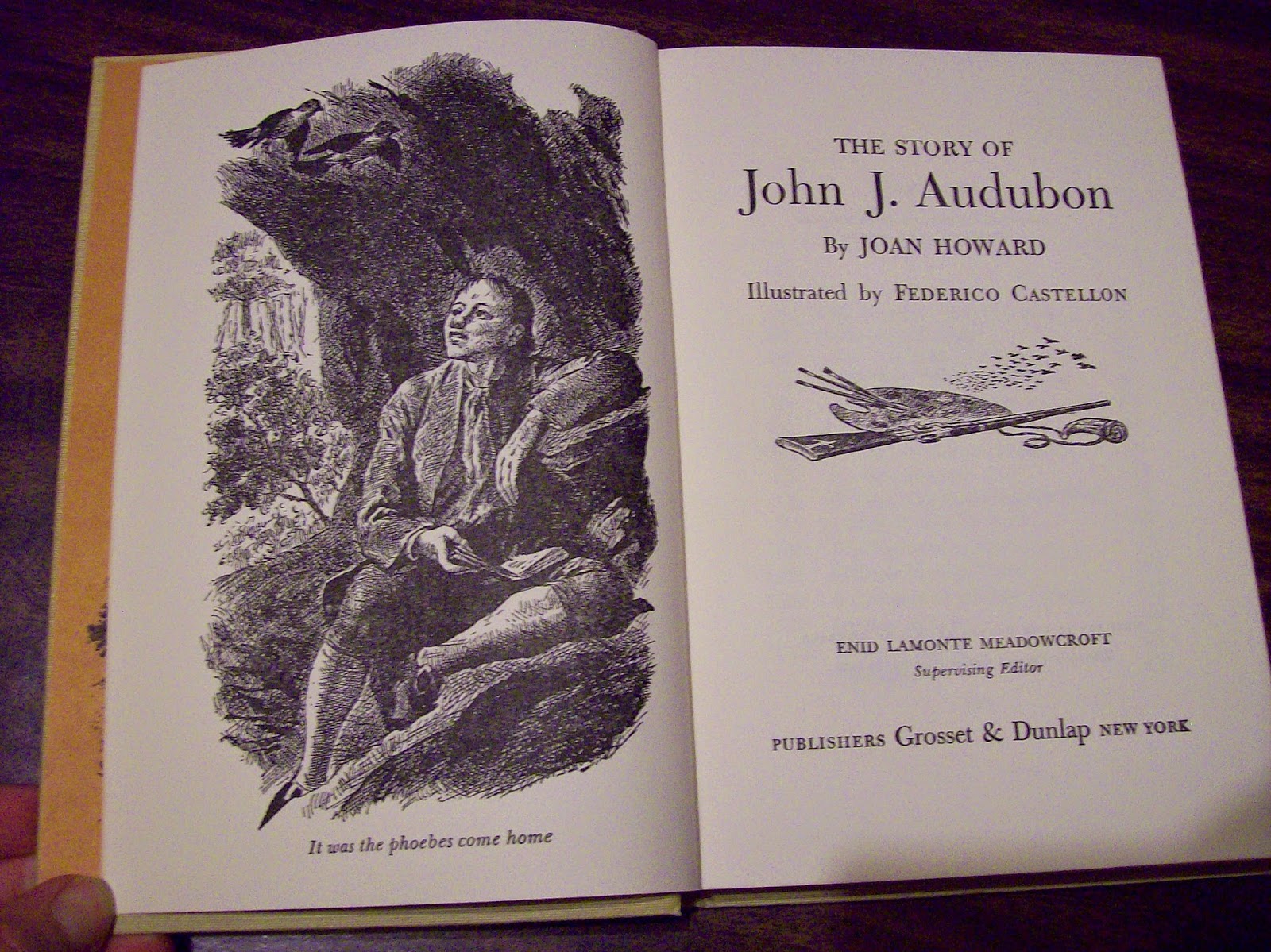
Last term, we studied Benjamin West and his work for our Artist/Picture Study.   This term, we are studying John James Audubon.  We started off reading The Story of John J. Audubon, which is a Signature Book by Joan Howard.   I spent over a week reading the first five chapters aloud.

Initially, there was a small spark, but it just didn't catch fire.  After some pondering with the kiddos, we decided to scrap it.  Instead, reading The Boy Who Drew Birds: A Story of John James Audubon by Jacqueline Davies.  It is recommended by both TruthQuest history and Beautiful Feet.  Davies' book proved to be a suitable replacement.  Obviously the picture book didn't afford the depth of the Signature Book.  However, it provided an overview with a fascinating story and wonderful illustrations.  Now that we have some history on Audubon, we will continue to study his drawings throughout the term using The Birds of America.