Tuesday, May 24, 2016

Living Science Book Sale...

Updated 9-24-2016 Updated 11-23-2016

Spring is definitely in full swing here on Drywood Creek and nature study is at its peek!  In preparation, RileyAnn and I cleaned off our science shelves and decided to offer you some fabulous books.

We are a smoke and pet free home.  Some books are ex-library, while others are from private collections.  There are several out of print books as well.   I accept PayPal and ship media mail anywhere in the U.S.  Please use the contact form on the right side bar for questions, clarifications, or book list quotes.

Thanks for your consideration,
Melissa

Science

The Brown Paper School Series $4 each
-       This Book is about Time by Marilyn Burns
-       Blood and Guts by Linda Allison SL 5/F

The Magic School Bus Lost in the Solar System by Joanna Cole SL $2

White Snow Bright Snow by Alvin Tresselt $3

Rain Drop Splash by Alvin Tresselt $3

Dolphin Adventure, A True Story by Wayne Grover SL $3 each

Shark Lady, True Adventures of Eugenie Clark by Ann McGovern SCM $3 each

Unlocking the Mysteries of Creation by Dennis Petersen (hardcover) $4

Science Around the Year by Janice VanCleave $5

202 Oozing, Bubbling, Dripping, & Bouncing Experiments by Janice VanCleave $4

Rocks & Minerals by Janice VanCleave $3

Microscopes and Magnifying Lenses by Janice VanCleave $3

See For Yourself More Than 100 Experiments for Science Fairs & Projects by Vicki Cobb $4

A+ Projects in Biology by Janice VanCleave $4

Science in the Creation Week by Unfred – grades 2-5 $5

Exploring Nature with Your Child by Dorothy Edwards Shutttlesworth (hardcover) $6

The Tarantula in My Purse and 172 Other Wild Pets by Jean Craighead George WP $3 each

I Wonder Why series $10 set
-       Why Fish Don’t Drown and other neat facts about underwater animals
-       If Dragons are Real and other neat facts about reptiles & amphibians
-       Why Skunks Are So Smelly and other neat facts about mammals
-       Where Butterflies Go In Winter and other neat facts about insects
-       Why Kangaroos Have Pouches and other questions about baby animals

Field Trips by Jim Arnosky (hardcover) $5

Fun with Nature Take-Along Guide (hardcover) $4

Glow-in-the-Dark Fish and 59 More Ways to See God through His Creation by B.J. Reinhard (hardcover) $4

Our Place in Space and 59 More Ways to See God through His Creation by B.J. Reinhard (hardcover) $4

The Country Diary of an Edwardian Lady by Edith Holder (hardcover w/jacket) $8

Kids Can Do It Electric Gadgets and Gizmos Battery-powered buildable gadgets that go! By Alan Bartholomew $3

Kids Can Do It Electric Mischief Battery-powered gadgets kids can build By Alan Bartholomew $3

Teacher Created Materials Thematic Unit Inventions (Intermediate) $3

The Nature Company Discoveries Library – Flight by Donald Lopez (hardcover) $3

Usborne Science with Magnets $4

Turtles by Bertie Ann Stewart and Gordon E. Burks (hardcover) $3

Simple Chemistry Experiments with Everyday Materials by Louis V. Loeschnig $3


Hands-On Physical  Science Activities for Grades K-8 $4 


Making Things Float and Sink with Easy-to-make Scientific Projects $2


Science Topic/Unit Sets

Insects & Spiders $15 set

The DK Picturepedia Insects and Spiders
Simon & Schuster’s Children’s Guide to Insects and Spiders by Jinny Johnson
Incredible Insects! (and spiders too!) by Annalisa Suid
Teacher Created Material Thematic Unit on Creepy Crawlers
Dover Coloring Book – Insects by Jan Sovak
Monarch Butterfly by Gail Gibbons
Usborne First Nature Butterflies and Moths
Little Giants by Seymour Simon
Monarch Butterflies by Alice L. Hopf
Spiders by Gail Gibbons
Life Story – Spider by Michael Chinery
The Audubon Society Field Gide to North American Insects & Spiders
Lady Bugs by Mia Posada
Charlotte’s Web by E. B. White
Misc. activities to accompany study


Animal/Mammals/Habitats $15 set

Dover Coloring Book – Ponies of the World by John Green
The Magic School Bus Adventures in the Food Chain Coloring and Activity Book
Animals of the Bible by Dorothy P. Lathrop
The Racers: Speed in the Animal World by Hilda Simon
DK Eyewitness Amazing Wolves Dogs & Foxes
Nature’s Children – Hippopotamus by Sally Banks
Wallabies and Their Babies by Marianne Johnston
Who Lives Here? By Dot and Sy Barlowe
Animals Keeping Safe by Jane Burton
Animals in Their Homes by Anita Ganeri
A First Look at Animals with Horns by Millicent E. Selsam and Joyce Hunt
What is a Mammal? By Jenifer Day
An Animal Information Book – 14 book set
-       Lions & Tigers
-       Puppies & Dogs
-       Kittens & Cats
-       Zoo Animals
-       Horses & Ponies
-       Farm Animals
-       Baby Animals
-       Bears
-       Birds
-       Wild Animals
-       Monkeys & Apes
-       Sea Animals
-       Reptiles & Amphibians
-       Big & Little Animal
Misc. activities to accompany study


Birds $15 set

Birds in the Sky by Lucy and John Hawkinson
The Peregrine Falcon by Alvin, Virginia, and Robert Silverstein
The Eagle and the River by Charles Craighead
Owls and Their Homes by Deborah Chase Gibson
Bird Watching by Aubrey Burns
Ducks Don’t Get Wet by Augusta Goldin
How Ducklings Grow by Diane Molleson
Animal Architects: How Birds Build Their Amazing Homes by W. Wright Robinson
Bird Watching Housing and Feeding by Walter E. Schutz
Misc. activities to accompany study


Plants & Trees $ 15 set

Growth and Change in Plants – The Solski Group
Plants by Linda Schwartz
Plants – From Your Friends at Mailbox
Teacher Created Material Thematic Unit Our Environment
The Great Kapok Tree by Lynne Cherry
Starting With Nature: Trees by Pamela Hickman
Seeing Science through Art Sky Tree by Thomas Locker
Corn Belt Harvest by Raymond Bial
Sugar by Sheryl Peterson
Growing Apples and Pumpkins by Amy and Richard Hutchins
Trees of the Eastern and Central United States and Canada by William M. Harlow (field guide)
Misc. activities to accompany study


Earth Science & Biomes $10 set

Our Earth, a skill-builder activity book
Science in Special Places by Lucia Kemp Henry
Teacher Created Material Thematic Unit Rocks & Soil
A Walk in the Deciduous Forest by Rebecca L. Johnson
Rivers by E. Joseph Dreany
Planet Earth Animals of Africa by Lisa L. Ryan-Herndon
The Taiga Biome by Carol Talley
Misc. activities to accompany study


Oceans $10 set

Outstanding Oceans! By Annalisa Suid
Habitats Oceans and Ponds by Jo Ellen Moore & Joy Evans
Sea Turtles by Frank Staub
Giant Tubeworms by Valerie J. Weber
Whale Sharks by Sarah Palmer
Blue Whales by Sarah Palmer
Whales the Gentle Giants by Joyce Milton
Sharks by Brenda Z. Guiberson
Misc. activities to accompany study


Human Body & Nutrition $15 set

Food, Fact, Fund & Fiction by The Solski Group
The Human Body by The Solski Group
Your Body by Linda Schwartz
Science Pocket – Human Senses & Body Parts by Dinah Zike
Drugs & Your Body – Creative Teaching Press
The Air I Breathe by Bobbie Kalman & Janine Schaub
Looking Into My Body by Nigel Nelson
Your Lungs by Anne Ylvisaker
Your Stomach by Anne Ylvisaker
A Book About Your Skeleton by Ruth Belov Gross
Misc. activities to accompany study


Physics, Magnets, & Electricity $10 set

Delta Science – Properties of Matter
My First Batteries & Magnets Book by Jack Challoner
A True Book – Experiments with Magnets by Salvatore Tocci
Science Secrets: Magnets by Jason Cooper
Electricity Unit Study Adventures by Amanda Bennett
All About Electricity by Melvin Berger
Misc. activities to accompany study

Friday, May 20, 2016

Friday Findings: BF Modern American and World History, Classical Education, Object Lessons, R. W. Emerson on Reading Plutarch, and Limiting Summer Screen Time....

We're celebrating our last official week of the academic school year here on Drywood Creek.  We will continue BF Modern American and World History as well as some intermittent math and reading over summer, but for the most part, our 'school year' has ended.  Over the next couple of weeks, I hope to start my summer planning mode, which gets me excited since I'm a better planner than an implementer of my plan....ahem.  

I don't have a ton of links this week since I haven't been on online much.  In my quest for knowledge on Classical Education, I've been checking out Classical Conversations over the past couple of months. I've observed Foundations, Essentials, and Challenge A in the past, as well as spending a day in a CC Parent Practicum this week.  I'll be posting my observations at some point over the upcoming summer months.  But for now...

Nicole Williams at Sabbath Mood Homeschool wrote some helpful thoughts on Object Lessons.

Did you know Ralph Waldo Emerson read Plutarch?  Anne White shows us a quote in On the boyhood reading of Plutarch.

In 8 Ways We Limit Screen Time in Our Home, Marianne gives some excellent tips for setting up your summer without screens.

That's all for this week.  I'm off to more thrift sales today.  A neighboring community holds their annual city wide sales this weekend.  The kids and I look forward to it every year!

Monday, May 16, 2016

Contemplating Classical Education: Various Types, Part 2 (Norms & Nobility and Catholic Classicism)....

It's been a couple of months, but I'm finally getting back to Classical Education: The Movement Sweeping America by Veith and Kern.  In this part 2, I aim to further my contemplation's on the various types of classical education.  You can view Part 1 here, which reflects on Christian Classical and Democratic Classicism.

Norms and Nobility

Much has been made in the Classical Education revival movement of David Hicks' Norms and Nobility: A Treatise on Education.  This less than two hundred page treatise was originally published in the early 1980's, but has since been reissued.  Hicks is the first to confess that his writing was not originally intended for a book with a variable audience in mind.

In the 1970's, Hicks was hired to write a curricula for the Westminster School in Atlanta, GA.  As part of his research process, he had the privilege of traveling to the best schools to get ideas for the development of his curricula.  As time went on, he decided to publish his findings so people could see what Classical Education is and what it was attempting to achieve.  His hope was then that parents and teachers would come up with their own ideas on how best to put those findings into practice in their own schools and homeschools.

In Classical Education, The Movement Sweeping America, Veith and Kern, say this about Hicks' book...
In his book, Norms and Nobility: A Treatise on Education (1981), Hicks develops these ideas into a comprehensive theory of education.  He places special emphasis on the importance of teaching morality and fostering virtue that characterizes the classical approach to learning but noticeable by its absence in most contemporary schools. Norms and Nobility offers a modern curriculum and methodology based on classical standards and ideals.... (pg. 48)
Veith and Kern further assert that "If the ACCS offers a Christian classicism and Paideia champions a democratic classicism, Hicks can be described as a spokesman for what he calls a 'normative classicism'."  I believe this to mean normative as of or relating to a norm, especially an assumed norm regarded as the standard of correctness in behavior, speech, writing, etc. and classicism meaning the ideas and styles that are common in the literature, art, and architecture of ancient Greece and Rome and/or a traditional style of art, literature, music, architecture, etc., that is usually graceful and simple with parts that are organized in a pleasing way.   Veith and Kern also suggest Hicks "...finds inspiration in the ideals of Plato.  He builds his educational theory on a search for the ideal and a condition that education should be a path to virtue".

In theory, according to Veith and Kern, Hicks argues that ancient education looks very different from modern education.
The present clash is between the normative and the analytical.  In the ancient world, teachers and students learned together in an atmosphere dominated by what Hicks calls the Ideal Type. The Ideal Type is an image of the fully developed human being.  
Because educators accepted the Ideal as a model or prototype, their instruction was aimed at cultivating within individuals what we now call "the whole person."  The educational Ideal informed what the individual aspired to become; it expressed what religion taught as God's will for mankind; and it incorporated the most elevated components of what classical culture held up for admiration.
The rise of "modern" philosophy changed all that.  The Ideal Type was replaced by scientific method, which reduced the reality of the Ideal to the particularity of atomized individuals whose traits could be measured.  (pg. 50-51)
Charlotte Mason addressed this same issue in Principle 12, which states 'Education is the Science of Relations'.  She believed in providing a broad and liberal education for all children in order to cultivate "those first-born affinities", rather than teaching to the test or providing a utilitarian education.

Hicks also advocates cultivating virtue in lieu of merely helping students become successful in a career.  He suggests that we rely on dialectic, the art of investigating, to teach virtue, as "Everything begins with the question." This should be done using good books, i.e. classic literature.
...classical schools should be selective about what students read.  Such schools will prefer time-honored books to those that superficially reflect current trends.  History will be studied without cynicism, and ancient soul-nourishing myths, folk tales, and Bible stories will be cherished.  Even science will be taught in light of virtue.  (pg. 52)
In Classical Education..., Veith and Kern explain Hicks' use of dogma, which is a Greek word meaning 'that which seems good' in teaching truth.
Classical teachers must be dogmatic teachers in the sense that they cannot be skeptical or neutral toward knowledge.  Instead, they must be committed and responsible to knowable truth.  (pg. 53)
The student accepts dogma, but as the teacher and student read, they question, or use dialectic, "to reformulate dogma to better align with truth".

This chapter holds some really great information that I will not further give away here, but suffice to say, I hope to someday read Norms and Nobility for myself.  If you're interested in more information regarding David Hicks and/or Norms and Nobility, may I suggest this podcast between David Hicks and Matt Bianco,  this CiRCE Institute Q&A Podcast with David Hicks, or this CiRCE Magazine interview with David Hicks.   Brandy Vencel at Afterthoughts blog also did a series of posts relating her thoughts on Norms and Nobility against some of Charlotte Mason's theory.

Catholic Classicism
No institution has a longer tradition or more vigorous claim to classical education than the Catholic school.  While only a few Catholic schools refer to themselves as classical, Catholic education has always contained a classical element, and today there are a variety of classical forms within the orbit of Catholic education, including home schools., home school co-operatives, parochial schools, and private schools.  Though a relatively small movement, classicism has a long heritage and a natural home within Catholicism.  (pg. 59)
I attended a Catholic school from 1st through 8th grade.  I am no longer a practicing Catholic, but I have always felt privileged by the wonderful elementary education I received in comparison to my public high school counterparts.

Veith and Kern point out the excellence of Catholic education as being rooted in tradition.  The history of Catholic education dates back to the early church fathers beginning with Cassiodorus in the sixth century, Thomas Aquinas in the Middle Ages, Ignatius Loyola and the Jesuits in the sixteenth century, John Baptist de la Salle in the seventeenth century, and Elizabeth Ann Seton in the U.S. in the early 1800's.  With the rise of Catholic schools, came a conflict with dominant Protestant culture eventually sparking the 1834 burning of a Catholic convent and the 1844 Philadelphia Bible riots.   As a result, state funding was ended for Catholic schools.  To no avail, the Catholics instead embraced the change and enrollment in Catholic schools increased, peaking in 1965 at over 6 million students.  Sadly, a great decline has occurred for a variety of reasons since.

The theory of Catholic Classicism, as cited by Veith and Kern, outlines five qualities of Catholic schools.  First, Catholic education forms the whole child with "eyes fixed on a vision of God."  "Second, Catholic schools are founded on a Christian anthropology - a term that means "an understanding of man" and that comes from the Greek word for 'man,' anthropos."  Third, the school is developed as community based on teamwork among all involved, interaction of students and teachers, and the school's physical environment and appearance.  Fourth is a distinct Catholic Worldview.  And, fifth, Catholic schools attempt to maintain staff "who meet the standards of doctrine and integrity of life essential to maintaining and advancing a school's Catholic identity."  Veith and Kern further assert,
These five characteristics of Catholic education mesh well with the four characteristics of classical education presented in this book, namely: a high view of man, logocentricity, a respect for the Western tradition, and a pedagogy that concentrates its efforts on a true classical liberal arts education. (pg. 65)
Catholic education is rooted in a tradition that values a sense of history.  (pg. 65)
Catholic schools prioritize the liberal arts, emphasizing knowledge, thought, communication, and conversation.  (pg. 65)
Catholic schools promote personalism over individualism.   (pg. 65)
If you are interested in learning more about the practice of Catholic Classicism, Designing Your Own Classical Curriculum by Laura Berquist is a great place to start.  "Berquist founded Mother of Divine Grace School in 1995, and it now serves about 4,000 students. It is accredited and licensed in California and provides home schooling legal and curricular assistance to families."   The Kolbe Academy is another excellent resource, as is Seton Home Study School.

This wraps up the various types of Classical Education as outlined by Veith and Kern in Classical Education, The Movement Sweeping America.  There are a few chapters left that I will attempt to outline as I read and ideas are sparked.

Friday, May 13, 2016

Friday Findings: School Reviews, Hiding a Bible, Classical Education, and Charlotte Mason...

We're down to one week left of our official academic school year here on Drywood Creek!  You may have noticed some of my review/wrap-up posts over the past couple of weeks.

Beautiful Feet History of Science
Beautiful Feet Modern American and World History
Life of Fred

Over the coming months, I will continue to review as well as brainstorm about possibilities for fall.  I've also been cleaning shelves and purging books.  I have listed and will continue to list books as they become available.

Around the web this week I found Rea Berg's historical post, A Bible in a Chignon? fascinating.  We have so many freedoms here in America, that it's hard to fathom not being able to freely worship.  ....And, our ancestors were so clever!

How do you define Classical Education?  In What is Classical Education?, Dr. Christopher Perrin attempts to share his thoughts on a definition.  I'm a word girl so the etymology of 'classical education' is interesting to me, but Dr. Perrin's analogies are also fabulous in painting a picture of classical education.  There is so much to ponder in his 16-minute video clip at the bottom.  I will more than likely be watching it again many times over as I further my study of classical education.  The last 60 seconds spoke volumes to me.

I started reading Consider This by Karen Glass when it was first published, but got distracted and let if fall by the wayside.  It's now back on my summer reading list as I hope to pick up and finish where I left off.  In the meantime, Carol at Journey and Destination gave a wonderful overview in Consider This: Charlotte Mason and the Classical Tradition by Karen Glass.

We're also thinking about planting our vegetable gardens soon, though the possibility of frost has not quite past.  Dear daughter has been working fervently in the flower gardens, while brother inspects :)


Monday, May 9, 2016

Beautiful Feet Modern American and World History Update...

We are a little over half way through our Beautiful Feet Modern American and World History study (lesson 65 of 117) with only a couple weeks left of our academic school year.  The program is fabulous!  The books are incredible!  However, as previously mentioned, the readings are long and I've had to split the lessons in half so we are not making the progress I'd hoped.  Fortunately, our kids love history so much that in our discussion on how to proceed, they were quick to jump at the chance to continue over summer....now that says a ton about the program if you ask me ;-)

The books we've read so far are:

Across Five Aprils by Irene Hunt
The Perilous Road by William O. Steele
Frederick Douglass Fights for Freedom by Margaret Davidson (subbed for Narrative of the Life of Frederick Douglass)
Carver: A Life in Poems by Marilyn Nelson
Theodore Roosevelt by Genevieve Foster
The Wright Brother: Pioneers of American Aviation by Quentin Reynolds
Sergeant York by John Perry
The Singing Tree by Kate Seredy
Rascal by Sterling North
Gladys Aylward: The Little Woman by Gladys Aylward
Roll of Thunder, Hear My Cry by Mildred D. Taylor
House of Sixty Fathers by Meindert De Jong (currently reading)

As I was typing this list, I immediately began to feel sentimental.  My memories are fond.  I was thinking about a favorite and couldn't narrow it to one book.  I can totally see how the folks at Beautiful Feet had a hard time making the final cuts.

In looking at the books ahead, we've read Twenty and Ten by Claire Huchet Bishop and The Little Riders by Margaretha Shemin in the past while using Sonlight so I don't plan to re-read them, although, they are excellent books.  Riley remembers both.  Ruben was sketchy so I may have him read them independently.  I have also heard fabulous reports on Snow Treasure by Marie McSwigan and will consider substituting it depending on how I feel the coverage is after skipping the above two mentioned books and also considering time.

For more information on our study, you can read my Getting Started post here and our Term One Review here.  There are also samples of numerous notebooking pages at both posts as well as the linked books above.  Overall, we are loving this BF study and not only will continue, but also recommend it!  

Friday, May 6, 2016

Friday Findings: Old Science Books, FREE Greenleaf Guide, Multiplication Circle Patterns....

Ball, books, babysitting, and buying the next size clothing for our kiddos is what this week brought.  I can't believe it's already Friday!  And would you believe it could hit 90 degrees today here in WI!!  Speaking of books, I just have to share a bit of info on our local homeschool curricula sale happening tomorrow....

Annual Chippewa Valley Homeschool Book Sale
& Kid’s Craft Sale
Sponsored by HomeStars (Homeschool Ministry of Bethesda Lutheran Church)

Saturday, May 7, 2016
9:00 a.m. to 12:00 p.m.

Bethesda Lutheran Church
123 W Hamilton Avenue
Eau Claire, WI 54701

40+ vendors with new and used books, curriculum, toys, games, crafts, and misc. educational resources  

There’s something for everyone!!

I totally realize many of you are around the world from me and it's not possible to attend, but for those of you in and around the area, it's always a good time.  And, for those of you anywhere in the lower 48 states, I will be posting updated book sale lists very soon, so stay tuned.

Around the web this week, I was intrigued by How Old is Too Old for a Science Book because this is something I often wonder.  You can't change history, but science is constantly evolving.  There are new science discoveries and theories every day.  Some are obviously better, but some...well, who's to say.  I love what Nicole has to say about using living science books.  I was encouraged to hear a mix of both is best.

I cannot believe the Greenleaf Guide to Old Testament History is FREE on Lulu!!  This resource looks amazing and I've been contemplating using it with the kiddos in the fall.  I've owned the print copy for years, but was elated to see it accessible online as well.

We need fact practice!  There's just no way around it.  This week I stumbled on this Multiplication Circle Patterns post that looks super fun.   I printed the lesson plan and intend to try it.

At home, The Farmer recently dumped a sand pile for the boys.  Here they are in last week's cold, rainy weather building a 'retention pond'....


Wednesday, May 4, 2016

Roll of Thunder, Hear My Cry...

The more I read, the more it takes to impress me.  I've noticed that I am pickier than I used to be about what constitutes a good book.  But every now and then, I still come across one.   Roll of Thunder, Hear My Cry by Mildred D. Taylor is one of those great books.  It is the story of an African-American family's struggle in the deep south during the Great Depression.  It is a book about racism.

Though Taylor's subject matter is heavy, her story is engrossing.  The characters are deep, sympathetic, and multi-faceted.  Taylor develops them in such a way that we see their person-hood come to life.   Throughout the struggle and hardship, there is growth.  I used one such example a couple of weeks ago in A Matter of Principle.

It is my understanding that Roll of Thunder, Hear My Cry is part of a series Taylor wrote, with it being a middle book chronologically in the series.  I have not read other books in the series, but I know RileyAnn was immediately investigating them and plans to read more at some point.  I have seen Roll of Thunder, Hear My Cry on many book lists including, Sonlight and TruthQuest, but of course, we read it as part of our Beautiful Feet Modern American and World History study.  When studying American history, Roll of Thunder, Hear My Cry by Mildred D. Taylor is not to be missed!

Monday, May 2, 2016

My Love Hate Relationship with Life of Fred....

Kids love Fred.  My kids even love(d) Fred.   Some parents love Fred.   Some parents think it's all you need for math and that Life of Fred can stand alone.  I have worked through Apples to Goldfish with Ruben.  I do not love Fred.  I do not think Life of Fred is a stand alone math program.   But wait, before throwing stones, please let me explain...

I acquired a few elementary Life of Fred math books several years ago, when they were first coming on the scene.  I had/have friends using them with mixed reviews so I wasn't sure I wanted to attempt them.  However, after hitting many walls with traditional curricula, this year I caved.

RileyAnn really wanted to try Life of Fred so she was my biggest push.  She dabbled in the intermediate levels of Fred at the end of 5th grade, but felt like she was missing the story and the math was a bit of a challenge, so she started back at the beginning this year in 6th grade with Life of Fred Apples.  Initially, she was loving the story and the math was easy so she thought it fun.  I thought, how fabulous!  Fred is bringing life and a love of math back into our homeschool.

Of course, what's good for the goose, must be good for the gander, so I immediately sought to start Life of Fred with Ruben.  After all, he was also struggling in math and I so wanted to develop a love of learning.  Therefore, we also began with Life of Fred Apples.  Riley worked independently, but Ruben and I worked together.  I read Fred aloud and he performed "Your Turn to Play" on paper, just as prescribed.  Without hesitation, he too loved the story so we tarried on.

After finishing Apples, Ruben wanted to continue with Butterflies.  After finishing Butterflies, he wanted to continue with Cats.  After finishing Cats, of course, we had to proceed with Dogs....and so the story goes.  Our school year pushed forward, one month leading into another as we walked through Life of Fred.

Now, as for me, I suspected twaddle early on.  Something just didn't feel right.  The story is just so stupid! The words of Charlotte Mason rang in my head, "I have said much of history and science, but mathematics, a mountainous land which pays the climber, makes its appeal to mind, and good teachers know that they may not drown their teaching in verbiage." (Vol. 6, p. 51)  "Verbiage", hmm, could this be Life of Fred?   I found myself continually questioning and wrestling with the use of it.  And, why was I trying to make math 'fun'?  Isn't math true and beautiful in it's own right?  I felt like Life of Fred was trying to hide math in a story.....verbiage.  Also, there is not enough practice in Life of Fred for long term retention!  You either need to supplement or have facts mastered before beginning Fred, which is not indicative of a stand alone math program.  

On the other hand, presentation of what might be considered a difficult concept, became easier with Life of Fred.  Ruben was able to see math in a useful sort of way.  Numbers on a page are confusing to him.  However, he's quite genius with story problems and mental math.  Life of Fred presented some concepts of higher level math in a way that made understanding achievable for him.  This pacified my worries short term, but I kept having moments of doubt.  My kids still appeared to be loving it....or were they?

Ironically, about early March, after RileyAnn  had worked through nearly the entire elementary series, she came to me and said something like, mom, when can I go back and do real math?   I said, whatever do you mean by 'real math'?  She talked about having a more traditional text with pages of problems, rather than a storybook.  She explained that Life of Fred was becoming sickening to her because Fred kept having problems that he was too dumb to figure out.  She felt Fred was "cheesy".  I was shocked and elated!  I jumped for joy, not only because I was never a real fan of Fred, but because our 12-year old came to my conclusion all on her own.

Unfortunately, Ruben wants to continue Fred simply because of the story, but he hates the math.  We are currently in Honey and it's getting a bit more difficult for him.  He did say, he will be satisfied to finish the elementary series and move on to something else.  Now, you might say, if it's not working, why give him a choice?  Truth be told, we have three weeks left of school.  Wisconsin weather looks like it is finally going to settle into spring.  We are busy with other things and I really don't want to start a new math program at this point.  We will finish Honey and call it good.  If Ruben wants to read Ice Cream and Jelly Beans on his own, I certainly will not stop him.  However, I am personally done with Life of Fred!

By the way, Riley did also complete Simply Charlotte Mason's Your Business Math this year, as well as some misc. math books like Fractals, Googols, and Other Mathematical Tales and Mathematicians Are People Too, so all was not lost.   She has since went back and finished an old Math-U-See book and now she's working through a Modern Curriculum Press workbook that I had laying around, which actually seems like a good fit.  I'm trying to decide where to go from here. She is not quite ready for pre-algebra, but I'm actually OK with that....maybe by 8th grade. I really believe in getting arithmetic down solid before starting algebra.  Riley still hates math and feels like she's not good at it, though I would beg to differ. I think most other subjects come fairly easy for her and she's a perfectionist so when math is a bit challenging, she gets overwhelmed. I've actually been contemplating Saxon for a variety of reasons or possibly going back and finishing the elementary series of Math-U-See. I think she could work through them faster now and probably complete the last three elementary levels in 1 1/2 to 2 years. On the other hand, if MCP continues to go well, maybe we'll just stick with that until Algebra....I don't know, some days it feels like a crap shoot. It's six to one, half dozen the other.  However, I do know Life of Fred did not create the love of math in either of my kids that I'd hoped. More importantly, it did not strengthen their math skills.  And, it did not help them see the beauty and truth of mathematics.
Let his arithmetic lesson be to the child a daily exercise in clear thinking and rapid, careful execution, and his mental growth will be as obvious as the sprouting of seedlings in the spring. - Charlotte Mason, Vol. 1, p. 261
The question of Arithmetic and Mathematics generally is one of great import to us as educators.  So long as the idea of 'faculties' obtained no doubt we were right to put all possible weight on a subject so well adapted to train the reasoning power, but now we are assured that these powers do not wait upon our training.  They are there in any case; and if we keep a chief place in our curriculum for Arithmetic we must justify ourselves upon other grounds.. We take strong ground when we appeal to the beauty and truth of Mathematics; that, as Ruskin points out, two and two make four and cannot conceivably make five, is an inevitable law.  It is a great thing to be brought into the presence of a law, of a whole system of laws, that exist without our concurrence, - that two straight lines cannot enclose a space is a fact which we can perceive, state, and act upon but cannot in any wise alter, should give to children the sense of limitation which is wholesome, for all of us, and inspire that sursum corda which we should hear in all natural law. - Charlotte Mason, Vol. 6, p. 230-231 

Friday, April 29, 2016

Friday Findings: Grammar, Computers in Class, Can We Eat to Starve Cancer?...

Uffda, we nearly ran ourselves ragged thrift saling this week!  This is how I cloth my family on a very slim budget.  There were many neighborhood sales in surrounding communities yesterday.  It was raining and sleeting at only 39-degrees, but we found some deals.   Now, I will spend the weekend doing laundry, sorting closets and dressers, pulling out the too small and filtering in the new.  I actually rather enjoy it and the kids LOVE it!   They get so excited about their new treasures.  Even if we strike it rich some day, I believe we'll still sale.

Also, this week, around the web, I've been studying Grammar, trying to figure out the direction my students should go in the fall.  I found The Death of Grammar and the End of Education interesting.  I'm still pondering this one.

“One of the most powerful tools in education is conversation,’’ says Dr. Vallance in Computers in Class "a scandalous waste": Sydney Grammar Head, a fairly short article with much wisdom.

On a little health note, in Can We Eat to Starve Cancer?, Dr. Li gives some excellent food for thought...pun intended ;-)

Now, we're off to ball practice, but I'll leave you with the cousins....


Monday, April 25, 2016

Beautiful Feet History of Science Wrap-Up....

We wrapped up our Beautiful Feet History of Science last week.  I mentioned in the past that we used an original guide, not the newest History of Science pack, which, by the way, I was able to view at the Great Homeschool Convention and it looks great as well.   I love that they added a book about DaVinci by Diane Stanley and another about George Washington Carver.

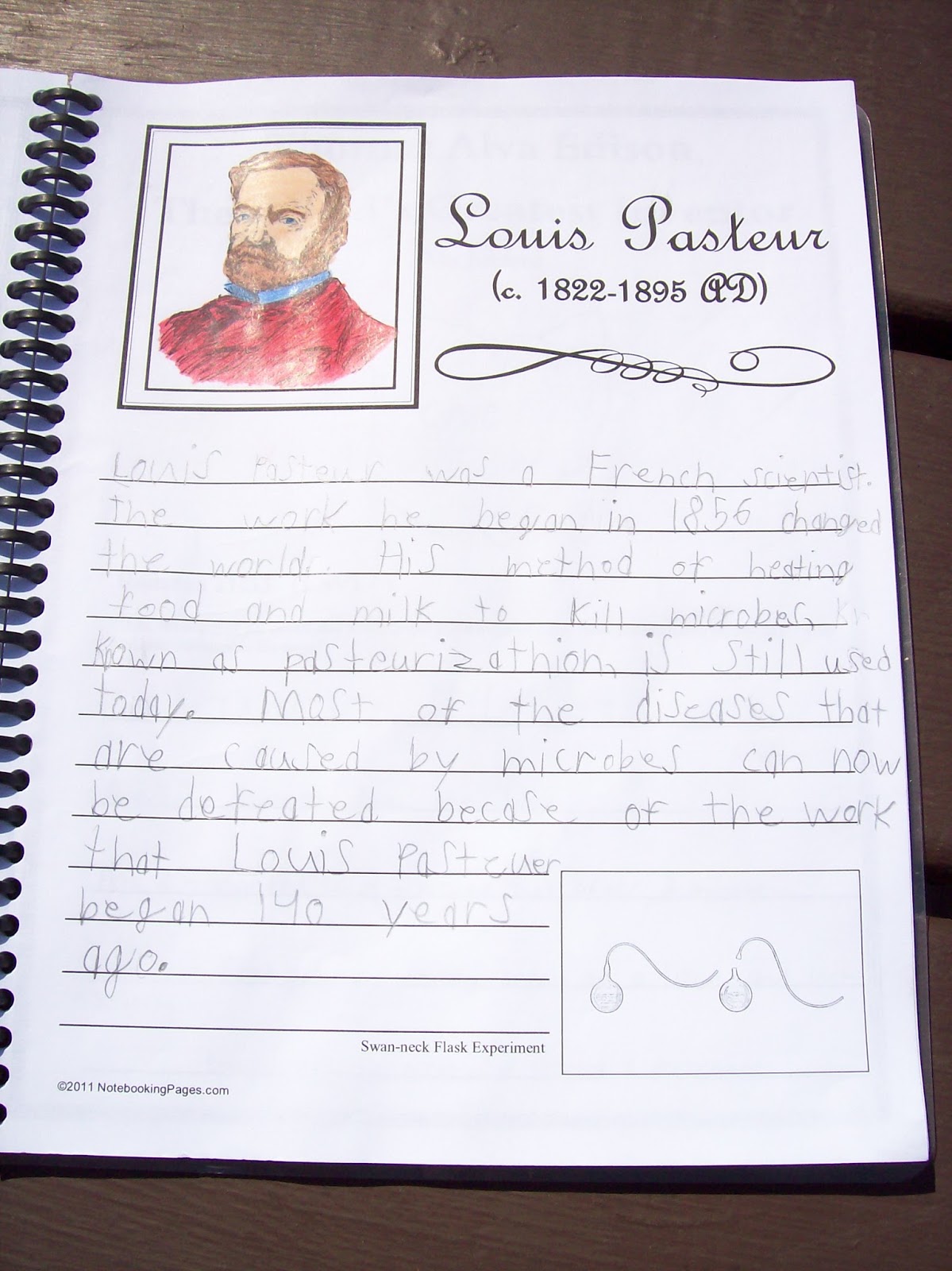
Anyway, I digress.  The original BF Science guide that we used had sixty-seven lessons, which allowed us to work through two lessons per week, a very doable pace.  We read books about great scientists like Archimedes, Galileo, Benjamin Franklin, The Wright Brothers, Louis Pasteur, Thomas Alva Edison, Marie Curie, and Albert Einstein.  The Picture History of Great Inventors by Gillian Clements, allowed us to discover many other inventors/scientists even though we didn't do an in depth reading/study of them.  In a one to two page spread, listed chronologically, The Picture History... covers the lives and work of over 50 inventors throughout history.

The BF History of Science also offers plenty of opportunity for experiments and hands on learning.  My kids are not big on science experiments so they did balk a bit at these.  I didn't make them complete all of the experiments, but at a minimum, they were required to read through them.

In addition, there was a good amount of notebooking.  You may remember from my first post about BF History of Science, that I created notebook pages for each of my students and bound them prior to beginning.  This is not necessary, but the kids really did like them.  They enjoy having a record and being able to look back through their work.  It's also good for review.  For other BF guides, we've simply used sewn composition books for our notebooking exercises.

Overall, we really enjoyed this fabulous study!  I believe it's intended for use with students in grades 3-7.  Riley and Ruben are in 5th and 6th and I felt this was an excellent and appropriate age for this study.  Younger students may enjoy the experiments more.  Older students may get more out of the notebooking exercises.  Speaking of which, I will leave you with more samples of our notebooking pages....


Saturday, April 23, 2016

Gladys Aylward...

Gladys Aylward was an amazing woman!  After reading her autobiography, written in conjunction with Christine Hunter, as part of our Beautiful Feet Modern American and World History study, I have a much greater appreciation for her life and work.  This Little Woman put her faith and trust in God to provide not only for her needs, but the needs of the children He entrusted in her care.  I remember reading a bit about Aylward from Hero Tales through Sonlight when Riley was in Kindergarten or first grade, so her name was familiar to me.  However, Gladys Aylward, The Little Woman really brought her story to life.

After reading the book, we did watch The Inn of the Sixth Happiness, starring Ingrid Bergman.  The film was good as far as movies go, but it was not an accurate portrayal of Aylward....definitely not in accordance with her autobiography.  I was a little disappointed, particularly with the romance Bergman developed throughout her role of Aylward's mission work.  It was surely made for Hollywood.  If you have to pick between the two, I would highly recommend the book over the movie.

Below are some of RileyAnn's notebooking pages she created during our study of Gladys Aylward...


Friday, April 22, 2016

Friday Findings: No Supermom Here, Lost Boys, The Green Ember, Conflict of the Story, and Simplifying Childhood....

I'm sorry I've been mostly absent here again this week.  April has been incredibly chaotic! I feel like winter activities are overlapping with spring activities.  Riley and Ruben started softball/baseball.  They have practices many evenings and scrimmages this weekend.  Wednesday we finished our last 5th/6th Grade Socratic Book Club.  We read The Secret Garden by Frances Hodgson Burnett.  It was wonderful and I plan to post a follow-up soon.  Yesterday RileyAnn finished choir and had her concert last night...which was fabulous!  We are so blessed to have a homeschool choir in our area!

Unfortunately, last weekend, my neck seized up and I've been fighting extreme pain in my occipital nerve.  I had a trip to ER, follow-up with doc, and three trips to our chiropractor this week. Next Monday I start physical therapy.  I don't tell you this for sympathy as I know many busy moms have struggles, just as part of the explanation for my absence.  The light from the computer screen and typing sends me into a frenzy.  I'm so grateful for dear friends and prayer for healing.  The kiddos have been great in picking up the slack while I attempt rest, altering between ice and heat.  I'm trying to avoid the Valium I was sent home from ER with since it makes me loopy, but Ibuprofen is a must.  I did get a full night's rest last night, which hopefully means things are turning a corner.  The down time has given me many ideas for blogging so stay tuned.

One thing I did manage to read online this week was Life Without a Cape, There Are No Supermoms Here by Brandy Vencel.  I found it extremely timely, especially in my condition.  I know in blog land it can sometimes seem like us bloggers live a dream life.  Let me be the first to tell you, I am no supermom and life on the inside looks a little crazy most days.  Never compare my outsides with your insides.

Have you read Loving the Lost Boys: Some Thoughts on Boyhood and Reading by Zach Franzen, illustrator of The Green Ember?  It's excellent and touches on so many troubling issues in our culture.

Speaking of The Green Ember, S.D. Smith had an exhibit at the Great Homeschoool Convention in Cincinnati and we picked up a copy of it and the prequel, The Black Star.  Smith was great, talking to Riley and offering to sign our copies.  We're looking forward to reading The Green Ember this summer.


In Conflict-The Heart of Every Story, Adam Andrews spells out the need to identify the conflict in order to understand the story.  There are five options and knowing them makes it easier to choose.
...conflict is the most essential ingredient in any story– without it, there’s really no story to tell. Adam Andrews, Center for Lit
Simplifying Childhood May Protect Against Mental Health Issues should be an awakening for us all.  As mentioned above, we recently started baseball/softball season here, running to the ball park 3-4 nights per week.  It's exhausting!!  I can't imagine a child sitting in a classroom all day, then bustling off to organized events in the evening.  I know we are personally re-evaluating which activities we can limit so as to enjoy more restful time at home.

Speaking of rest, I leave you with our youngest feigning nap time.  I think it's the smile that gives him away....


Monday, April 18, 2016

The Peterson Farm Brothers...

We took the kiddos to see the The Peterson Farm Brothers live over the weekend.  It was encouraging to see the trio of brothers spreading the word about agriculture and family farming.  We did get to visit briefly after the show.  These All American young men were humble and courteous and their passion rang through.  I asked them about the faith they portray it in their videos and they stated that their parents were very instrumental in grounding them so as not get lost in their fame.  It was apparent they are deeply committed to family, farming, and faith.  We give The Peterson Farm Brothers two thumbs up!

Saturday, April 16, 2016

Fiesta Blend Smoothie...

A while back, I picked up Season's Choice Fiesta Blend frozen pineapple and mango chunks at my local Aldi store.  On the back was a recipe for what sounded like a yummy smoothie.  One morning, with a little alteration, I gave it a try for breakfast and it was a hit!  The recipe called for apple juice, however, I didn't have any so I threw in two whole apples instead.  Here's what I did...

1 cup Organic Vanilla Whole Milk Yogurt
8 oz. Fiesta Blend frozen pineapple/mango chunks
2 whole apples (washed, cored, and sliced)

Add above ingredients to blender.  Mix and serve.

It was very easy and made a great breakfast smoothie.  Served with some protein, a Fiesta Blend Smoothie is a fabulous way to start your day :)


Friday, April 15, 2016

Friday Findings: Defining Self, Charlotte Mason Composition, Morning Time for All Ages, Seeds...

Baseball/softball practice started this week and we've got a couple weeks left of choir, so it's been a little crazy around here with all the running, but it's a good kind of crazy.  We're down to our final five weeks of the 2015-2016 formal academic schedule and trying to finish strong.  The weather has turned, it seems, from winter to summer over night.  Hopefully, spring has finally sprung here in the Midwest.  In between the busy, I did find a few things around the web.

A Fake Somebody Versus A Real Nobody is an interesting article on defining self.  It's long, but worthy.  I actually read it out loud.  It prompted a great discussion with RileyAnn.

Nancy Kelly at Sage Parnassus reprinted an article by H. H. Dyke on Composition, Letterwriting, and Narration that I found extremely helpful!

Pam Barnhill's Morning Time For All Ages is a fabulous resource whether you're aiming for Circle/Morning Time with littles, teenagers, or an only child.

Are you including seeds in your diet?  Super Seeds: They're Powerfully Amazing shows you how.  I am not a nut girl, but can do seeds.  I never thought of replacing nuts with seeds in recipes....good stuff!

We had a birthday boy earlier this month....


...and everyone needs a little brother to photo bomb his birthday pictures...


Tuesday, April 12, 2016

Robinson Crusoe...

Robinson Crusoe by Daniel Defoe or Foe, as was his birth name before he changed it to sound more aristocratic, was our March Socratic Book Club read.  Though nearly 300 years old, this great adventure tale still appeals to modern readers.  It is the story of shipwreck and survival, man against nature and man against self.  

In opposition of his father, Robinson Crusoe leaves home to find adventure at sea.  He is shipwrecked, captured by pirates, sold into slavery, eventually escaping, and becomes a prosperous land owner in Brazil. However, his success is not enough, for he sets sail from Brazil to Africa to participate in the slave trade.  While enroute, he is again shipwrecked.  Being the lone survivor, he makes his way to an uninhabited island.  It is here, he spends the next 28 years of his life.   

Weaving between first and third person narrative, Defoe keeps the reader's attention during those initial years of Crusoe being marooned. Like any masterful storyteller, Defore also uses a variety of literary devices, including vivid description, metaphors, similes, contrast, foreshadowing, and flashback. to make his story more interesting.  I was totally pulled into Crusoe's struggle.  The author writes,
I had a dismal prospect of my condition; for as I was not cast away upon that island without being driven, as is said, by a violent storm. quite out of the course of our intended voyage, and a great way, some hundreds of leagues out of the ordinary course of the trade of mankind, I had great reason to consider it as a determination of Heaven, that in this desolate place, and in this desolate manner, I should end my life.  The tears would run plentifully down my face when I made these reflections, and sometimes I would expostulate with myself, why Providence should thus completely ruin its creatures, and render them so absolutely miserable, so without help abandoned, so entirely depressed, that it could hardly be rational to be thankful for such a life.  
But something always returned swift upon me to check these thoughts, and to reprove me; and particularly one day, walking with my gun in my hand by the seaside, I was very pensive upon the subject of my present condition, when Reason, as it were, expostulated with me t'other way, thus: "Well, you are in a desolate condition, it is true, but pray remember, where are the rest of you?  Did you come eleven of you into the boat?  Where are the ten?  Why were they not saved, and you lost? Why were you singled out?  Is it better to be here, or there?"  And then I pointed to the sea.  All evils are to be considered with the good that is in them, and with that worse attends them.  
Then it occurred to me again, how I was furnished for my subsistence, and what would have been my case if it had not happened, which was an hundred thousand to one, that the ship floated from the place where she first struck and was driven so near to the shore that I had time to get all these things out of her; what would have been my case, if I had been to have lived in the condition in which I at first came on shore, without necessaries of life, or necessaries to supply and procure them?
Here, we see Crusoe attempting to rationalize and tame his thoughts.  For the first few years of his abandonment, he continues to wrestle with his fate. At one point, he makes a list of the good and evil of his circumstances, "And as my reason began now to master my despondency, I began to comfort myself as well as I could, and to set the good against the evil, that I might have something to distinguish my case from worse; and I stated it very impartially, like a debtor and creditor, the comforts I enjoyed against the miseries I suffered..."  

Over time he takes up the Bible and begins reading it on a regular basis trying to find purpose and meaning in his condition.  Finally, after multiple fits of "ague", Crusoe accepts Christ and his lot.
Thus I lived mighty comfortably, my mind being entirely composed by resigning to the will of God, and throwing myself wholly upon the disposal of His providence.  
From that point on, he not only tames his inner self, but also conquers the physical realms of nature.  He depends on God's provisions and learns to work the land instead of against it, making a comfortable home and life for himself.  Eventually, Crusoe even embraces the simplicity and solitude of life on the island.

Then one day, Crusoe sees a lone footprint in the sand on the shore.  He is both happy and afraid as he realizes the island has been visited by cannibals.  However, many years pass before he actually sees them.  I will not give away the second half of the story, but encourage you to read Robinson Crusoe for yourself, which by the way was originally titled, The Life and Strange Surprizing Adventures of Robinson Crusoe, Of York, Mariner: Who lived Eight and Twenty Years, all alone in an un-inhabited Island on the Coast of America, near the Mouth of the Great River of Oroonoque; Having been cast on Shore by Shipwreck, wherein all the Men perished but himself. With An Account how he was at last as strangely deliver'd by Pyrates.

If you are fortunate enough to come across a Charles Scribner copy of Robinson Crusoe, pictured above, illustrated by N.C. Wyeth, I would recommend it as the illustrations are fabulous and add to the antiquity of the story...


My only caution is that the illustrated copy does not include the full ending, so I did finish the book reading from my Watermill Classic paperback, which included approx. 40 more pages.

This review of Robinson Crusoe will be included as part of my 2016 Back to the Classics Challenge in the Adventure category.